BIOLOGY Volume 3 - A Guide to General Biology - 2004
ANSWERS AND DISCUSSION
Class="center">Chapter 2
Time, units of 20 min each |
0 |
7 |
2 |
3 |
4 |
5 |
6 |
7 |
8 |
9 |
10 |
A. Number of Bacteria |
1 |
2 |
4 |
8 |
16 |
32 |
64 |
128 |
256 |
512 |
1024 |
B. Log10 of the number of bacteria |
0,0 |
0,3 |
0,6 |
0,9 |
1,2 |
1,5 |
1,8 |
2,1 |
2,4 |
2,7 |
3,0 |
C. Number of bacteria expressed as powers of 2 |
20 |
21 |
22 |
23 |
24 |
25 |
26 |
27 |
28 |
29 |
210 |
2.1. Curve A (arithmetic plot) becomes progressively steeper over time.
Curve B (logarithmic plot) is a straight line (increases linearly with time). See Fig. 2.1 (ans.).
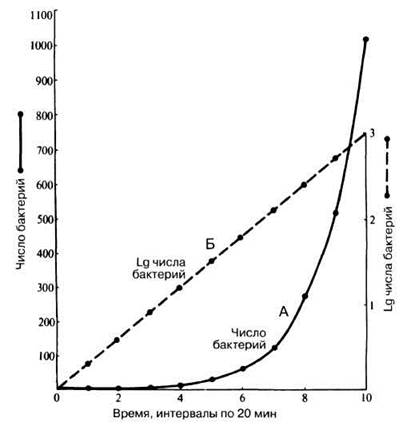
Fig. 2.1 (ans.). Arithmetic and logarithmic growth curves for a model bacterial population.
2.2. See Tables 2.6 and 2.7 (Chapter 2).
2.3. The sporangiophore elevates the sporangium above the mycelium, thereby increasing the likelihood that spores will enter air currents and, consequently, improving their dispersal efficiency.
2.4. Amphibians, much like liverworts and mosses, are only partially adapted to terrestrial life: their bodies lose Water easily, and they require an aqueous medium for sexual reproduction. According to some scientists, both of these groups represent intermediate stages in the evolutionary progression toward more advanced forms better suited to life on land.
2.5. The sporophyte is adapted to terrestrial life, whereas the gametophyte remains dependent on water because it is required for swimming Gametes. The sporophytic generation possesses true Vascular Tissues along with true roots, stems, and leaves, enabling a much more efficient exploitation of the terrestrial environment.
The sporophyte is the dominant generation. The lifespan of the gametophyte is short. The mature sporophyte is no longer dependent on the gametophyte.
2.6. Sexual reproduction relies on the availability of water, as it is essential for the swimming sperm Cells. The gametophyte thallus cannot tolerate desiccation.
Plants often tolerate intense illumination poorly.
2.7. Dryopteris spores are capable of germinating wherever they happen to land, provided that moisture and essential nutrients are available. Pollen grains germinate exclusively on the FEMALE REPRODUCTIVE Organs of the sporophyte.
2.8. Megaspores are large because they must store sufficient nutrient reserves to nourish the female gametophyte and the developing sporophyte until it becomes self-sufficient. Microspores are small, allowing them to be produced in large quantities with minimal metabolic expenditure. They are lightweight enough to be carried by air currents, which enhances the probability that the male gametes they contain will reach the female reproductive structures of plants.
Chapter 3
3.1. The empirical formula indicates the number of atoms of each element present in a given compound. The structural formula shows the relative spatial arrangement of atoms within a molecule. It can also illustrate Bond Angles between atoms; see, for example, Figs. 3.3 and 3.5.
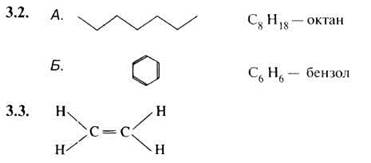
3.4. Pentose C5H10O5 Hexose C6H12O6
3.5. a) Valencies: C = 4, O = 2, H = 1.
b) In both cases, the empirical formula is C3H6O3. Consequently, these compounds are trioses.
c) Each molecule contains two hydroxyl groups. Their number can be predicted in advance since, as previously explained, in Monosaccharides a hydroxyl group is attached to every carbon atom except one.
3.6. The Main sources of diversity are as follows.
a) Polysaccharides consist of both pentoses and hexoses, although each polysaccharide is typically formed by a single type of monosaccharide.
б) Общими для остатков являются два типа химической связи: 1,4- и 1,6-связи. Следовательно, молекула может ветвиться.
в) Длина цепи и ответвлений, а также степень ветвления могут очень сильно варьировать.
г) Важную роль играют также α- и β-формы моносахаридов. (Сравните крахмал и целлюлозу.)
д) Сахара могут относиться к классу Кетоз или к классу альдоз.
е) Высокая реакционноспособность сахаров (обусловленная наличием альдегидной, кетонной и гидроксильной групп) означает, что они легко соединяются с другими веществами.
3.7. Реакция конденсации — это реакция, при которой происходит соединение двух веществ с выделением молекулы воды.
3.8. При низких температурах окружающей среды Температура тела пойкилотермных животных понижается. Липиды, содержащие большое количество ненасыщенных жирных кислот (имеющие низкую температуру плавления), обычно остаются жидкими при низких температурах (5 °С или ниже) в отличие от липидов, содержащих насыщенные Жирные кислоты. Это играет важную роль в выполнении липидами их функций, таких как поддержание структуры мембран.
3.9. Триолеин — потому что он содержит три молекулы ненасыщенной олеиновой кислоты. Тристеарин — жир, триолеин — масло.
3.10. а) Клеточное Дыхание (внутреннее, или тканевое дыхание). Жир подвергается окислению.
б) Только водород углевода и жира образует воду при окислении (2Н2 + О2 —> 2Н2О), а жиры содержат примерно вдвое больше водорода, чем Углеводы, в пересчете на единицу массы.

Это значительно больше, чем число атомов во Вселенной (оно приблизительно равно 10100)! Таким образом, существуют практически бесконечные возможности для разнообразия белков.
д) 20n, где n — число аминокислотных остатков в молекуле.
3.13. Примечательно, что отношение числа молекул аденина к тимину всегда равно 1,0; таково же отношение гуанина к цитозину. Другими словами, число молекул аденина равно числу молекул тимина, а гуанина — числу молекул цитозина. Обратите внимание также на то, что число пуриновых остатков (аденин + гуанин) соответствует числу пиримидиновых остатков (тимин + цитозин). Обнаружено также, что ДНК различных организмов имеют различный состав оснований, т. е. отношение А:Г или Т:Ц варьирует в разных ДНК.
3.14. Аденин должен спариваться с тимином, а гуанин — с цитозином. Этим объясняется наблюдаемое соотношение оснований.
3.15. Сравните объем неизвестной пробы, требуемой для восстановления красителя, с объемом 0,1% раствора аскорбиновой кислоты, израсходованным в стандартном промере. Процентное содержание аскорбиновой кислоты в неизвестной пробе=

3.16. а) Проверьте все три раствора по методу Бенедикта. Раствор сахарозы после кипячения не образует кирпично-красного осадка. Растворы глюкозы и глюкозы с сахарозой можно различить, предварительно обработав их как для гидролиза (см. тест на нередуцирующие сахара) и повторив тест Бенедикта. Теперь в смеси глюкозы с сахарозой содержится больше редуцирующего сахара. (На практике для получения достоверных результатов лучше использовать растворы сахаров различной концентрации. Например, 0,05%-ный раствор глюкозы, 0,5%-ный раствор сахарозы и смесь равных объемов 0,1 %-ного раствора глюкозы и 1,0%-ного раствора сахарозы.)
б) 1. Бумажная или Тонкослойная Хроматография.
2. Эффект на плоскополяризованный свет, используемый в поляриметре (и сахароза, и глюкоза являются правовращающими сахарами, но раствор сахарозы вращает плоскость поляризации света сильнее, чем раствор глюкозы).
3. Сахароза превращается в редуцирующие сахара (глюкоза + фруктоза) ферментом сахаразой (инвертазой). Реакцию можно выявить с помощью поляриметра или метода Бенедикта.
3.17. Растворите 10 г глюкозы в дистиллированной воде и доведите объем раствора до 100 мл. (Не растворяйте 10 г глюкозы сразу в 100 мл дистиллированной воды, потому что конечный объем окажется больше 100 мл.)
3.18. Добавьте 10 мл 10%-ного раствора глюкозы к 50 мл 2%-ного раствора сахарозы и доведите объем до 100 мл дистиллированной водой.
Chapter 4
4.1. a) Initially, reactions A and B proceed rapidly, yielding a large amount of product. Subsequently, product formation slows down and plateaus completely. This may occur because 1) all the substrate has been converted into product;
2) the enzyme has been inactivated, or 3) the equilibrium point of the reversible reaction has been reached, meaning both substrate and product are present in balanced concentrations.
b) As the Temperature increases, 1) the initial reaction rate increases, and 2) the enzyme becomes less stable and is rapidly inactivated.
c) Sensitivity to elevated temperatures indicates the protein Nature of the enzyme.
d) At low temperatures (as in the case of curve C), The rate of product formation remains constant for more than 1 h.
4.2. a) 5.50.
б) 1) Pepsin; 2) Salivary amylase.
в) The Active Site of the enzyme is disrupted. Modification of the ionizable groups of the enzyme occurs, particularly those located within the active site. Consequently, the substrate can no longer fit into the active site, and catalytic activity decreases.
г) Changes in pH alter The activity of most Enzymes. The rates of various enzymatic reactions change to different degrees, as Each enzyme has its own characteristic pH optimum. The life of every Cell depends on the delicate balance of its enzyme systems; therefore, any alteration in enzymatic activity can lead to the death of The Cell or the entire multicellular Organism.
д) See Fig. 4.2 (ans.). The pH optimum for the enzyme is 6.00. At pH values from 4 to 6, the ionizable groups of the active site change in such a way that the active site interacts and binds with the substrate more effectively. As the pH changes from 6 to 8, the reverse process occurs.
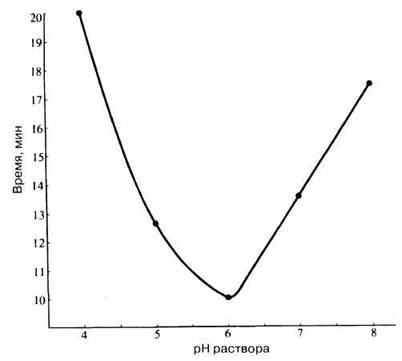
Fig. 4.2 (ans.). Effect of catalase on hydrogen peroxide at various pH levels.
4.3. An increase in Substrate Concentration makes it more probable for substrate molecules to enter the active site than for inhibitor molecules.
4.4. An increase in substrate concentration does not affect the overall reaction rate, as there is no competition for the active site.
4.5. a) Two distinct sites are located in different PARTS OF THE enzyme: the active site, which binds substance A, and another site specific for binding X.
б) 1. X may inhibit e1, and only in this case is The formation of product S via the A—S pathway possible. This situation persists until the reserves of X are exhausted.
2. X could enhance the catalytic activity of e5, thereby increasing the formation of S at the expense of X.
в) Product inhibition.
4.6. 1) All enzymes are Proteins and are synthesized by living organisms.
2) Enzymes catalyze Chemical Reactions by lowering the activation energy required for the reaction to initiate.
3) Only a very small amount of enzyme is required for an enzymatic reaction to proceed.
4) At the end of the reaction, the enzyme remains unchanged.
5) Each enzyme is specific and possesses an active site where the enzyme and substrate temporarily combine to form an enzyme-substrate complex. Upon dissociation of this complex, the product is released.
6) Enzymes function most effectively at optimal pH values and temperatures.
7) Being proteins, enzymes undergo Denaturation at extreme pH levels and temperatures.
Chapter 5
5.1. Endoplasmic reticulum, Ribosomes, microtubules, microfilaments, microvilli (visible under a Light Microscope as the "brush border"). In addition, small structures such as Lysosomes and Mitochondria, which are difficult to identify with a light microscope but easily distinguished using an Electron microscope.
5.2. a) Cell wall with middle lamella and plasmodesmata, METABOLISM/14.html">Chloroplasts, large central vacuole (animal cells contain small vacuoles, such as food and contractile vacuoles).
б) Centrioles, microvilli. (Pinocytotic vesicles are most characteristic of animal cells.)
5.3. A: polar (hydrophilic) phospholipid HEAD. B: non-polar (hydrophobic) phospholipid hydrocarbon tails.
C: phospholipid.
D: phospholipid layer.
5.4. a) A; б) B; в) A; г) B; д) -1000 kPa.
5.5. a) The (Na+,K+)-pump operates such that the efflux of Na+ ions is coupled with the influx of K+ ions into the cell. In the absence of K+, Na+ efflux does not occur, and Na+ accumulates inside the cells via diffusion, while K+ leaves the cells also As a result of diffusion.
б) ATP serves as the energy source for The Active Transport of Na+ ions.
Chapter 7
7.1. Photoautotrophic organisms use solar radiation as an energy source to synthesize Organic compounds from inorganic Materials. Carbon dioxide serves as the carbon source for these organisms. Chemoheterotrophic organisms use carbon found in organic compounds already synthesized by autotrophs to build their own organic substances. In this case, chemical reactions serve as the energy source.
7.2. General Shape and Arrangement
A high surface area-to-volume ratio for maximum light energy capture and efficient gas exchange. The leaf blade is often positioned at a right angle to incoming light, particularly in dicots.
Stomata allow gas exchange to take place. Carbon dioxide is required for Photosynthesis, while oxygen is a byproduct. In dicots, stomata are located primarily on the shaded lower surface of the leaf, which minimizes water loss through Transpiration.
Guard Cells
Regulate the opening of stomata (stomata are open only in the light, when photosynthesis is taking place).
Mesophyll
Mesophyll parenchyma cells contain specialized Organelles—chloroplasts—which carry out photosynthesis. Chlorophyll is located within the chloroplasts. In dicots, palisade mesophyll cells containing more chloroplasts are located near the upper surface of the leaf, ensuring maximum light capture. The relatively great length of these cells increases their light-absorbing capacity. Chloroplasts are situated at the periphery of the palisade cells. This allows them to absorb the maximum possible amount of light and facilitates gas exchange. Chloroplasts exhibit phototaxis, meaning they move within the cell toward the light. In dicots, spongy mesophyll has extensive intercellular air spaces for efficient gas exchange.
Water, which participates in photosynthesis, and mineral salts are transported through vessels. Products of photosynthesis are also transported via vessels. Along with collenchyma and sclerenchyma, vascular elements provide structural support for the plant.
7.3. Chlorophyll a absorbs in the red region of the spectrum twice as efficiently as chlorophyll b. The absorption peak occurs at a slightly longer wavelength, which carries less energy. Absorption in the blue region is less efficient and is shifted toward shorter wavelengths carrying more energy. Note that very slight differences in the molecular structures of these two chlorophylls account for the differences in their absorption capacities.
7.4. If an isotope has a short half-life (e.g., 20.5 min for 11C), it decays rapidly and can no longer be detected. This severely limits The Use of such an isotope in biological experiments, which often require several hours or even days to complete.
7.5. The biochemical reactions occurring during photosynthesis in Chlorella and higher plants are similar; for this and several reasons listed below, this organism is commonly used in The Study of photosynthesis:
1) a Chlorella culture is essentially a culture of chloroplasts, since the greater part of each cell's volume is occupied by a single chloroplast;
2) the culture makes it possible to achieve a more uniform algal growth;
3) Chlorella cells incorporate radioactive carbon very rapidly when supplied with labeled carbon dioxide and die just as quickly, which makes culturing techniques straightforward.
7.6. To ensure maximum illumination of the Algae.
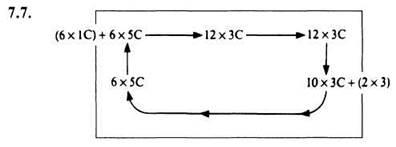
This diagram emphasizes the cyclic Transport of Carbon; The complexity of The Calvin Cycle is primarily due to the difficulty of converting 10хЗСв6х5С.
7.8. Carbon dioxide, water, light, and chlorophyll concentration.
7.9. a) In region A, light intensity is the limiting factor.
b) B: some factor other than light intensity alone becomes limiting. In other words, in region B both light intensity and other factor(s) are limiting. C: light intensity is no longer a limiting factor.
c) D: the "saturation point" for light intensity under these conditions, i.e., the point beyond which increasing light intensity causes no further increase in the rate of photosynthesis.
d) E: the maximum rate of photosynthesis achievable under experimental conditions.
7.10. X, Y, and Z are the points where light ceases to be the main limiting factor in these four experiments. Up to these points, a linear relationship is observed between light intensity and the rate of photosynthesis.
7.11. Enzymes begin to denature.
7.12. Such conditions occur: a) in a shaded canopy, such as a forest; at dawn and dusk in warm climates; b) on a clear winter day.
7.13. Mesophyll chloroplasts participate in the light reactions, while bundle-sheath chloroplasts participate in the dark reactions.
7.14. Oxygen competes with carbon dioxide for the active site of RuBP carboxylase.
7.15. Carbon dioxide pump. The malate shunt, acting as a carbon dioxide pump, increases its concentration in bundle-sheath cells, thereby enhancing the efficiency of RuBP carboxylase.
Hydrogen pump. Malate transfers hydrogen from NADPH2 in mesophyll cells to NADP in bundle-sheath cells, where NADPH2 is regenerated. The advantage of this transport is that NADPH2 is produced via efficient light reactions in mesophyll chloroplasts and can then be used as reducing power in the Calvin cycle within bundle-sheath chloroplasts, where autonomous NADPH2 synthesis is limited.
7.16. a) Lowering the oxygen concentration stimulates C3 photosynthesis because it reduces the competition between oxygen and carbon dioxide for the active site of RuBP carboxylase.
b) Lowering the oxygen concentration has no effect on photosynthesis in C4 plants because PEP carboxylase does not bind oxygen.
7.17. The dark blue color of the dye fades as it becomes reduced, while the green chloroplasts remain.
7.18. DCPIP remains blue in control tubes 2 and 3. Tube 2 demonstrates that light alone cannot induce color change and that chloroplasts are required for the Hill reaction to proceed. Tube 3 shows that light is just as essential for the Hill reaction as chloroplasts are.
7.19. The two organelles closest in size to chloroplasts are nuclei (slightly larger) and mitochondria (slightly smaller). Isolating pure chloroplasts requires more precise differential centrifugation or density gradient centrifugation.
7.20. Indirect evidence suggests that nuclei and mitochondria are not involved in DCPIP reduction, since this process requires light, whereas these organelles contain neither chlorophyll nor any other visible pigment.
7.21. To lower enzyme activity. During homogenization, enzymes could be released from other cellular organelles, such as mesosomes or vacuoles.
7.22. Cellular reactions proceed efficiently only within a specific pH range; any significant pH change caused, for example, by the release of acids from other parts of the cell can affect chloroplast activity.
7.23. a) Water. b) DCPIP.
7.24. Applicable to non-cyclic Photophosphorylation only:
1) oxygen was evolved;
2) electrons were captured by DCPIP and therefore could not return to PSI.
7.25. a) The chloroplasts lack an envelope (limiting membrane) and stroma. Only the internal membrane system remains.
b) The sucrose-free medium is hypotonic to the chloroplasts. Lacking a protective cell wall—which was disrupted during cell homogenization—the chloroplasts osmotically take up water, swell, and burst. The stroma dissolves, leaving only the membranes.
c) These changes are desirable because the ruptured chloroplasts provide more efficient access of DCPIP to the membranes where the Hill reaction takes place.
7.26. The Discovery of the Hill reaction was a turning point for several reasons. 1) It demonstrated that oxygen evolution can occur without carbon dioxide reduction, thereby proving that the light and dark reactions, as well as water-splitting reactions, are uncoupled. 2) It showed that chloroplasts can carry out light-dependent reduction of electron acceptors. 3) It provided biochemical evidence that the light reactions of photosynthesis are entirely localized within the chloroplasts.
7.27. Plants kept in the dark continue to consume sugars, for instance, for Respiration. Photosynthesis ceases in the dark, and once all the sugars are depleted, stored starch is converted into sugars, which are broken down into sucrose and transported from the leaves to other parts of the plant.
7.28. It must be placed in an identical flask, but with the water replaced by potassium hydroxide solution. A waterproof cotton fabric should protect the stem bearing the leaf. (The stem surface itself can be treated with limewater to prevent any accidental damage that might affect photosynthesis.)
7.29. One can measure the rate of carbon dioxide uptake, the rate of oxygen evolution, and the rate of carbohydrate production. The rate of increase in leaf dry mass can also be measured. This measurement is particularly convenient for crop plants at the end of the growing season, when a sufficiently large amount of material is available for research. The experiment to measure the rate of CO2 uptake is described in section 7.5.
7.30. a) The rate of gas production is directly proportional to light intensity up to a value of I equal to x units. At this point, light saturation begins and is completed at point y (The values of x and y depend on the experimental conditions). Consequently, the rate of gas production was limited not by light, but by some other factor.
b) The laboratory was shaded to prevent external light from entering, which could stimulate additional photosynthesis. The temperature is kept constant because fluctuations in it also affect the rate of photosynthesis.
7.31. a) The temperature may fluctuate because the lamp heats the air (this can be prevented by using a water bath).
b) The concentration of CO2 in the water may change during the experiment, especially if KHCO3 was previously added.
c) Any stray light accidentally entering the laboratory will affect photosynthesis.
7.32. As oxygen bubbles rise to the water's surface, some of the nitrogen dissolved in the water passes out of solution into these bubbles, and some of the oxygen from the bubbles dissolves in the water. This exchange occurs due to differences in the pressures (concentrations) of oxygen and nitrogen between the bubbles and the water; over time, the concentrations of these substances tend to reach equilibrium. Trace amounts of water vapor and CO2 will also be present in the collected gas. The collected gas will tend to equilibrate with atmospheric air via gas diffusion through the water.
7.33. It is necessary to collect all the oxygen evolved during photosynthesis throughout the experiment. If the water is not aerated, some of the photosynthetically generated oxygen will dissolve in it, and consequently, a lower amount of oxygen will be recorded.
7.34. A sample data record is presented in the following table:
Time, h |
Indicator colour |
|||
tube A |
tube B |
tube C |
tube D |
|
0 |
red |
red |
red |
red |
18 |
yellow |
purple |
red |
red |
Control tubes C and D are needed to confirm that any changes in tubes A and B occur solely due to the presence of leaves within them. In tube A, the medium becomes more acidic due to carbon dioxide released during respiration. In the absence of light, photosynthesis does not occur. In tube B, the medium becomes less acidic, indicating the consumption of CO2. Carbon dioxide produced by respiration was utilized in photosynthesis along with the carbon dioxide already present in the air surrounding the leaf and dissolved in the indicator solution. The rate of photosynthesis was higher than the rate of respiration.
7.35. The CO2 compensation point. At this point, the rate of photosynthesis equals the rate of respiration.
Chapter 8
8.1. 1) They decompose organic matter and, consequently, facilitate the return of chemical elements contained in dead organisms to living ones.
2) They cause food spoilage, for example, by forming mold on bread.
3) In the Far East, Mucor was used to produce alcohol. Rice was added to a mixture of Mucor and Yeast. Mucor converted the starch in the rice into sugars, which the yeast then converted into alcohol.
8.2. See section 2.8.3 and table 8.1.
8.3. Active pepsin would digest the very cells that produce it, since the gastric glands lack the protective barrier formed by mucus.
8.4. a) Folds of the Small Intestine wall, villi, and microvilli.
б) This increases the secreting and absorbing surface area of the small intestine manifold and enhances the efficiency of these processes.
8.5. Enzyme activity would decrease or cease altogether as a result of denaturation caused by the acidic environment.
8.6. Active transport ensures The transfer of soluble food substances into the Blood even when their concentration is lower than that in the blood.
8.7. Due to constant heat loss from the relatively large body surface area (compared to its volume) of a mouse.
8.8. Fats are much richer in hydrogen than CARBOHYDRATES, and since most of The energy released in the body is generated by The oxidation of hydrogen to water, fats yield more heat than carbohydrates.
8.9. a) The diet must contain small amounts of specific "factors" (now called Vitamins). They are essential for normal GROWTH AND DEVELOPMENT.
б) These "growth factors" must have been present in the portion of milk (3 ml) received by the rat pups. This confirms that "growth factors" are required only in very small quantities. When the milk was withdrawn, growth rapidly stopped. The rat pups that received no milk initially grew; this means they had a small reserve of vitamins in their bodies.
в) Adults would experience a deficiency in iron, B vitamins, and roughage (dietary fiber).
8.10. The RDAs given for a specific group do not represent the average requirement for that group, but rather a level that covers the needs of virtually every member of that group. Many view RDAs as minimum requirements. However, for the majority of people, RDAs significantly exceed their actual needs. Misuse can lead to an overestimation of the recommended daily allowances for an average person.
8.11. The amount of dietary fat providing energy needs should decrease from 40% to 33%. This is to be achieved by reducing saturated Fatty acids in the diet from 16% to 10%. This reduction should be compensated for by increasing dietary carbohydrates in the form of starch and cell wall sugars contained in dietary fiber. (Milk contains saturated fats.)
8.12. There are quite a few possible Answers to this question; for example, a person may err in estimating their Energy Requirements; variations may occur in daily and long-term diet; and tables listing energy values for various foods may not be entirely accurate, as they are often based on assumptions about the fat content in an arbitrarily chosen cut of meat.
8.13. The risk of deficiency for any individual is very low. Most people consume more energy than they actually need.
8.14. It is very difficult to accurately measure an individual's energy requirements, as these needs change over time.
If an individual's requirements fall between the lower and upper reference limits, it can be stated that the closer they are to the upper limit, the lower the probability of deficiency. Moreover, if there are no signs or symptoms of deficiency, it cannot be claimed that the diet is inadequate for that individual's needs.
8.15. A consumer might assume that the label shows average intake norms and that he or she must follow those norms, whereas most people do not require such quantities.
8.16. Low-income populations spend a significant portion of their income on food purchases. For such groups, the risk of nutrient deficiency is particularly high. Therefore, dietary assessment and planning in this situation become crucial.
Chapter 9
9.1. Light energy is essential for photosynthesis. Photosynthetic organisms (plants and algae) form the base of almost all food chains. Animals, therefore, directly or ultimately depend on plants, ultimately deriving their energy and building materials for cellular structures from them.
9.2. See fig. 9.2 (ans.)
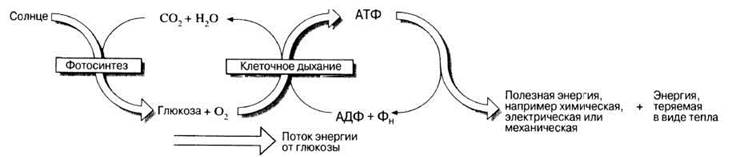
Fig. 9.2 (ans.).
9.3. Oxygen is the final hydrogen acceptor in the Respiratory Chain.
9.4. Oxygen uptake increases with a higher rate and depth of breathing, as well as increased Cardiac Output.
9.5. Blood removes the accumulated lactic acid from the Muscles and transports it to the Liver.
9.6. For the rapid diffusion of intermediates from the Cytoplasm into the mitochondria and back.
9.7.
Inputs: |
Outputs: |
Pyruvic acid |
|
Oxygen |
Carbon dioxide |
Reduced hydrogen carrier, e.g., NAD · H + H+ |
Oxidized hydrogen carrier, e.g., NAD |
ADP |
ATP |
Phosphate |
Water |
9.8. Initially, when blood comes into contact with water, the oxygen concentration gradient between them will be steep. However, as both fluids continue to flow in the same direction, the gradient will gradually decrease until the relative oxygen saturation of the blood and water becomes equal. As a result, blood saturation will remain well below the maximum level and thus prove insufficient (Fig. 9.8 ans.).
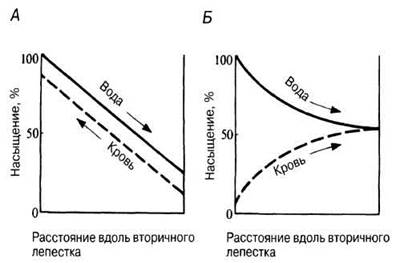
Fig. 9.8 (ans.). A. Countercurrent flow of water and blood. B. Parallel flow of water and blood.
9.9. Five times: upon entering the alveolar epithelial cell; exiting this cell; entering the capillary endothelial cell; exiting this cell; and entering THE RED BLOOD cell.
9.10. Because not all the air exchanged in a single breath reaches the alveoli. Part of it remains in the bronchioles, Bronchi, and Trachea (the "dead space").
9.11. Small animals have a high ratio of heat-losing body surface area to body volume, which increases heat loss. Consequently, they require more oxygen to maintain a constant body temperature.
9.12. To do this, one must compare their oxygen consumption per gram of body mass per unit of time.
 is characteristic of Lipids.
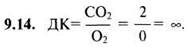
This is a typical scenario for Anaerobic respiration. When anaerobic and aerobic respiration occur simultaneously, the RQ values can be very high.
9.15. Because human respiration typically relies on carbohydrates and fats.
9.16. a) The breathing rate is approximately 17 breaths per min.
б) The volume of air exchanged in a single respiratory cycle (tidal volume) is 450 mL (on average).
в) Pulmonary ventilation is 17 × 450 mL = 7.65 L per min.
г) Oxygen consumption is represented by the slope of line AB. Thus, oxygen consumption is 1500 mL over 4 min, or 375 mL per min.
9.17. а)
Aerobic respiration |
Photosynthesis |
A catabolic process in which carbohydrate molecules are broken down into simple Inorganic Compounds |
An anabolic process in which carbohydrate molecules are synthesized from simple inorganic compounds |
Energy is stored as ATP for immediate use |
Energy is trapped and stored in carbohydrates. Some ATP is also produced |
Oxygen is consumed |
Oxygen is released |
Carbon dioxide and water are released |
Carbon dioxide and water are consumed |
Results in a decrease in dry mass |
Results in an increase in dry mass |
In eukaryotes, the process takes place in mitochondria |
In eukaryotes, the process takes place in chloroplasts |
Occurs continuously throughout life in all cells, regardless of the presence of chlorophyll and light |
Occurs only in chlorophyll-containing cells and solely in the presence of light |
б) List of similarities between photosynthesis and respiration
Both processes result in energy transformation. Both require a mechanism that ensures the exchange of CO2 and O2.
In eukaryotes, both processes require specialized organelles—namely, mitochondria for respiration and chloroplasts for photosynthesis. Mitochondria and chloroplasts resemble prokaryotic organisms in possessing circular DNA and a prokaryotic type of protein-synthesizing system.
The light-dependent reactions of photosynthesis are similar to cellular respiration in the following respects:
1) phosphorylation (i.e., the synthesis of ATP from ADP and Pi) occurs in both cases;
2) both processes are linked to a flow of electrons along an Electron Transport Chain;
3) coupling electron transport with phosphorylation requires a specific Organization OF THE carrier system within membranes; in mitochondria, such membranes are cristae, whereas in chloroplasts they are thylakoids.
Chapter 10
10.1. Dry mass is used because the water content of various foods or organisms can vary, but it does not affect the amount of energy contained within these objects.
10.2. Small birds and mammals have a higher surface-area-to-volume ratio than humans, and therefore they lose heat more rapidly. Since small mammals and birds, like humans, are homeothermic ("warm-blooded") organisms, they must consume more energy to maintain a constant body temperature. (In birds, metabolic rate and body temperature are higher than in mammals.)
10.3. Example for steppe habitats:
Grass (sheep's fescue - Festuca ovina) → Sheep → Human
10.4. Seeds → Blackbird → Hawk; 3 trophic levels, T3
Fallen leaves → Earthworm → Blackbird → Hawk; T4
Fallen leaves → Caterpillar → Ground beetle → Insectivorous bird → Hawk; T5
Dog rose (juice) → Aphid → Ladybird → Spider → Insectivorous bird → Hawk; T6
10.5. In winter, the number of primary producers does not change significantly, as these producers are predominantly trees. However, the Abundance of herbivores feeding on leaves, flowers, and fruits in temperate deciduous forests must drop sharply in winter because these food sources become unavailable during this period. It is unlikely that the pyramids of numbers for a temperate deciduous forest would be inverted in winter; indeed, any inversion of trophic levels 1 and 2 seems highly improbable. In winter, detritus food chains become more important than grazing food chains.
10.6. a) In May, June, and July.
б) 1) Increased light intensity and day length, coupled with rising temperatures and the availability of nutrients. All these factors favor photosynthesis and growth.
2) Grazing by primary consumers, such as zooplankton, and a decline in productivity due to nutrient depletion (the latter caused by dead producer remains sinking into colder water layers that do not participate in Circulation).
3) A drop in zooplankton numbers. Increased food resources (nutrient circulation improves in autumn when surface water layers cool and mix more thoroughly with deeper, colder layers). Temperature and light conditions remain favorable.
4) Decreased light intensity and lower temperatures, which are unfavorable for photosynthesis and growth.
10.7. Photosynthetic organisms also include blue-green bacteria and certain other bacteria (these are prokaryotes, not plants). Chemosynthetic bacteria are also autotrophs (Section 7.2) and contribute to primary production. The overall contribution of all these organisms is small compared with autotrophic eukaryotes (photosynthetic protoctists and plants).
10.8. Mutualistic bacteria inhabiting ROOT nodules on the roots of legumes are capable of fixing atmospheric nitrogen. This leads to enhanced Plant Growth and, consequently, an increased demand for other mineral elements, particularly potassium and phosphorus. (However, periodically ploughing in legumes helps retain these mineral elements in the soil.)
10.9. Chemoheterotrophs. They can also be referred to as saprotrophic.
10.10. Wherever There is a deficiency of oxygen for the complete decomposition of all accumulated organic matter, such as in bogs, bottom sediments of various water bodies, the Arctic tundra, deep soil horizons, and waterlogged soils.
10.11. Both processes enhance aeration and, consequently, increase the oxygen content in the soil. This stimulates organic matter decomposition and nitrification. In addition, denitrification is suppressed because oxygen is utilized instead of nitrate.
10.12. Photosynthesis (see ch. 7 and sec. 10.3)
On average, only 1–5% of the solar radiation incident on plants is utilized for photosynthesis, serving as the energy source for all other trophic levels of the food chain.
Light is also essential for chlorophyll synthesis.
Transpiration (see ch. 13)
About 75% of the solar radiation reaching the plant is expended wastefully. This energy drives transpiration (water evaporation).
Ensures water conservation.
Photoperiodism (see ch. 16 and 17)
Crucial for synchronizing plant life cycles and animal behavioral responses (particularly those related to reproduction) with the seasons.
Movements (see ch. 16 and 18)
Phototropism and photonasty in plants (play a vital role in directing plant organs toward a light source).
Phototaxis in animals and unicellular plants (important for directing these organisms toward favorable environmental conditions).
Animal Vision (see ch. 17)
One of the primary Senses.
Other Functions
Vitamin D synthesis in humans.
Prolonged exposure to ultraviolet radiation causes Various Forms of damage, especially in animals; consequently, animals have evolved protective mechanisms (pigmentation, seeking shade from direct sunlight, etc.).
10.13. Geographical barriers, such as oceans; ecological barriers, such as unsuitable habitats separating favorable regions; dispersal distance; air and water currents; the size and nature of the colonized area.
10.14. a) On average, exactly two offspring must survive from each female.
б)
Number of fertilized eggs that must perish to keep population size constant |
Pre-reproductive mortality, % |
|
Oyster |
(100х106)-2 |
>99,9 |
Cod |
(9х106)-2 |
>99,9 |
Flounder |
(35x104)-2 |
>99,9 |
Salmon |
(10х104)-2 |
>99,9 |
Three-spined |
498 |
498/500 = 99,6 |
stickleback |
||
Winter |
198 |
99,0 |
moth |
||
Mouse |
48 |
96,0 |
Shark |
18 |
90,0 |
Penguin |
6 |
75,0 |
Elephant |
3 |
60,0 |
Victorian Englishwoman |
8 |
80,0 |
c) Three-spined sticklebacks and sharks give birth to live young, i.e., they are viviparous organisms. Thus, when parents invest heavily in rearing offspring, fewer eggs are required. Furthermore, females are physically incapable of producing numerous offspring in such cases.
10.15. Population b, because a greater proportion of its individuals die before reaching reproductive age. In population a, high survival rates are balanced by low birth rates, keeping the overall population size constant.
10.16. a) Out of 3,200 fry, 640 survive and 2,560 die, meaning the mortality rate is 80%.
б) Out of 640 fry, 64 survive and 576 die — yielding a mortality rate of 90%.
c) Out of 64 silver-y salmon, 2 survive while 62 die, which corresponds to a mortality rate of approximately 97%.
The total prereproductive mortality in salmon is 3198 individuals out of 3200, i.e., 99.97% (see Fig. 10.16 (ans.)).
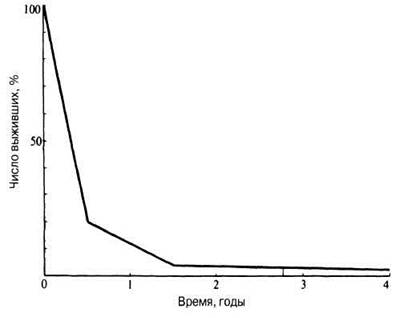
Fig. 10.16 (ans.). Graph showing prereproductive mortality in sockeye salmon.
10.17. a) Sigmoid (S-shaped) growth curve.
b) For food and space. In this case, most likely for food.
c) High reproduction rate. More abundant food supply. Higher resistance to toxic Metabolic waste products of Paramecium or bacteria growing in the same culture (as demonstrated, P. aurelia is more resistant than P. caudatum). Production of a toxic substance or growth inhibitor (allelopathy). Predation.
10.18. a) Deforestation reduces the total number of photosynthesizing organisms on our planet, thereby decreasing the amount of atmospheric carbon dioxide used for photosynthesis.
b) Removal of tree canopies leaves the lower forest strata unprotected from direct sunlight and high temperatures. In forests with a thick litter layer and humus-rich soil, this accelerates the decomposition of organic matter and the release of carbon dioxide.
10.19. BOD of wastewater.
BOD of the receiving water body.
Nature of the organic material.
Total organic content in the river.
Temperature.
Scale of natural aeration (depends on wind, etc.).
Dissolved oxygen content in tributaries.
Number and species of bacteria present in the incoming wastewater and tributaries.
Ammonia content in wastewater.
10.20. The appropriate environment surrounds living organisms throughout their lives. Consequently, the presence (or absence) of organisms in a particular environment reflects the fact that this environment meets (or fails to meet) all the vital needs of the organisms inhabiting it. A sudden, large-scale environmental pollution event would result in the absence of pollution-sensitive organisms long after visible and chemically detectable signs of the pollution have vanished. Therefore, biological indicators can be more sensitive and representative indicators of environmental status. Continuous 24-hour chemical monitoring can also be performed, but it has not become standard practice for many aquatic systems. This primarily applies to small rivers, streams, and remote areas. Chemical monitoring is time-consuming and requires expensive laboratory analyses. The main disadvantage of biological Methods is The Need for precise identification of the organisms present and the dependence of these methods on fluctuating seasonal factors.
10.21. a) 1) x 2; 2) x 500; 3) x 2500; 4) x 3750.
b) DDT concentration increases as it is passed along the food chain. From this, it can be concluded that DDT is a persistent substance, highly resistant to breakdown. It accumulates in living organisms faster than it is metabolized. (In fact, DDT remains active in soil for 10–15 years.)
c) 1) and 2) at the fourth trophic level (top carnivores); 3) at the second trophic level (herbivores).
d) DDT has spread globally for two main reasons. First, although in very small quantities, it is transported by water. When DDT washes off agricultural lands, rivers carry part of it into the seas, where it concentrates in marine food chains. Penguins feed on fish and thus represent a link in these food chains. Second, DDT can spread through the atmosphere because it is volatile and is often sprayed as a fine powder that can be carried by air currents over long distances.
e) 1) Initially, a small fraction of small dipteran insects was resistant to DDD and survived the spraying. Between spraying events, their population increased. Following subsequent sprayings, they continued to reproduce and eventually came to make up the majority of the population. In other words, the population underwent intense Selection pressure (see Ch. 26).
2) The presented data indicate that DDD (and consequently DDT) accumulates predominantly in adipose tissues. (This occurs because DDD and DDT are much more soluble in fats than in water.) During periods of food scarcity, fats are mobilized and used by the organism; as a result, the DDD or DDT accumulated over a long period is released into the blood in relatively high concentrations.
e) It can be hypothesized that the high mortality rate among birds in the winter of 1962/63 compared to 1946/47 was caused by the additional impact of DDT previously stored in adipose tissue. In 1946–47, DDT was used on a limited scale, whereas by the late 1950s and early 1960s, it had come into widespread use.
10.22. Any population characterized by a shared Gene pool will evolve slowly over time. If a population is very small, its members soon become inbred and lose hybrid vigor. In the recent past, the black rhinoceros was on the brink of extinction due to intensive hunting for its valuable horn. Currently, each local population represents only a very small fraction of the original population, and these local populations are separated from one another by physical barriers. Naturally, Inbreeding will occur in such populations. Outbreeding increases genetic diversity within populations and is of paramount importance for very small populations. Animal sperm can be collected from anesthetized or captured males and used for insemination during estrus (at ovulation) in anesthetized females. Such Artificial Insemination does not require the transportation of animals, yet enables gene flow. Furthermore, this technique makes it possible to build up reserves of genetic material (via cryopreservation — deep freezing of sperm) in cases where only females are found in a given local population.
Chapter 11
11.1.
11.1. Fresh mass of soil |
60 g |
Dry mass of soil |
45 g |
Consequently, mass of water |
60-45 = 15 g |
Consequently, water content in fresh soil |
15/60x100 = 25% |
Dry mass of soil |
45 g |
Dry mass of soil after ignition |
30 g |
Consequently, mass of organic matter |
15 g |
Consequently, organic matter content in fresh soil |
15/60x100 = 25% |
11.2. 43%.
11.3. 36%.
11.4. 4230.
Chapter 12
12.1. 1) Iron — found in Cytochromes, which act as electron carriers during respiration
Phosphorus — a component of Nucleic Acids, ATP, and membrane Phospholipids.
2) Nitrogen — a component of proteins, nucleic acids, and many other organic molecules.
Magnesium — an essential constituent of chlorophyll (bacteriochlorophyll) and a cofactor for many enzymes, such as ATPase.
12.2. K2HPO4 and KH2PO4 — sources of K and P. (In addition, these salts act as buffers, preventing pH fluctuations caused by bacterial metabolic waste products.)
(NH4)2SO4 — source of N and S.
MgSO4 — source of Mg and S.
CaCl2 — source of Ca and Cl.
Glucose — source of C and energy.
12.3. See Fig. 12.3 (ans.)
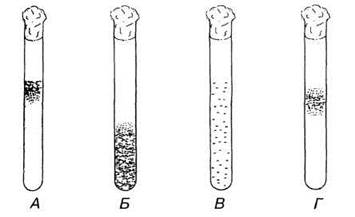
Fig. 12.3 (ans.) Distribution of various bacteria. A — aerobic, B — anaerobic, C — facultative anaerobes, D — microaerophilic.
12.4. Prepare a medium free of nitrogen-containing components but containing all other nutrients essential for growth. Inoculate with soil, place in a nitrogen atmosphere, and incubate under sterile conditions. The only organisms capable of GROWTH AND REPRODUCTION will be nitrogen fixers.
12.5. The steepness of curve A increases over time. Curve B (the logarithmic curve) is a straight line (increasing linearly over time). See Fig. 2.1 (ans.).
12.6. The graph will represent a typical Bacterial population growth curve (see Fig. 12.8), except that the lag phase is absent, as the bacteria have already adapted to this medium.
12.7. See Fig. 12.7 (ans.). The factors responsible for these changes are discussed in Section 12.1. The differences between the growth curve of living bacteria and the growth curve of total (living and dead) bacteria are due to the following reasons:
a) some cells die during the lag and log phases;
b) during the stationary phase, the total number of living and dead cells continues to increase slowly for some time because cells are still multiplying;
c) during the deceleration phase, the total number of living and dead cells remains constant, although many cells are dying.

Fig. 12.7 (ans.) Growth of a bacterial population.
12.8. The doubling time is 2.5–3 h.
12.9. a) See section 12.10.2.
b) See section 12.10.5.
c) See section 12.5.3.
12.10. Any of the following:
1) confidentiality — the user is the first to learn about her Pregnancy;
2) rapid results; pregnancy can be detected almost from the first day a period is due, as the test is highly sensitive;
3) ease of use builds confidence that the test has been performed correctly.
12.11. Fungi may have an unappealing appearance. Some buyers might find them uninviting or even hazardous. Emphasizing the words "natural" and "plant" is reassuring. Referring to similar well-known products, such as mushrooms, is also convincing.
Chapter 13
13.1. The external solution. Recall that The cell wall is freely permeable to solutions (Fig. 13.2).
13.2. Zero. The protoplast exerts no pressure on the cell wall.
13.3. In prokaryotes, fungi, and certain protoctists, such as algae. These organisms are also protected from cell rupture in solutions with a higher water potential or in pure water.
13.4. a) In cell B.
b) From cell B to cell A.
c) Cell A at equilibrium:
ψг = ψ — ψ0
= -1000 кПа — (-2000 кПа)
= 1000 кПа
Cell B at equilibrium:
ψг = ψ — ψ0
= -1000 kPa — (-1400 kPa)
= 400 kPa
13.5. —1060 kPa. For values intermediate between those given in Table 13.4, plot a graph of osmotic potential versus sucrose molarity.
13.6. The average ψ0 in beet cells will be approximately —1400 kPa.
13.7. ψ in beet cells will be about —940 kPa.
13.8. A more precise result can be obtained by taking the mean of two or more replicates. The figures presented in Table 13.6 give some idea of the magnitude of variation that can be expected in this case.
13.9. To prevent water evaporation and the resulting increase in sucrose concentration, as well as potential drying of the tissue strips.
13.10. ψг = ψ — ψ0
= —950 kPa — (—1400 kPa)
= 450 kPa
Note that different beet roots may have different values of ψ0 and ψ.
13.11. a) Cells of the intact flower stalk are turgid, and consequently their walls tend to stretch under turgor pressure. The thick walls of epidermal cells are less stretchable than the thin walls of cortical cells, thus restricting the expansion of these cells. Cortical cells are compressed. Cutting the epidermis removes this restriction, causing all cortical cells to expand slightly, the total volume of the cortex to increase, and the strips to curl outward.
b) Distilled water has a higher water potential than the flower stalk cells. Therefore, water enters the tissue by osmosis, further stretching the cortical cells and increasing the curvature.
c) Concentrated sucrose solution has a lower water potential than the flower stalk cells. Consequently, water leaves the tissue via osmosis, cortical cells contract more than epidermal cells, and the tissue curves inward.
d) Dilute sucrose solution should have exactly the same water potential as the flower stalk cells; therefore, no net Movement of water occurs between the solution and the cells.
e) Water potential. The design for such an experiment could be as follows.
Prepare a series of dilute sucrose solutions, starting with a 1 M solution down to distilled water (e.g., distilled water — 0.2 M — 0.4 M — 0.6 M — 0.8 M — 1.0 M). Record the typical curvature of freshly cut dandelion flower stalks by making drawings; then place two flower stalk strips into each solution dispensed in separate labeled Petri dishes (it is best to use two strips to determine a mean result). Once equilibrium is reached (after approximately 30 min), carefully record the curvatures of the stalks (e.g., by drawing them). The solution in which no change occurs will have the same water potential as the average flower stalk cell at the time of cutting.
13.12. The design for two suitable experiments could be as follows.
Effect of temperature. Cut cubes from a fresh beetroot, rinse them to wash away the red pigment from damaged cells, and place them in beakers with water at various temperatures, say, ranging from 20 to 100 °C. The appearance of red pigment in the water will indicate a breakdown in the selective permeability of the tonoplast (vacuolar membrane) and Plasma Membrane, leading to the diffusion of pigment from the cell sap into the water. The time required for a specific amount of pigment to appear will serve as an indicator of the rate of Membrane Structure disruption. The staining intensity can be measured using a colorimeter or assessed visually.
Effect of ethanol. The Procedure is identical, except that a range of ethanol concentrations is used instead of varying temperatures.
13.13. a) Leaves have numerous stomata for gas exchange, leaving almost no barriers to the movement of water vapor through these pores.
b) Leaves have a large surface area (for capturing sunlight and gas exchange). The larger the surface area, the greater the water loss through transpiration.
13.14. As the sun rises higher, light intensity increases, reaching a peak at noon when the sun is at its zenith. Air temperature rises similarly, but with a time lag of about two hours (mainly because the ground heats up first and then radiates heat into the air). The initial acceleration of transpiration between 3:00 and 6:00 AM, even before air temperature rises, is driven by the opening of stomata in response to light. From 6:00 AM onward, the increasing transpiration rate correlates closely with temperature (the reasons for this are explained in the text). It shows little correlation with light intensity because the stomata are fully open by this time, and any further increase in illumination has no effect.
After noon, light intensity decreases as the sun begins to descend. Temperature drops as well, but with a similar delay of about two hours. Transpiration slows down due to both falling temperatures and declining illumination, though it correlates much more strongly with light, the reduction of which causes the gradual closure of stomata. Darkness sets in around 7:30 PM, and the stomata are likely closed by then. Any remaining transpiration presumably occurs via the cuticle and continues to be influenced by temperature.
13.15. q) Thin-walled hollow cylinder.
b) Solid rod (cylinder) providing support.
c) Solid rod (cylinder) providing support.
d) Solid cylinder.
13.16. 1) Xylem consists of long tubes formed by the fusion of adjacent cells and The breakdown of transverse walls between them.
2) The tubes lack living contents, thereby reducing resistance to flow.
3) The tubes possess sufficient rigidity, preventing them from collapsing.
4) Narrow tubes are essential to prevent the water Column within them from breaking.
13.17. Soil solution > root Hair cell > cell 3 > cell 2 > cell 1 > xylem sap.
13.18. a) At both temperatures, there is a rapid initial uptake of K+ (within the first 10–20 min). After 20 min at 25 °C, K+ uptake continues, whereas at 0 °C no further uptake occurs. Uptake at 25 °C is inhibited by KCN.
b) Inhibition by KCN indicates that uptake is dependent on respiration. Thus, uptake represents active Transport Across the cell membrane into the cell.
c) In order to remove all potassium ions from the root.
13.19. An increase in respiration rate is accompanied by an enhanced uptake of KCl. When KCl is available, it appears to be absorbed via active transport driven by the energy supplied by increased respiration.
13.20. By inhibiting respiration, KCN thereby suppresses the active transport of KCl into the carrot discs.
13.21. A significant portion of the phosphate inside the root was located in the free space and could therefore diffuse back into the surrounding water.
13.22. No. The endodermis acts as a barrier to the movement of water and dissolved solutes via the apoplastic pathway (see section 13.5.2).
13.23. Autoradiography reveals the localization of ions in thin sections. Inhibit active transport in one plant (e.g., using KCN or low temperature) and use the other plant as a control. Now allow both plants to absorb a radioactive ion. In the plant with suppressed active transport, ions will move only passively through the cell walls. Autoradiography should demonstrate that radioactive ions barely penetrate beyond the endodermis, whereas in the control, ions will be seen to penetrate much further into the tissue inside the endodermis.
13.24. Through 2500 sieve plates per meter:
1 m = 106 µm;
400 µm = 4 · 102 µm,
106/(4 · 102) = 104/4 = 2500.
Chapter 14
14.1. The majority of the sediment consists of red Blood Cells.
14.2. Solutions such as Na and K salts, Digestion products, Plasma Proteins, gases (O2 in red blood cells and CO2 in red blood cells and plasma).
14.3. In the systemic circulation, oxygenated blood enters the capillaries under high pressure. This is crucial for the normal functioning of organs and the Formation of tissue fluid; furthermore, it helps maintain a High Metabolic Rate and high body temperature. The relatively low blood pressure in the pulmonary artery prevents the rupture of delicate pulmonary capillaries.
14.4. The dilation of Blood Vessels in the affected area improves its supply of oxygenated blood and nutrients, thereby accelerating the healing process. The resulting increase in overall blood pressure prepares the animal's body for a faster and more effective response to any subsequent stress.
14.5. Before the start. Anticipation of the start triggers a surge of adrenaline. Under The Influence of adrenaline, all blood vessels constrict except those supplying vital organs, resulting in an increase in blood pressure. Heart rate increases, and an additional volume of blood is released from the Spleen into the general circulation.
During the run. Metabolic activity increases significantly during this time, particularly in skeletal muscles. Carbon dioxide, produced in elevated quantities by the muscles, causes local vasodilation. Elevated body temperature promotes even greater vasodilation. At the same time, the rising concentration of CO2 in systemic blood is detected by aortic and carotid body chemoreceptors, and signals from these receptors stimulate the vasomotor center. Stimulation of this center leads to vasoconstriction, increased blood pressure, and accelerated blood flow. The rate and force of heart contractions also increase, allowing the ventricles to empty more completely. Toward the end of the run, anaerobic respiration predominates in the muscles, leading to the accumulation of lactic acid (sec. 9.3.8). Vigorous Muscle contractions rhythmically compress the Veins, which helps accelerate the return of venous blood to The Heart.
Recovery period. The oxygen debt is fully repaid, and lactic acid is cleared from the blood; tissue activity and CO2 levels decrease. As a result, heart rate and blood pressure return to normal.
14.6. a) High metabolic activity also leads to a temperature increase in the given body region, which reduces the affinity of Hemoglobin for O2 and enhances the dissociation of oxyhemoglobin. Consequently, the dissociation curve shifts to the right, which is physiologically advantageous as it delivers more oxygen from the blood to active tissues.
б) In small mammals, metabolic activity is much higher than in humans, meaning oxygen must be released much more rapidly.
14.7. The shift of the fetal dissociation curve relative to that of the mother indicates that fetal Blood has a higher affinity for O2 than maternal blood. This is entirely natural, as the fetus must receive all its oxygen through the Placenta from the maternal blood. Therefore, at any given partial pressure of oxygen, fetal blood will absorb O2 from maternal blood and will always maintain a higher oxygen saturation than maternal blood. This holds true specifically for human fetuses.
14.8. In South American llamas, blood exhibits a high affinity for oxygen and is capable of binding it even at the low partial pressures found at high altitudes. This is yet another striking example of physiological adaptation.
14.9. 1. Carboxyhemoglobin reaches the Lungs, becomes oxygenated, and is converted into oxyhemoglobin.
2. Oxyhemoglobin has a lower affinity for H+ ions than hemoglobin, and therefore it releases H+.
3. In the erythrocytes, H+ ions combine with bicarbonate ions to form carbonic acid.
4. Carbonic acid dissociates into CO2 and water. This process is catalyzed by the enzyme Carbonic anhydrase.
5. As a result of the loss of bicarbonate ions from the erythrocytes, new bicarbonate ions diffuse into the erythrocytes from the plasma.
6. New molecules of carbonic acid are formed from bicarbonate within the erythrocytes, which again dissociate into CO2 and water.
7. CO2 diffuses out of the erythrocytes and is ultimately eliminated from the body via the lungs.
Chapter 15
15.1. The information must include the following:
1) justification for regular screenings;
2) specification and rationale for recall intervals;
3) identification of the age groups targeted for screening;
4) information regarding risk groups (older women and women with multiple sexual partners are at the highest risk);
5) confirmation that the screening is free of charge;
6) information regarding the Location OF THE cervix;
7) a Description of the examination procedure, including an internal inspection which may involve mild discomfort (pain or embarrassment);
8) the possibility of an adverse result;
9) information regarding Treatment options if this result occurs;
10) sources for obtaining more detailed information.
Chapter 16
16.1. Locomotion is primarily driven by the need to search for food (and is closely linked to the evolution of The Nervous system). Green plants are autotrophic organisms capable of synthesizing their own organic molecules, eliminating the need to forage for organic nutrients.
16.2. See Table 16.2 (ans.).
Table 16.2 (ans.)
Advantages |
|
Shoots and coleoptiles exhibit positive phototropism, whereas roots show negative phototropism |
Leaves are positioned in the light, which serves as the energy source for photosynthesis. Exposed roots grow downward into the soil or another suitable substrate |
Shoots and coleoptiles display negative geotropism, whereas roots display positive geotropism |
Shoots and seedlings grow upward, i.e., toward the light, while roots grow deeper into the soil |
Rhizomes, stolons, etc., exhibit diageotropism; the leaves of dicotyledons do so as well |
This helps plants colonize new soil patches; leaves grow horizontally to capture maximum light |
Lateral roots and stem branches exhibit plagiogeotropism |
Roots exploit a larger volume of soil, and their arrangement enhances their anchorage function; leaves on branches occupy more space to utilize light efficiently |
Fungal hyphae and pollen tubes demonstrate positive chemotropism |
Hyphae grow toward nutrients, while pollen tubes grow toward the Ovary (where ovule Fertilization takes place) |
Roots and pollen tubes exhibit positive hydrotropism |
Water is essential for all vital metabolic processes |
Climbing plant tendrils exhibit positive haptotropism; the sensitive tentacles of sundews do as well |
This enables tendrils to provide support and allows tentacles to capture insects crawling across the leaves |
Pollen tubes exhibit negative aerotropism |
The tube immediately begins to grow into the pistil tissue (away from the air) |
16.3. A variety of experimental Procedures are possible. The simplest experiment is illustrated in Fig. 16.3 (ans.).
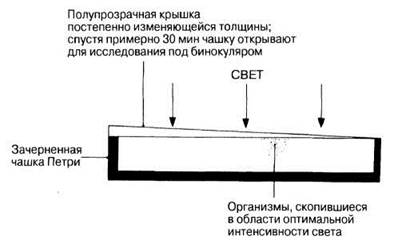
Fig. 16.3 (ans.). An experiment designed to determine the light intensity preferred by Euglena or Chlamydomonas.
16.4. a) Bacteria are aerobic and exhibit positive aerotaxis. Consequently, they move along the O2 concentration gradient from regions of low concentration to higher concentrations. The highest oxygen concentration is found at the edges of the coverslip, where oxygen diffuses into the water from the air, and in the immediate vicinity of the algal filament, where oxygen is released as a byproduct of photosynthesis.
б) You can leave the slide in the dark for approximately 30 minutes and then examine it again. All the bacteria should now aggregate near the edges of the coverslip, as the alga does not photosynthesize in the dark.
16.5. a) The light stimulus is perceived by the tip of the coleoptile. A signal is then transmitted from the tip (the receptor) to the region just below the tip (the effector).
б) Experiment C was necessary to verify the results of experiment B, which might have been a consequence of physical damage to the coleoptile.
16.6. Additional evidence was obtained indicating the existence of a signal—apparently a chemical substance (hormone). This substance cannot pass through an impermeable barrier. It moves primarily downward along the shaded side of the coleoptile. In experiment C, the mica sheet blocks this movement. Therefore, light either inhibits hormone production, causes its inactivation (stimulates its breakdown), or induces its lateral redistribution.
16.7. See Fig. 16.7 (ans.).
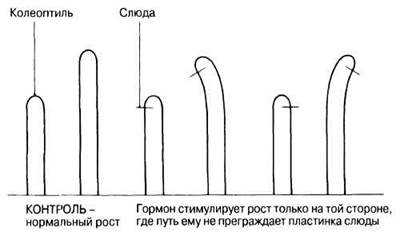
Fig. 16.7 (ans.). Replication of Boysen-Jensen's experiments under uniform illumination. Three experiments are shown; in all cases, experimental conditions are presented on the left and results on the right.
16.8. The tip of the coleoptile produces a chemical substance that diffuses into the Agar. This substance can stimulate growth in the zone located below the tip and restore normal growth (experiment A). Under uniform illumination or in the dark, virtually no lateral transfer of this substance occurs (experiment B).
16.9. The coleoptile will bend and grow to the left.
16.10. A — 100 ppm; Б — 10 ppm; В — 1 ppm; Г — 0.1 ppm; Д — 0.01 ppm; Е — zero.
16.11. See Section 17.5.4.
16.12. a) Abscisic acid can be transported upward from the root tips, undergo lateral translocation within root tissues in response to gravity, and inhibit growth.
б) IAA is probably not involved in the geotropic response of maize roots, as it does not appear to be transported upward from the root tip.
16.13. a) starch;
b) maltose;
c) maltase.
d) Starch stored in the endosperm serves as the primary nutrient for cereal seeds.
16.14. Reserve Proteins are digested (hydrolyzed) to release Amino Acids, which are the fundamental structural units of proteins. These Amino acids are then used to synthesize enzymes (all enzymes are proteins), such as a-amylase; these enzymes are subsequently utilized to digest the nutrients stored in the endosperm.
16.15. Amylase activity may be due to the presence of microorganisms on the Skin or saliva transferred from the Mouth to the fingers. Therefore, in experiments of this kind, it is crucial not to handle the seeds with bare hands after their surface has been sterilized.
16.16. Seeds can be incubated with radioactive (14C-labeled) amino acids. This will result in The production of labeled amylase. Alternatively, seeds can be incubated with Protein Synthesis Inhibitors (such as cycloheximide); this will prevent amylase synthesis, and consequently, no amylase activity will be detected.
16.17. By separating the seeds into aleurone and non-aleurone fractions, it can be demonstrated that labeled amylase appears first in the aleurone layer. One can also separately incubate the endosperm with the aleurone layer and the endosperm without this layer on agar containing starch and gibberellin; in this case, amylase should be synthesized only in the former case (although achieving this result in practice is quite challenging).
16.18. One of the best biological assays for gibberellin (fast, reliable, and sensitive) is based on incubating embryo halves of barley seeds with the test material. After two days, the reducing sugar content in the embryos will be proportional to the amount of gibberellin in that material.
16.19. a) In a young leaf, The amino acid is retained and does not travel far from the application site. In an old leaf, a portion of it is exported via the veins and petiole.
б) Молодой лист использует аминокислоту в процессе роста для построения белков. Старый же лист уже не растет и поэтому экспортирует питательные вещества в другие части растения, например в корни и молодые листья.
c) Tissue treated with kinetin retains amino acids or even "attracts" them. (The exact reasons for this remain unclear; it is likely related to kinetin either maintaining or stimulating normal cellular activity.)
16.20. For instance, one could take a plant known to exhibit stem elongation in response to applied gibberellin and remove its endogenous source of Auxins by cutting off the SHOOT apex. Under these conditions, gibberellin should prove ineffective. It is essential to demonstrate that the plant's response can be restored by adding an auxin (such as IAA in lanolin paste), as a lack of response to Gibberellins could otherwise be due to tissue damage or the influence of some other factor. Such experiments indeed demonstrate the absolute auxin dependence of the response.
16.21. a) Auxin (IAA).
b) See Fig. 16.21 (answers).
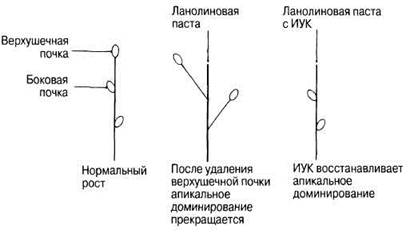
Fig. 16.21 (answers). An experiment demonstrating The Role of IAA in apical dominance.
16.22. Smaller leaves pass through the soil more easily (cereal leaves remain enclosed within the coleoptile). The curved plumule in dicotyledonous plants protects the delicate apical meristem from damage by soil particles. Elongated internodes maximize the leaves' chances of reaching the surface and light.
16.23. See Chapter 7.
16.24. The graph is presented in Fig. 16.24 (answers). It demonstrates the opposing effects of red and far-red light. A 30-second exposure to red light (at the light intensity used in this experiment) completely abolishes the inducing effect of a long night. The effectiveness of red light increases with exposure time up to 30 s. The Effect of red light can be fully reversed by far-red light, although this requires a longer exposure (50 s). These results suggest that Phytochrome acts as the photoreceptor in this experiment.
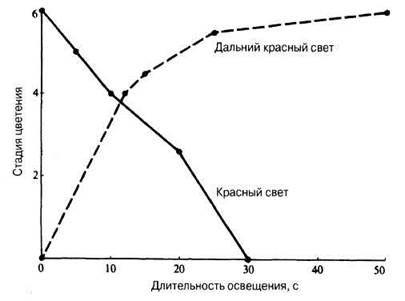
Fig. 16.24 (answers). The effect of interrupting a "long" night with red and far-red light on cocklebur flowering.
16.25. Several methods can be employed. One of the simplest setups is illustrated in Fig. 16.25 (answers). The plant parts shaded from light to create a short-day effect are enclosed in rectangles.
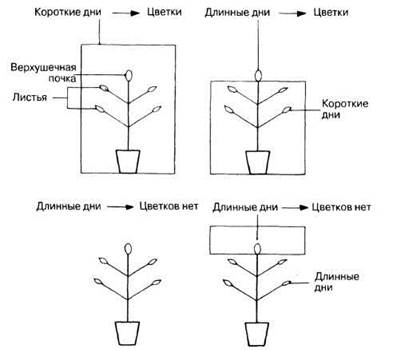
Fig. 16.25 (answers). An experiment designed to determine which plant parts — leaves or the floral apex — are sensitive to the photoperiod that stimulates flowering.
16.26. The suppression of axillary bud growth, or apical dominance, is primarily regulated by auxins. (For details on apical dominance, see Section 16.3.3.)
Chapter 17
17.1. a) A steep concentration gradient of Na+ exists between the external environment and the internal space of the axon, causing Na+ ions to rapidly diffuse down this gradient.
b) The influx of positively charged Na+ ions into the axon is also favored by the relatively negative internal Resting Potential.
17.2. If the efflux of Na+ ions were balanced solely by The entry of K+ ions, there would be little to no change, or perhaps a slight decrease, in the resting potential. However, this would still fall short of reaching the threshold value required to trigger an Action Potential.
17.3. a) Normal seawater;
b) diluted by half;
c) diluted threefold.
The amplitude of the action potential is determined by the number of Na+ ions entering the axon from the extracellular fluid. In the solutions corresponding to graphs a, b, and c in Fig. 17.5, the concentration of Na+ ions progressively decreased.
17.4. The larger the diameter of the axon, the lower the resistance of its axoplasm to longitudinal current flow. As this resistance decreases, the length of the membrane section affected by the local circuit increases, leading to a greater distance between adjacent depolarizing regions and faster impulse conduction.
17.5. The frog is a cold-blooded (poikilothermic) animal, active at temperatures between 4–25 °C, whereas the cat is a warm-blooded (homeothermic) animal with a constant body temperature of approximately 35 °C. With such a rise in temperature, the Nerve Impulse Conduction velocity increases threefold.
17.6. Upon entering the eye, a ray of light follows this pathway: conjunctiva → cornea → aqueous humor → lens → vitreous body → retina.
17.7. Light striking several photoreceptor rods connected to the Brain through different Neurons may lack sufficient energy to trigger propagating action potentials in any of those neurons, in which case the light will not be perceived. However, if this light falls on three rods connected to the brain via a single shared neuron, the individual receptor potentials induced by the rods will summate and successfully trigger a propagating action potential, which the brain perceives as light.
17.8. When we look directly at an object, the light reflected from it travels along the optical axis of THE EYE AND strikes the fovea centralis of the retina, which contains only cones. During the day, due to the high intensity of light hitting the cones, the brain forms a detailed image of the object. At night, however, the light intensity is too low to activate the cones. If you shift your gaze slightly to the side, light from the object falls outside the fovea onto another region of the retina containing more sensitive rods; these rods can be activated even by dim light, allowing the brain to perceive the image.
17.9. One might expect the object to appear yellow. Each retina would perceive only a single color: in one eye, light with a wavelength of 530 nm would stimulate the green cones, while in the other eye, light with a wavelength of 620 nm would stimulate the red cones. In the brain, the signals from both eyes combine, making the object appear in a color corresponding to the intermediate wavelength 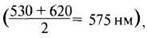 , i.e., yellow. Note that mixing different light rays does not produce the same effect as mixing pigments, such as paints. Blue and yellow light, for instance, do not produce the sensation of green (you can find out what actually results by referring to Table 17.8). Failure to realize this hindered The Development of Color Vision theories for a long time.
Chapter 18
18.1. a) Unrestricted movement of the mammalian rib cage is ensured.
b) An elastic "suspension" allows the animal to cushion the impact experienced by its forelimbs upon landing at the end of a jump.
c) The forelimbs acquire a wide range of motion necessary for activities such as climbing, grooming, food manipulation, and digging.
18.2. The width of the A band remains unchanged.
18.3. This ensures a greater influx of Ca2+ ions required for Muscle contraction.
18.4. The sarcoplasmic reticulum is more developed in synchronous muscles because regulating their activity requires a higher frequency of nerve impulses, with each impulse triggering the release of Ca2+ from the sarcoplasmic reticulum.
18.5. a) Streamlined body shape.
b) Smooth body surface—scales overlap in the appropriate direction, and a mucosal or oily secretion reduces friction.
c) Various types of fins that provide forward propulsion and stability during swimming.
d) Well-developed body musculature.
d) The swim bladder in teleost fish.
e) Highly coordinated activity of the neuromuscular apparatus.
18.6. This increases the effective length of the limbs. As a result, each step is longer, and the body is carried forward a greater distance. Thus, for the same rate of limb movement, the running speed increases.
Chapter 19
19.1. The rate of water transpiration is inversely proportional to atmospheric humidity. At high humidity, this process is slow, so the plant cannot effectively dissipate heat and lower its temperature through this mechanism.
19.2. Daily sweat production is 4 L, or 4000 cm3.
The evaporation of 1 cm3 of sweat results in the loss of 2.45 kJ of energy.
Consequently, the energy loss is 4000 x 2.45 = 9800 kJ, or (9800 / 50,000) x 100 = 19.6%.
19.3. During this period, the subject had the opportunity to reach equilibrium with the environment.
19.4. There is a direct correlation between these two parameters; this suggests that sweating is regulated by the Hypothalamus.
19.5. The direct relationship between skin temperature and moisture evaporation over the first 20 minutes indicated that an equilibrium is established between these variables. When evaporation slows down under the Influence of the hypothalamus responding to the ingestion of ice water, the skin begins to lose less heat via evaporation, which explains the observed rise in its temperature.
19.6. Fever is caused by a resetting of the hypothalamic "thermostat," which now attempts to maintain a higher temperature. Until the temperature rises to this new level, the body reacts to the lower "normal" temperature as if it were cooling. Shivering occurs, and we feel cold until the core body temperature matches the new Setting of the hypothalamic "thermostat."
Chapter 20
20.1. Hepatic vein, INFERIOR VENA CAVA, right atrium, right ventricle, pulmonary artery, lungs, pulmonary vein, left atrium, left ventricle, aorta, renal artery, Kidneys.
20.2. Proteins do not enter Bowman's capsule because protein molecules are too large to pass through the capsule wall. All other substances enter the capsule in solution, and their concentration remains unchanged.
20.3. 80%. 20% remains in the tubule.
20.4. All glucose is reabsorbed. Na+ remains at level d, therefore 80% has been reabsorbed (1/5, or 20%, remains).
20.5. The flow rate index changes from 20 to 1.
Consequently, 19/20, or 95%, of the residue was reabsorbed. Thus, the concentration of substances should increase 20-fold. The concentration of Na+ increased from d to 2d; 20d - 2d = 18/20 reabsorbed = 90% of the remaining Na+ was reabsorbed. The concentration of urea increased from 3c to 60c, i.e., 20-fold; therefore, no change occurred in the total amount of urea in the nephron.
20.6. 99% of the water was absorbed (the flow rate index changed from 100 to 1). 98% of Na+ was reabsorbed.
Chapter 21
21.1. a) If the plants producing the pollen grains can be identified, certain Conclusions can be drawn about the climate in which these plants grew.
б) Any human Interference with natural vegetation is inevitably reflected in the palynological record. For instance, the pollen of weeds and crops, such as wheat, indicates the Destruction of natural vegetation and land cultivation, while the absence of tree pollen in certain areas points to deforestation.
21.2. In dioecious species, half of the plants produce no seeds. Furthermore, a vast amount of pollen is wasted, which is disadvantageous in terms of material and energy resource utilization.
21.3. In animals, separate sexes are more economical than in plants, thanks to the mobility of males and females. Consequently, their gamete losses are lower.
21.4. (50%). Recall that pollen grains are haploid:
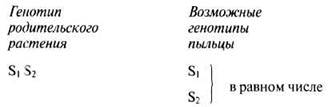
S1 pollen grains are compatible with S2S3 styles.
S2 pollen grains are incompatible with S2S3 styles.
Note that neither S1 nor S2 pollen grains are compatible with the style of the parent plant (S1S2), thus preventing self-pollination.
21.5. a) Most pollen will be deposited on the part of the bee's body that brushes against the anthers while the bee is feeding on nectar. Therefore, cross-pollination typically occurs between anthers and stigmas located at the same height within the flowers, i.e., between pin-eyed and thrum-eyed flowers.
b) It promotes outbreeding (the opposite of inbreeding).
21.6. The Functions of the organelles found in Sertoli cells indicate that these cells produce substances utilized within the cells themselves. The raw materials for these processes are obtained by breaking down materials taken into the cell,* utilizing enzymes stored in lysosomes. The synthesized products are stored in the Golgi apparatus for subsequent use. The agranular ER produces testosterone (a steroid). Mitochondria supply energy in the form of ATP.
21.7. a) Both the egg cell and the sperm are haploid.
b) Sperm: motile, small (2.5 µm in diameter), contain no nutrient reserves, produced continuously. Egg cells: non-motile, large (140 µm in diameter), produced once a month.
21.8. Rh Antigens introduced via donor blood will stimulate the mother's immune system to produce Rh Antibodies. These antibodies will not harm the mother; however, if her child is Rhesus-positive, the infant will inevitably develop hemolytic disease.
21.9. The child's immune system only becomes functional after birth. Even if it were functional, it would not have enough time to react and produce antibodies capable of crossing the placenta into the mother's body immediately before birth, i.e., before the placenta is damaged.
21.10. Blood would flow in the reverse direction through the ductus arteriosus (duct of Botallus).
Chapter 22
22.1. a) A loss in mass occurs due to the consumption of stored nutrient reserves during respiration.
b) Green leaves have emerged and unfolded.
c) Photosynthesis. Its rate must now exceed the rate of respiration.
d) This is accounted for by the shedding of seeds and fruits.
22.2. In small seeds, nutrient reserves are limited; therefore, the growing shoot must reach the light as quickly as possible so that photosynthesis can begin before these reserves are depleted.
22.3. a) Chlorophyll strongly absorbs light in the red and blue regions, but not in the green and far-red regions (see the absorption spectrum of chlorophyll, Fig. 7.11).
b) Red light stimulates the germination of lettuce seeds, whereas far-red light inhibits it (section 16.4.2.). Consequently, the germination of seeds located beneath a leaf canopy, where the light is enriched with the far-red component, may be suppressed until gaps appear in the canopy and the seeds receive sufficient light for photosynthesis and growth.
22.4. During the germination of a barley grain, its stored nutrients—primarily starch and some protein—are mobilized. Starch is converted into sugars, and proteins into amino acids; both are transferred to the embryo and utilized in growth processes. As a result, while the dry mass of the embryo increases, the dry mass of the endosperm decreases.
At the same time, the total dry mass decreases During the first week. This is because aerobic respiration consumes sugars from both the endosperm and (to a greater extent) the embryo. Around the 7th day, the first leaf emerges and photosynthesis begins. As a result, dry mass increases, with respiratory losses being more than compensated for, leading to an overall net gain in total dry mass. Concurrently, the growth of the embryo—now developed into a seedling—accelerates.
22.5. a) The dry mass increases by 8.6 g, calculated as follows:
Mass of seeds = 51.2 g.
Mass of fatty acids = 51.2/2 = 25.6 g.
Mol. mass of the fatty acid = 256.
Hence, 1 mol = 256 g, and 25.6 g = 0.1 mol.
From the reaction equation, it follows that:
0.1 mol fatty acid → 0.1 mol sugar + 0.5 mol water + 0.4 mol СО2.
Mol. mass of sugar = 342.
Therefore: 25.6 g fatty acid → 34.2 sugar + water + СО2.
Water is not included in the dry mass, and СО2 escapes; therefore, the increase in dry mass = (34.2 — 25.6) g = 8.6 g.
b) Respiration should lead to a decrease in dry mass. In reality, the dry mass nevertheless increases.
c) The volume of СО2 released from the seeds = 8.96 L at standard temperature and pressure; this is calculated as follows:
According to the equation, 0.1 mol fatty acid → 0.4 mol СО2; 0.4 mol СО2 at standard temperature and pressure occupies 0.4 x 22.4 L = 8.96 L.
d) Via lipase-catalyzed Hydrolysis. The other component of the lipid is glycerol.
e) 51 carbon atoms (the lipid was tripalmitin: the fatty acid is palmitic acid). Each lipid molecule contains three fatty acid molecules, with 16 C atoms each, plus one glycerol molecule with three C atoms.
f) Sucrose or maltose.
g) Oxygen diffuses into the storage tissues through the seed coat and micropyle.
22.6. a) Storage substances are predominantly lipids, making up about 70% of the seed's dry mass before germination begins. By the 4th day, the mass of lipids begins to decrease, while the mass of sugars increases: lipids are converted into sugars and transported to the embryo. Sugars cannot be formed via photosynthesis, as the seeds germinate in the dark. On the 5th day, the respiratory quotient (RQ) of the embryo is equal to one; this indicates that the embryo respires using sugar formed from lipids. At the same time, the cotyledons (RQ = 0.4 - 0.5) obtain energy through The conversion of lipids into sugar and, possibly, through the oxidation of sugar and fatty acids.
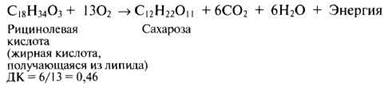
The conversion of lipid into sugar is accompanied by an increase in dry mass, so that the dry mass of the seedlings increases up to the 6th or 7th day. Then the lipid reserves become depleted, so that the rate of sugar utilization begins to exceed the rate of its formation. After that, the sugar mass and total seedling mass begin to decrease. Sugar is consumed in respiration and in anaerobic reactions.
b) On the 11th day, the RQ for the entire embryo will probably be slightly less than 1.0. This is achieved through two processes; the main one is the oxidation of sugar during respiration (RQ = 1); however, some contribution from the conversion of lipid into sugar (RQ = 0.4 - 0.5) is also possible.
22.7. Typically, the amount of oxygen penetrating through the seed coat is insufficient to fully support aerobic respiration; the RQ consists of the RQ for aerobic respiration (likely around 1.0) and the RQ for anaerobic respiration, which is equal to infinity. Removal of the seed coat allows for faster oxygen penetration via diffusion, which leads to an increase in aerobic respiration and a decrease in RQ. Ethanol is a product of anaerobic respiration; therefore, when the seed coat is removed, it accumulates in smaller amounts.
Chapter 23
23.1. a) Meiosis
b) W — interphase
X — telophase I
Y — telophase II
c) Germ Cells
23.2. See Fig. 23.2 (ans.)
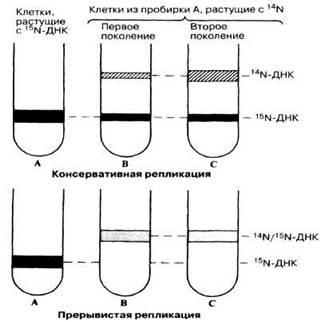
Fig. 23.2 (ans.). Diagrams explaining two theories of DNA replication. The appearance of DNA in a cesium chloride density gradient is consistent with the theories presented in Fig. 23.22.
23.3.
Bases |
A |
G |
T |
C |
A |
AA |
AG |
AT |
AC |
G |
GA |
GG |
GT |
GC |
T |
TA |
TG |
TT |
TC |
C |
CA |
CG |
CT |
CC |
23.4. 4 bases used singly = 4x1 = 41 = 4
4 bases used in pairs = 4x4 = 42 = 16
4 bases used in triplets = 4x4x4 = 43 = 64
Mathematically, this is expressed as xy, where x is the number of bases, and y is the number of bases used.
23.5. See Fig. 23.5 (ans.)
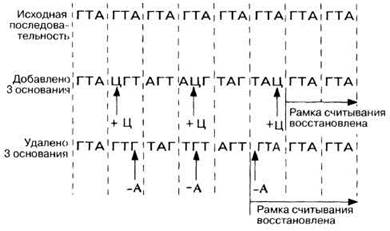
Fig. 23.5 (ans.). The general principle behind restoring the normal triplet reading frame by inserting or deleting bases is to either add or remove three bases within any given region of the nucleotide code.
23.6. UAC AAG CUC UUG GUA CAU UGC
Chapter 24
24.1.
a) Let B represent brown coat (dominant trait)
b represent gray coat (recessive trait)
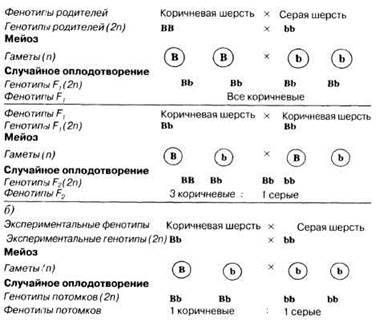
In a monohybrid cross between a heterozygous individual and an individual homozygous for the recessive allele, the offspring will show equal numbers of both phenotypes—in this case, 50% with brown coat and 50% with gray coat.
24.2. If a testcross is performed between an individual of unknown genotype and an individual homozygous for the dominant allele of the gene under study, all offspring will exhibit the dominant phenotype, as shown below.
Let: T be the dominant allele of the gene
t be the recessive allele
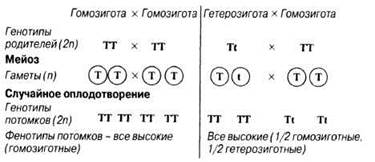
24.3. a) If all guinea pigs in the F1 generation have short black fur, this indicates that short fur is dominant over long fur, and black coat color is dominant over white.
Let B be black coat color
b - white coat color
S - short coat
s - long coat
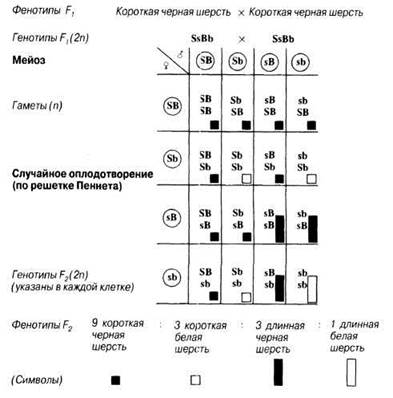
24.4.
Let R, r and S, s be two pairs of allelomorphic genes determining flower color
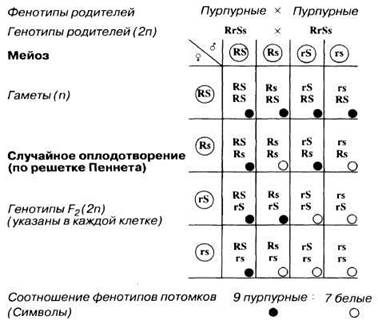
24.5. Segregation of these two alleles occurs in metaphase I and anaphase I.
24.6. The number of possible chromosome combinations in pollen grains (male gametes) is calculated using the formula 2n, where n is the haploid chromosome number.
In saffron, 2n = 6, i.e., n = 3.
Therefore, the number of combinations = 23 = 8.
24.7. As the F1 phenotypes show, purple flowers and short stems are dominant traits, while red flowers and long stems are recessive. An approximate ratio of 1 : 1 : 1 : 1 in a dihybrid cross indicates that the two genes controlling flower color and stem length are unlinked and that the four corresponding alleles reside in different chromosome pairs. This can be explained as follows:
Let: P - purple flowers
p - red flowers
S - short stem
s - long stem
Since both parent plants were homozygous for both traits, the F1 plants must have the genotype PpSs.
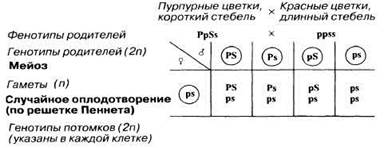
Offspring phenotypes
1 purple flowers, short stem:
1 purple flowers, long stem:
1 red flowers, short stem:
1 red flowers, long stem
24.8. a) Homologous Chromosomes
b) Body coloration and wing length
24.9. Out of 800 seeds obtained, only 24 show evidence of Crossing Over between the seed color genes and the endosperm type genes. In the remaining 776 seeds, the alleles determining these traits remain linked, as indicated by their ratio of approximately 1:1.
Thus, the recombination frequency is (24/800) x 100 = 3%. Therefore, the map distance between the seed color genes and the endosperm type genes is 3 map units (centiMorgans).
24.10. a) Let:
N - normal wings (dominant trait)
n - short wings (recessive trait)
R - red eyes (dominant trait)
r - white eyes (recessive trait)
XX - female ( )
)
XY - male ( )
)
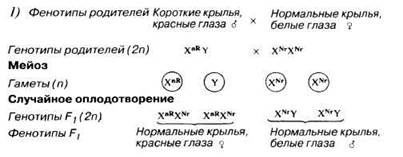
2) Assuming no crossing over occurs between the wing length and eye color genes, the following results would be expected
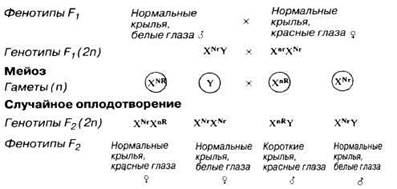
b) The deviation from the 1 : 1 : 1 : 1 phenotypic ratio among the offspring of this cross indicates that crossing over has occurred between the wing length and eye color genes in the female.
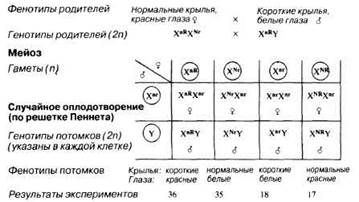
The alleles determining wing length and eye color are shown above on the two maternal (X) chromosomes of F1. Crossing over between these alleles produces the recombinant genotypes shown above. Out of 106 flies, 35 (18 + 17) resulted from recombination; thus, the recombination frequency is 35/106, or approximately 30%.
24.11. Peppered moth
Let: N - normal coloration (dominant trait)
n - pale coloration (recessive trait)
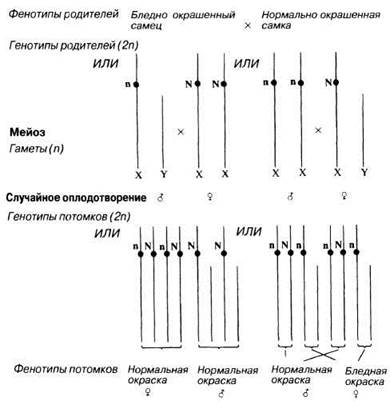
Based on the phenotypes of the progeny, it can be concluded that the female is the heterogametic sex in this moth species.
Cat
Let B - black coloration (dominant trait)
b - ginger coloration (recessive trait)
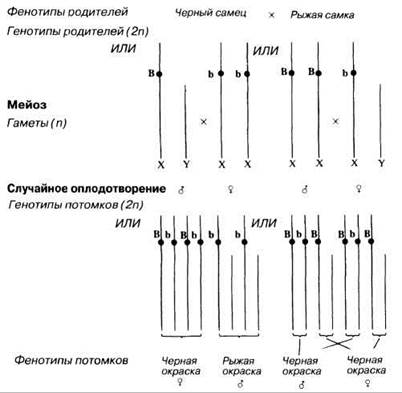
Based on the phenotypes of the offspring, it can be concluded that the male is the heterogametic sex in cats.
24.12.
Let B be black coat
G - ginger coat
XX - female cat
XY — male cat
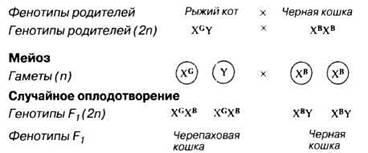
(Female cats must be homozygous for the black coat gene, because only in this case will the black phenotype be expressed.)
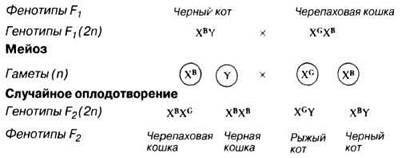
24.13.
a) Let I be the gene determining blood type

o - allele O (recessive)
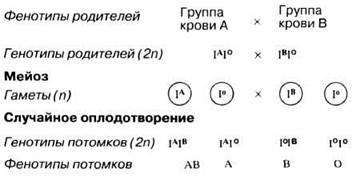
b) Each child has a 1/4 (25%) probability of having blood type A. Thus, the probability that both twins will have blood type A is 1/4 x 1/4 = 1/16 (6.25%).
24.14. Let: P - pea comb
R - rose comb
One P allele and one R allele together produce a walnut comb.
Individuals homozygous for both recessive genes (p and r) have a single comb
W - white plumage (dominant trait)
w - black plumage (recessive trait)
If eight different phenotypes are observed among the offspring of a cross, each of the parent individuals must be heterozygous for the maximum possible number of alleles. Therefore, they must have the genotypes indicated below.
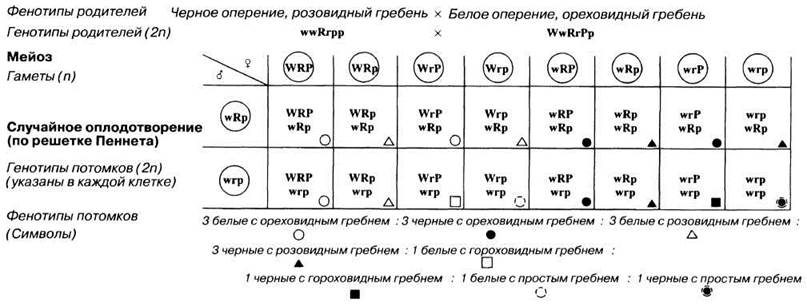
24.15. Since the heterozygous genotype of the F1 generation contains both dominant alleles — W (white coloration) and B (black coloration), while the chickens are white in phenotype, it can be concluded that these alleles interact epistatically, with the white allele being epistatic.
The phenotypic ratios in F2 are shown below, using the symbols given in the problem.
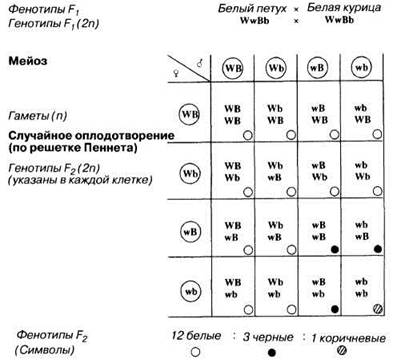
Chapter 25
25.1. Economic aspect: reducing the economic burden on a) individual families forced to care for sick relatives, and b) society, which has to cover treatment costs through the National Health Service. Social aspect: alleviating the suffering of a) the patients and b) their families.
25.2. a) Spouses 3 and 4 are phenotypically normal but have an affected daughter. If the gene were dominant, at least one of the parents would have to be affected. The condition is unlikely to be caused by a spontaneous mutation in the gene, as the mutation is already present in the family (individual 5).
b) Individual 9 is an affected female born to phenotypically normal parents. Given that the gene is recessive, both parents must carry a copy of this mutant gene. If the gene were sex-linked, the father would have to exhibit symptoms of phenylketonuria, since the Y chromosome carries only sex-determining genes.
c) Individuals 3 and 4 are definitely carriers.
d) Individuals 1, 2, 6, 7, 8, 10, 11, 12, and 13 could potentially be carriers. Considering only phenotypically normal offspring, it is impossible to prove definitively that an individual is not a carrier; this requires biochemical testing.
e) The usual answer given is a 1 in 2 (50%) probability, since The ratio of affected to carriers to normal offspring from individuals 3 and 4 should be 1:2:1. However, individuals 10, 11, and 12 know that they do not have phenylketonuria and are therefore either carriers or unaffected non-carriers. In this situation, there is a 2 in 3 chance (66.7%) that they are carriers. Your advice should include a recommendation for carrier genetic testing.
25.3. While the fetus is in utero, excess phenylalanine is cleared by the maternal organism. It takes a few days for phenylalanine levels to stabilize after birth.
25.4. If phenylalanine were not an essential amino acid, it could be synthesized by the body. Consequently, a phenylalanine-restricted diet would be ineffective.
25.5. When maternal blood phenylalanine levels are high, the amino acid can cross the placenta and impair fetal brain development.
25.6. a) First, it provides a degree of certainty; second, it allows you to plan for the future, such as deciding whether or not to have children.
b) First, the desire to maintain peace of mind and an enjoyment of life; second, the age of onset is uncertain, and an individual might simply die of other causes before any symptoms appear.
25.7. Symptoms manifest only after the disease has already been passed on to the children.
25.8. P2, P3, and P4.
Chapter 26
26.1. A control experiment in which each of the variables would be systematically eliminated.
26.2. Redi proceeded from the assumption that the appearance of "maggots" was linked to flies having free access to the vessels.
26.3. Sealing the flasks containing broth could prevent living organisms from entering. Conversely, the absence of air in the sealed flasks might deprive organisms of the oxygen essential for respiration.
26.4. Pasteur's core assumption was that every generation of organisms originates from a preceding generation rather than arising spontaneously.
Chapter 27
27.1. Carriers of the cystic fibrosis gene possess a heterozygous phenotype. Genotype frequencies are calculated using the Hardy–Weinberg equation:
р2 + 2pq + q2 = 1, where
р2 is the frequency of the homozygous dominant genotype,
2pq is the frequency of the heterozygous genotype,
q2 is the frequency of the recessive homozygous genotype.
Cystic fibrosis affects individuals with a recessive homozygous genotype; therefore, q2 = 1 in 2,000, or 1/2000 = 0.0005.
Hence, q = √0.0005 = 0.0224.
Since p + q = 1,
p = 1 — q = 1 - 0.0224 = 0.9776.
Therefore, the frequency of the heterozygous genotype (2pq) is
2 x (0.9776) x (0.0224) = 0.044 = 1 in 23 ≈ 5%.
Approximately 5% of the population are carriers of the recessive gene for cystic fibrosis.
27.2. The liver fluke (Fasciola hepatica) is a parasitic flatworm that infects sheep. It utilizes an intermediate host, the dwarf pond snail (Limnaea truncatula), which inhabits freshwater bodies and damp meadows. Draining ponds and waterlogged areas will alter environmental conditions and exert selection pressure aimed at eliminating these snails. As the snail population declines, the number of intermediate hosts will decrease, leading to a drop in the population of the parasite, the liver fluke.
27.3. Relaxed selection pressure at the peripheral ranges of each new population will favor increased Variability. New phenotypes may prove to be adapted to areas previously occupied by eliminated subspecies and will spread inward across the range, occupying the vacant ecological niche. The initial ecological segregation of the cline may have triggered allopatric speciation. If the ring species reconnects, gene exchange may prove impossible due to reproductive isolation, in which case each subpopulation will diverge genetically even further, evolving into distinct species—much like the current situation in the British Isles, where two gull species exist sympatrically. If genetic isolation between the two subpopulations is not yet complete, Hybridization may occur upon their secondary contact. Such a hybrid zone can function as a reproductive barrier, as seen in the case of carrion and hooded crows.
Last update: 06/08/2026
Editorial and Educational Adaptation: This material has been compiled based on the primary/original source text. The project team performed an editorial review, corrected technical inaccuracies, structured sections, and adapted the content for an educational format.
What was processed:
- elimination of formatting defects (OCR errors, structural breaks, corrupted characters);
- editorial organization of content;
- standardization of terminology in accordance with academic sources;
- verification of factual statements against the original source text.
All mentions of the author, publication year, and origin of the primary text have been preserved in accordance with the source.