Principles of Biochemistry Volume 2 - A. Lehninger 1985
Bioenergetics and Metabolism
ATP Cycle and Cellular Bioenergetics
ATP serves as a common intermediate in group transfer reactions involving phosphate
As we saw above, ATP occupies an intermediate position in the thermodynamic scale of phosphorylated compounds, meaning it is characterized by an intermediate value of ∆G0'. It is precisely this feature of ATP, along with its other properties, that enables it to act as an intermediate carrier of phosphoryl groups from super-high-energy compounds—that is, those that release more Free energy upon Hydrolysis than ATP does—to phosphate acceptors whose phosphorylated derivatives have a low ∆G0' and therefore release less free energy upon hydrolysis under standard conditions than ATP.
How exactly does ATP carry out this intermediary role? We already know that metabolic pathways consist of a series of sequential enzymatic reactions linked by common intermediates (Section 13.3), in which the product of each preceding reaction serves as the substrate for the next. For example, the two reactions
Class="center">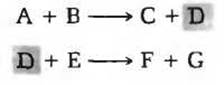
are linked by a common intermediate, D. At constant Temperature and pressure, chemical energy can be transferred from one chemical reaction to another only if the two reactions share a common intermediate. In our two-reaction example, intermediate D can serve as an energy carrier from the first reaction to the second.
Box 14-2. Free energy of ATP Hydrolysis in Intact Cells
The Standard Free Energy of ATP hydrolysis is -7.3 kcal/mol. However, within The Cell, the concentrations of ATP, ADP, and phosphate are not only unequal to one another but are also much lower than the standard 1 M value (Table 14-4). Furthermore, the pH of the cellular contents may also deviate to some extent from the standard value (7.0). Therefore, the true free energy of ATP hydrolysis under intracellular conditions, ∆Gp, does not equal the standard free energy ∆G0'. The actual free energy change for ATP hydrolysis in the cell (∆Gp) can be readily calculated. Table 14-4 lists the concentrations of ATP, ADP, and Pi in human erythrocytes as 2.25, 0.25, and 1.65 mM, respectively. For simplicity, let us assume standard values for pH and temperature (pH 7.0; temperature 25°C). Under these conditions, the true free energy ∆G of ATP hydrolysis in erythrocytes is determined from the equation

Substituting the corresponding values into this equation, we obtain
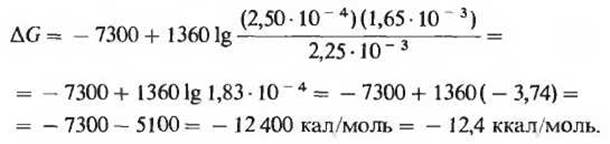
Thus, we can see that the true free energy change of ATP hydrolysis in intact erythrocytes (-12.4 kcal/mol) significantly exceeds the standard free energy change (-7.3 kcal/mol). Further evidence for this is the fact that the free energy change for the synthesis of ATP from ADP and phosphate in erythrocytes is +12.4 kcal/mol.
Because the intracellular concentrations of ATP, ADP, and Pi vary among different cell types (Table 14-4), these cells also differ in the magnitude of ∆Gp for ATP hydrolysis. Moreover, the value of ∆Gp can fluctuate over time depending on cellular METABOLISM—which dictates the local concentrations of ATP, ADP, and phosphate—as well as the fluctuating pH of the cell interior. We can calculate the true free energy change for any metabolic reaction occurring within a cell if we know the concentrations of all reactants and products, along with other parameters (such as temperature, pH, or Mg2+ ion concentration) that determine the Equilibrium Constant and, consequently, ∆G0'.
Within the cell, ATP Functions as a common intermediate that transfers energy, coupling exergonic reactions (those releasing free energy) with endergonic ones (those consuming free energy). During Catabolism, The energy released from The breakdown of organic nutrients drives The formation of phosphorylated compounds. Through the action of a specific kinase enzyme, a phosphoryl group from such a super-high-energy phosphorylated compound (designated here as  ) is transferred to ADP, yielding ATP. In the second stage, another specific kinase transfers the terminal phosphoryl group of ATP to a molecule acting as a phosphate acceptor (designated as Y), thereby increasing its energy level. This results in the formation of
  molecules.
Let us write out both reactions:
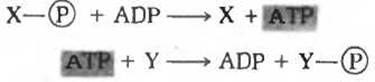
As a result of these two coupled reactions—linked via the common intermediate ATP—chemical Energy is transferred from  via phosphoryl group transfer. ATP serves as the mediator in such phosphoryl transfer reactions almost universally, as cells typically lack Kinases capable of directly transferring phosphoryl groups from super-high-energy phosphorylated compounds to low-energy acceptors.
Last update: 06/08/2026
Editorial and Educational Adaptation: This material has been compiled based on the primary/original source text. The project team performed an editorial review, corrected technical inaccuracies, structured sections, and adapted the content for an educational format.
What was processed:
- elimination of formatting defects (OCR errors, structural breaks, corrupted characters);
- editorial organization of content;
- standardization of terminology in accordance with academic sources;
- verification of factual statements against the original source text.
All mentions of the author, publication year, and origin of the primary text have been preserved in accordance with the source.