BIOCHEMISTRY - L. Stryer - 1984
VOLUME 2
PART II GENERATION AND STORAGE OF METABOLIC ENERGY
CHAPTER 16. GLYCOGEN AND DISACCHARIDE METABOLISM
16.2. Glycogen Breakdown Also Requires a Debranching Enzyme
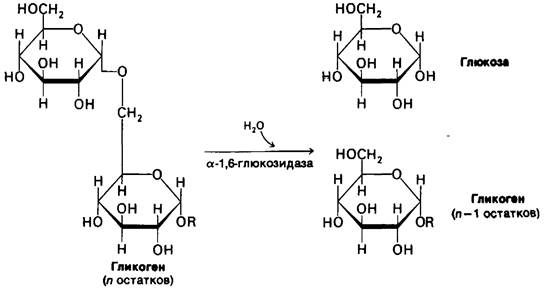
Glycogen degradation by phosphorylase alone is incomplete. The α-1,6-glycosidic bonds at the branch points are not susceptible to Cleavage by phosphorylase, because its action on α-1,4-bonds stops when it reaches a residue four units away from a branch point. The action of phosphorylase on two outer branches of a glycogen molecule is shown in Fig. 16.4. Five α-1,4-glycosidic bonds on one branch and three on the other are cleaved by phosphorylase. At this stage, the process halts because the terminal residues a and d are located four residues away from the branch point e. At this juncture, an additional enzymatic activity is required. A transferase shifts a block of three glycosyl residues from one outer branch to another. The α-1,4-glycosidic bond between b and c is cleaved, and a new α-1,4-bond is formed between b and d. As a result of this transfer, residue c is exposed and becomes accessible to the third degrading enzyme, α-1,6-glucosidase, also known as the debranching enzyme. This enzyme hydrolyzes the α-1,6-glycosidic bond between residues c and e.
Phosphorolysis is the cleavage of a bond by orthophosphate (as opposed to Hydrolysis, which signifies cleavage by Water).
Class="center">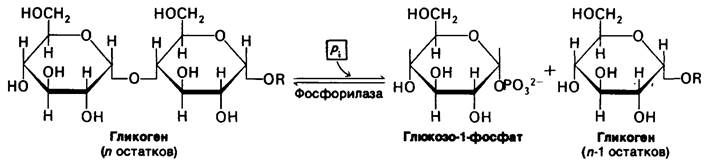
Fig. 16.4. Stages of glycogen breakdown

Thus, the transferase and the debranching enzyme (α-1,6-glucosidase) convert the branched Structure into a linear one, paving the way for further degradation of the molecule by phosphorylase. Following the removal of c, all residues from a to m become susceptible to phosphorylase. Interestingly, a single 160-kDa polypeptide chain contains both the transferase and α-1,6-glucosidase active sites.
16.3. Phosphoglucomutase Interconverts Glucose-1-Phosphate and Glucose-6-Phosphate
Glucose-1-phosphate, produced during the phosphorolytic breakdown of glycogen, is converted into glucose-6-phosphate by phosphoglucomutase. The equilibrium mixture contains 95% glucose-6-phosphate. The Active Site of the enzyme contains a phosphorylated Serine residue. During catalysis, this phosphoryl group is presumably transferred to the hydroxyl group at C-6 of glucose-1-phosphate, yielding glucose-1,6-bisphosphate. Subsequently, the phosphoryl group of this intermediate is transferred back to the serine residue at the active site, resulting in The formation of glucose-6-phosphate and the regeneration of the phosphorylated enzyme.

The phosphoryl group of the mutase is slowly lost through hydrolysis. It is restored by The transfer of a phosphoryl group from glucose-1,6-bisphosphate, which is formed from glucose-1-phosphate and ATP in a reaction catalyzed by phosphoglucokinase. These processes are analogous to the Reactions Catalyzed by the glycolytic enzyme phosphoglyceromutase (Section 12.7). The Role of 2,3-bisphosphoglycerate (2,3-BPG) in the interconversion of 2-phosphoglycerate and 3-phosphoglycerate is akin to that of glucose-1,6-bisphosphate in phosphoglucose interconversions. Furthermore, a phosphorylated enzyme serves as an intermediate in both reactions.
16.4. The Liver Contains Glucose-6-Phosphatase, a Hydrolytic Enzyme Absent in Muscle
The primary function of the Liver is to maintain Blood glucose at a relatively constant level. The liver releases glucose into the blood during periods of muscular activity and between meals. The released glucose is taken up predominantly by the Brain and skeletal Muscles. In contrast to unesterified glucose, phosphorylated glucose cannot readily diffuse out of Cells. The liver contains the hydrolytic enzyme glucose-6-phosphatase, which enables glucose to exit this organ. This enzyme plays a crucial role in Gluconeogenesis (Section 15.14).
Glucose-6-phosphate + H2O → Glucose + Pi.
Glucose-6-phosphatase is also present in the Kidneys and intestines, but it is absent in Muscle and brain. Consequently, glucose-6-phosphate is retained by muscles and the brain, which require large amounts of this fuel to generate ATP. At the same time, glucose is not the primary fuel for the liver. The liver stores and releases glucose primarily to meet the needs of other Tissues (Section 23.5).
Last update: 06/08/2026
Editorial and Educational Adaptation: This material has been compiled based on the primary/original source text. The project team performed an editorial review, corrected technical inaccuracies, structured sections, and adapted the content for an educational format.
What was processed:
- elimination of formatting defects (OCR errors, structural breaks, corrupted characters);
- editorial organization of content;
- standardization of terminology in accordance with academic sources;
- verification of factual statements against the original source text.
All mentions of the author, publication year, and origin of the primary text have been preserved in accordance with the source.