BIOCHEMISTRY - L. Stryer - 1984
VOLUME 2
PART II GENERATION AND STORAGE OF METABOLIC ENERGY
CHAPTER 16. GLYCOGEN METABOLISM AND DISACCHARIDE METABOLISM
16.5. Glycogen Synthesis and Degradation Proceed by Different Pathways
The reaction catalyzed by Glycogen phosphorylase is readily reversible because ΔG0 for glycogen elongation involving glucose-1-phosphate is —0.5 kcal/mol. Indeed, Cori successfully synthesized glycogen from glucose-1-phosphate using phosphorylase and a branching enzyme. However, a series of subsequent experimental studies showed that glycogen is synthesized via a different pathway in vivo. First, the phosphorylase-catalyzed reaction is at equilibrium when the [Pi]/[glucose-1-phosphate] ratio is 3.6 at neutral pH, whereas this ratio typically exceeds 100 within Cells. Consequently, in vivo, the phosphorylase reaction must proceed in the direction of glycogen breakdown. Second, Hormones that elevate phosphorylase activity generally promote glycogen degradation. Third, patients with a total absence of Muscle phosphorylase [McArdle's disease] (Section 16.19) are still capable of synthesizing muscle glycogen.
In 1957, Luis Leloir and his coworkers demonstrated that glycogen synthesis proceeds via a different pathway. Uridine diphosphate glucose (UDP-glucose) rather than glucose-1-phosphate serves as the glucosyl donor. The glycogen synthesis reaction is not simply the reversal of its degradation:
Synthesis: Glycogenn + UDP-glucose → Glycogenn+1 + UDP.
Degradation: Glycogenn+1 + Pi → Glycogenn + Glucose-1-phosphate.
Class="center">
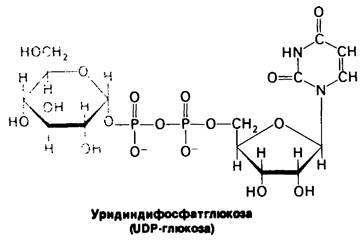
We now know that biosynthetic and degradative pathways in biological systems are almost invariably distinct. Glycogen METABOLISM provides the first clear example of this important principle. The existence of separate pathways for synthesis and degradation provides significantly greater flexibility, both energetically and regulatory. The Cell is no longer at the mercy of the law of mass action. Glycogen can be synthesized despite a high [orthophosphate]/[glucose-1-phosphate] ratio.
16.6. UDP-Glucose is an Activated Form of Glucose
UDP-glucose, the glucose donor in glycogen Biosynthesis, is an activated form of glucose, analogous to how ATP and acetyl-CoA serve as activated forms of orthophosphate and acetate, respectively. The C-1 carbon atom of the glucosyl moiety in UDP-glucose is activated because its hydroxyl group forms an ester linkage with the diphosphate component of UDP.
UDP-glucose is synthesized from glucose-1-phosphate and uridine triphosphate (UTP) in a reaction catalyzed by UDP-glucose pyrophosphorylase. The pyrophosphate released in this reaction is derived from the two outward phosphoryl groups of UTP.

The reaction is readily reversible, but pyrophosphate is rapidly hydrolyzed in vivo to orthophosphate by inorganic pyrophosphatase. This inherently irreversible Hydrolysis of pyrophosphate pulls the synthesis of UDP-glucose forward.
Glucose-1-phosphate + UTP ⇄ UDP-glucose + PPi,
PPi + Н2O → 2Pi
Glucose-1-phosphate + UTP + Н2O → UDP-glucose + 2Pi
The synthesis of UDP-glucose exemplifies a recurring theme in biochemistry: many biosynthetic reactions are driven by the hydrolysis of pyrophosphate. Another broad implication of this reaction is that nucleoside diphosphate sugars serve as glucosyl Donors in The biosynthesis of numerous Disaccharides and Polysaccharides.
16.7. Glycogen Synthase Catalyzes the Transfer of Glucose from UDP-Glucose to a Growing Chain
New glucosyl units are added to the nonreducing terminal residues of glycogen. The activated glucosyl moiety of UDP-glucose is transferred to the C-4 hydroxyl group of a terminal residue of glycogen, forming an α-1,4-glycosidic bond. In this elongation reaction, UDP is displaced by the terminal hydroxyl group of the growing glycogen molecule. The reaction is catalyzed by glycogen synthase, which can add glucosyl residues only if the polysaccharide chain already contains more than four residues. Thus, glycogen synthesis requires a primer, which is generated by a separate synthetic enzyme.
Last update: 06/08/2026
Editorial and Educational Adaptation: This material has been compiled based on the primary/original source text. The project team performed an editorial review, corrected technical inaccuracies, structured sections, and adapted the content for an educational format.
What was processed:
- elimination of formatting defects (OCR errors, structural breaks, corrupted characters);
- editorial organization of content;
- standardization of terminology in accordance with academic sources;
- verification of factual statements against the original source text.
All mentions of the author, publication year, and origin of the primary text have been preserved in accordance with the source.