Biochemistry - The Chemical Reactions of Living Cells, Volume 2 - D. Metzler 1980
Types of enzyme-catalyzed reactions
Nucleophilic substitution reactions (Type 1 reactions)
Glycogen phosphorylase
Many phosphorylases behave rather mysteriously. For instance, Muscle Glycogen phosphorylase, which catalyzes The conversion of glycogen (the Cleavage of a-glycosidic bonds) to a-D-glucose-1-phosphate, exhibits neither The ability to catalyze partial exchange reactions nor configuration inversion, as one might expect in a single-step nucleophilic substitution reaction. Similarly, incubating the enzyme with glucose-1-phosphate and arsenate does not lead to arsenolysis [18]. This is presumably because the enzyme remains inactive until both substrates are bound. Consequently, for the Active Site of the enzyme to function, a strict correspondence must be established between the enzyme conformation and The Structure of both substrates—meaning that the active conformation of the enzyme protein is stabilized in the presence of its substrates.
To explain the action of glycogen phosphorylase, a mechanism involving a carbonium ion has been proposed. This hypothesis is based, in part, on data showing strong inhibition of the enzyme by 5-gluconolactone (a compound featuring a "half-chair" conformation) [18, 19]:
Class="center">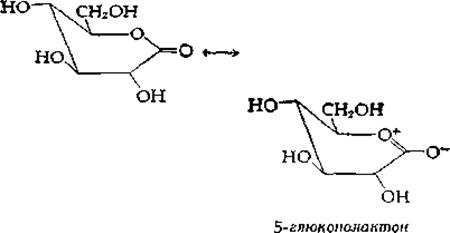
Glycogen phosphorylase is an unusual glycolytic enzyme. It contains a covalently bound coenzyme, pyridoxal-5'-phosphate (see Ch. 8, Sec. D,3), the exact role of which in the enzyme's catalytic mechanism remains unclear [18, 20].
Last update: 06/08/2026
Editorial and Educational Adaptation: This material has been compiled based on the primary/original source text. The project team performed an editorial review, corrected technical inaccuracies, structured sections, and adapted the content for an educational format.
What was processed:
- elimination of formatting defects (OCR errors, structural breaks, corrupted characters);
- editorial organization of content;
- standardization of terminology in accordance with academic sources;
- verification of factual statements against the original source text.
All mentions of the author, publication year, and origin of the primary text have been preserved in accordance with the source.