Biochemistry - The Chemical Reactions of Living Cells, Volume 2 - D. Metzler 1980
Types of enzyme-catalyzed reactions
Nucleophilic substitution reactions (Type 1 reactions)
Carbonium ions
Another well-known nucleophilic substitution mechanism involves the initial departure of a leaving group (often in its protonated form), yielding a carbonium ion:
Class="center">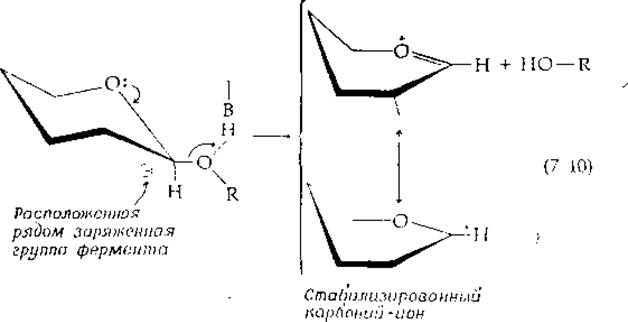
In physical organic chemistry terminology, this is an SN1-type reaction, rather than the SN2-type reaction shown in equations (7-3) and (7-6)1). Note that the carbonium ion is depicted as a Resonance hybrid of two states, in one of which (an oxonium ion) There is a double bond between Carbon and Oxygen. One can envision this double-bonded Structure as arising from the starting structure via internal displacement by a lone pair of electrons belonging to oxygen, as indicated by the small arrows. Such an internal type of substitution can also be viewed as an elimination reaction. Consequently, as often happens when studying enzymatic reactions, we encounter a semantic problem: is this reaction an elimination or merely a half-completed substitution? For the sake of classifying metabolic reactions, it is most straightforward to consider the overall process as a substitution reaction.
In the stabilized carbonium ion, the C-2, C-1, and C-5 ring carbon atoms, as well as the oxygen atom, are located in an almost coplanar arrangement. This ring conformation is referred to as a half-chair.
a. Lysozyme
It has been suggested that an enzymatic reaction mechanism involving The formation of a carbonium ion operates in the case of lysozyme—an enzyme whose primary role is to attack and cleave the polysaccharide chains of the peptidoglycan layer in bacterial Cell walls [10]. Lysozyme is present as a protective agent in tears and other bodily secretions, and in very large quantities in egg white. Hen egg-white lysozyme was the first enzyme whose complete three-dimensional structure was determined by X-Ray Diffraction [11].
1) This terminology is largely unsuitable for Enzymes because, although the reactions in question are nucleophilic substitutions (SN), The breakdown of enzyme-substrate complexes to yield products is generally a zero-order process, and the numerals 1 and 2 in the symbols SN1 and SN2 denote the order or molecularity of the reaction.
It turns out that the Topography of the six N-acetylglucosamine or N-acetylmuramic acid rings in the polysaccharide substrate molecule fits precisely into a cleft within the lysozyme molecule. Upon the action of lysozyme, the bond between the fourth and fifth rings is cleaved (Fig. 2-9). In the putative Active Site, a glutamic acid residue (No. 35) is positioned precisely to act as a proton donor [i.e., BH in equation (7-10)], whereas an aspartic acid residue (No. 52) lies on the opposite side of the cleft. Both Glu-35 and Asp-52 exhibit anomalously high pKa values (microscopic pKa values of ~5.3 and 4.6, respectively)1) within the fully protonated active site [12], which is attributed to their hydrophobic environment and hydrogen bonding with other groups. Asp-52 typically dissociates first, and due to the resulting electrostatic interaction, Glu-35 remains protonated up to ~pH 6. Nearby positively charged basic groups influence the pKa values, meaning the enzyme's behavior is dependent on the Ionic strength of the medium [12]. The Asp-52 anion lies close (~0.3 nm) to the center of the positive charge expected in the carbonium ion [13] and presumably serves to stabilize the carbonium ion [see scheme (7-10)].
The reaction catalyzed by lysozyme is completed by the stereospecific addition of a hydroxyl ion to the carbonium ion. The reaction product retains the original β-configuration. Such stereospecificity in reactions involving carbonium ions is hardly surprising, since the enzyme presumably participates in the generation and favorable orientation of the attacking hydroxyl ion2).
Molecular model studies indicate that for the six sugar rings of the substrate to be tightly bound by the enzyme, the ring containing the carbon atom undergoing substitution must be distorted from its normal chair conformation into the half-chair form required to facilitate the carbonium ion mechanism [15, 16]. Thus, As a result of binding the polysaccharide substrate chain at six distinct subsites, a specific ring undergoes conformational distortion, adopting a transition-state-like conformation. This may well be the most characteristic aspect of Enzymatic Catalysis.
1) At an ionic strength of ~0.2.
2) The Mechanism of lysozyme action is clearly described in the work of Dickerson and Geis [14].
b. Kinetic Isotope Effects
A carbon–Hydrogen bond is cleaved more easily than a carbon–deuterium bond, and significantly more easily than a carbon–tritium bond. Therefore, in cases where the rate-limiting step is hypothesized to involve C–H bond Cleavage, comparing the rates of cleavage of C–1H and C–2H bonds is a useful approach. In the lysozyme-catalyzed reaction, the slow step does not involve carbon–hydrogen bond cleavage, yet a secondary kinetic isotope effect is observed [17]. Differences in the masses of the 1H and 2H isotopes lead to minor differences in the vibrational energies of molecules containing these isotopes. As a result, a molecule containing 1H at position 1 can convert into a carbonium ion [equation (7-11)] somewhat more readily than a molecule bearing 2H at the same position. For example, in the non-enzymatic acid Hydrolysis of phenyl glucoside, which is known to proceed via

The intermediate formation of a carbonium ion, the k1H/k2H ratio is 1.14. In the base-catalyzed hydrolysis of the same compound (believed to proceed via a double-displacement mechanism involving a neighboring OH group at C-2), the k1H/k2H rate constant ratio is 1.03. The ratio measured for the lysozyme-catalyzed reaction is 1.11, which is much closer to that of the carbonium ion mechanism than to the double-displacement mechanism [17].
Compelling as the arguments for a carbonium ion mechanism in lysozyme may be, the available experimental data can alternatively be explained by a double-displacement reaction in which Asp-52 acts as a nucleophile, forming a transient covalent glycosyl-enzyme intermediate. Interestingly, both sucrose phosphorylase and lysozyme contain a carboxylate ion in their active sites. In the former case, the carboxylate ion forms a covalent glycosyl-enzyme complex, whereas in lysozyme, it appears to stabilize a carbonium ion. Are we truly dealing with distinct mechanisms? Or is the Formation of the glycosyl-enzyme intermediate an artifact related to the Denaturation of sucrose phosphorylase? Alas, nature guards her secrets well! The difficulties in elucidating the subtle details of enzymatic mechanisms compel researchers to maintain a degree of skepticism—to scrutinize experimental results and carefully evaluate all possible interpretations, even when a particular hypothesis seems beyond dispute.
Last update: 06/08/2026
Editorial and Educational Adaptation: This material has been compiled based on the primary/original source text. The project team performed an editorial review, corrected technical inaccuracies, structured sections, and adapted the content for an educational format.
What was processed:
- elimination of formatting defects (OCR errors, structural breaks, corrupted characters);
- editorial organization of content;
- standardization of terminology in accordance with academic sources;
- verification of factual statements against the original source text.
All mentions of the author, publication year, and origin of the primary text have been preserved in accordance with the source.