Plant Physiology - Musienko M.M. 2001
Plants and the Biosphere. Ecological Cycles of Matter and Energy Flow
Carbon and Oxygen Cycle
The primary pathway of the carbon cycle is from atmospheric carbon dioxide (CO2) into living matter and back into carbon dioxide (Fig. 218). The rate of the carbon cycle within its biogeochemical cycle is
Class="center">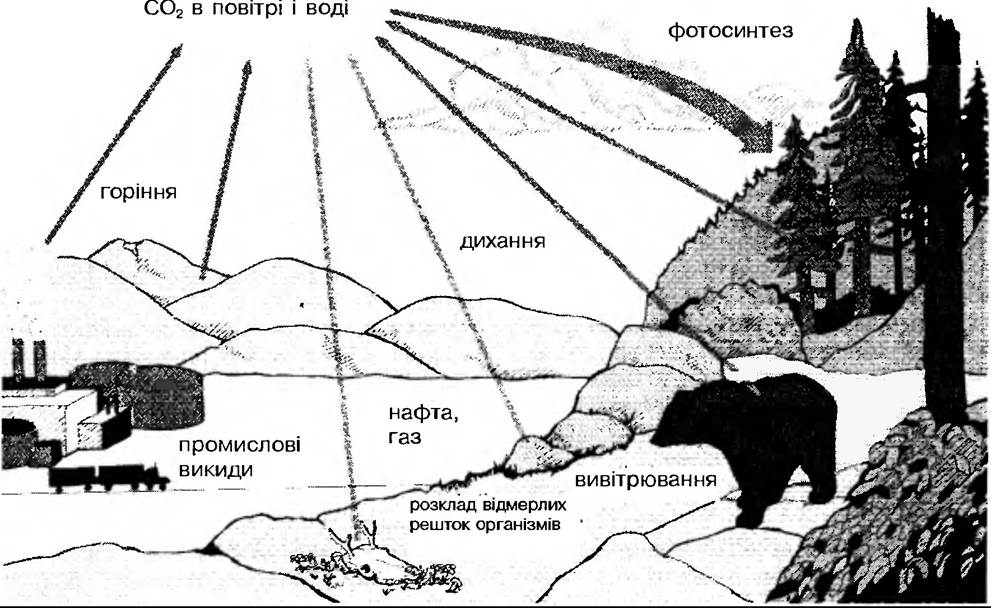
Fig. 218. The carbon cycle
quite high and approaches the rate of Energy Flow through an ecosystem. This is because organic matter consists of nearly 50% carbon. The reduced form of carbon, in which it is prevalent in all Organic compounds, serves as the main energy carrier across trophic chains.
The concentrations of carbon dioxide and oxygen in the atmospheric air remain balanced and virtually unchanged, despite their continuous involvement in Photosynthesis and Respiration. The total amount of carbon dioxide in the planet's atmosphere is approximately 2.3 × 10¹² t. Annually, about 10% of atmospheric Carbon dioxide is incorporated into photosynthetic assimilation by plants. A substantial amount of carbon dioxide is also held within the biosphere's living matter (around 1.5 × 10¹² t). Without the decomposition of organic matter by heterotrophic organisms, and without continuous replenishment processes—primarily through respiration—plant reserves of carbon would be depleted within just 20 years.
At the same time, annual oxygen production amounts to 1011 t. The Earth's gaseous envelope contains 1 trillion 200 billion t of oxygen. The release of oxygen via photosynthesis, on the one hand, and its consumption in Respiration and Fermentation, on the other (accounting for the abiogenic splitting of H2O and СО2 by ultraviolet rays), have established a stable atmospheric balance over nearly 3 billion years regarding The ratio of carbon dioxide to oxygen, where oxygen accounts for approximately 21% and СО2 for 0.03%. The oxygen cycle (Fig. 219) in nature is intimately linked to the carbon cycle. The current pool of atmospheric oxygen and inorganic oxidized products (such as iron oxides and sulfates) is largely of biogenic origin. The enrichment of the atmosphere with oxygen enabled the evolutionary development of oxidative respiratory METABOLISM as a mechanism to control The oxidation of compounds reduced during photosynthesis, a process accompanied by energy release. The ozone layer, which protects developing life on Earth, is likewise largely a byproduct of green plant photosynthesis.
The photosynthetic process consumes approximately 2.3 × 10¹¹ t of Water annually. Given that the planet's water reserves are roughly 1.5 × 10¹⁸ t, it can be calculated that over the past 400 million years—since terrestrial plants first appeared—the entire water reserve has been decomposed and regenerated about 60 times.
Annual global photosynthetic primary Production of organic matter is approximately 2 × 10¹¹ t. Carbon fixed in biomass is consumed in significant quantities by animals, which in turn release it as СО2 through respiration. The remains of dead organisms are decomposed by microorganisms, causing the carbon of dead organic matter to oxidize back into СО2 and re-enter the atmosphere.
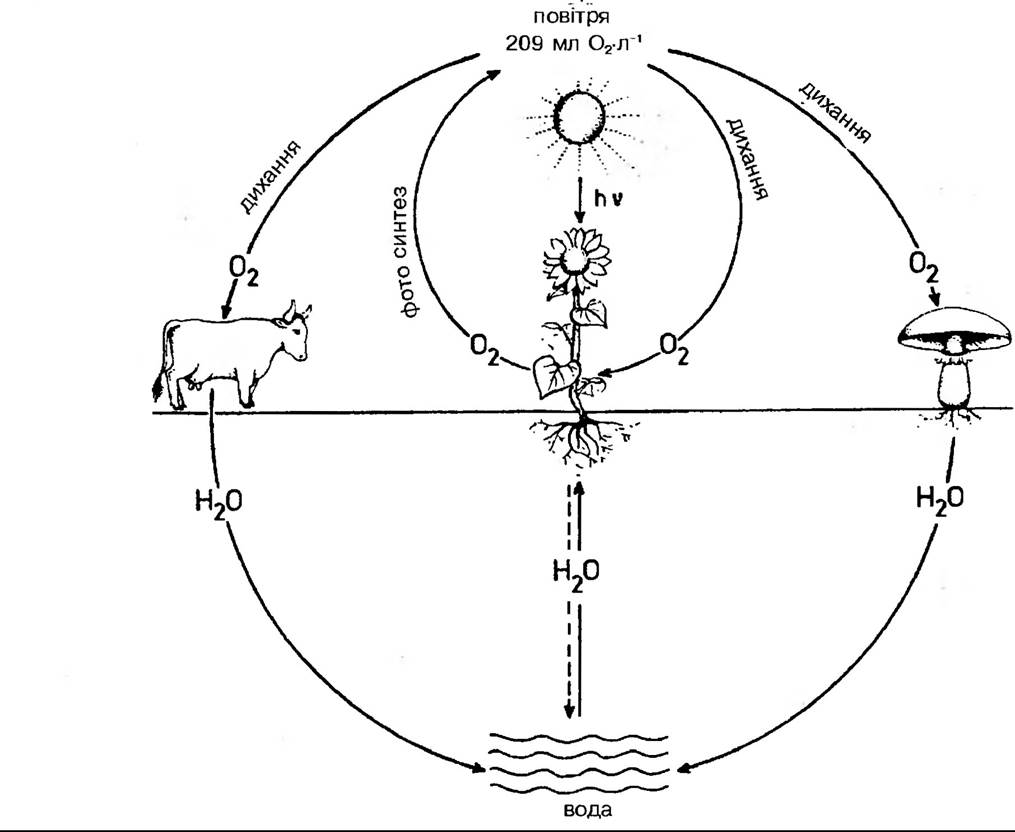
Fig. 219. The oxygen cycle
Thanks to modern technologies, fossil carbon from the photosynthesis of past geological epochs is also being returned to the atmosphere, accounting for roughly one-seventh of the СО2 assimilated by plants. It is estimated that green plants draw up to 300 billion t of СО2 (100 billion t of carbon) from the atmosphere annually, which matches the total input of СО2 into the atmosphere from various sources—respiration, industrial emissions, transportation, and others. The World Ocean, with its gigantic carbonate reserves, acts as a buffer and stabilizes atmospheric carbon dioxide levels. A constant migration of carbon takes place between the land and the World Ocean. The carbon dioxide of the atmosphere and hydrosphere is exchanged and renewed by living organisms over a period of 395 years.
Last update: 07/08/2026
Editorial and Educational Adaptation: This material has been compiled based on the primary/original source text. The project team performed an editorial review, corrected technical inaccuracies, structured sections, and adapted the content for an educational format.
What was processed:
- elimination of formatting defects (OCR errors, structural breaks, corrupted characters);
- editorial organization of content;
- standardization of terminology in accordance with academic sources;
- verification of factual statements against the original source text.
All mentions of the author, publication year, and origin of the primary text have been preserved in accordance with the source.