Plant Physiology - Musiyenko M.M. 2001
Respiration
Respiration and Fermentation
Dissimilation is The breakdown of organic matter (Catabolism) coupled with the release of the energy stored within it. Dissimilation occurs either anaerobically, in which case the process is called Fermentation, or aerobically, which is known as Respiration. Anaerobic respiration was first discovered by Louis Pasteur, who termed this phenomenon fermentation. However, Pasteur did not provide a thorough explanation of the process, which was later accomplished by S.P. Kostychev and the German biochemist C. Neuberg.
Around the same period, the German physiologist E. Pflüger discovered that certain animal organisms (such as frogs) could survive without access to air while still releasing CO3 during respiration. Pflüger viewed this as a breakdown product resulting from O2 bound within organic molecules, and he termed it intramolecular respiration. One of the most prominent physiologists of the late 19th century, W. Pfeffer, extended this concept to plant organisms. In his view, the initial stage involves Alcoholic Fermentation:

followed by The oxidation of alcohol by oxygen into carbon dioxide and Water:

the overall equation:

However, S.P. Kostychev, who set out to elucidate The Nature of anaerobic respiration and establish its connection to aerobic respiration, disagreed with this Conclusion. He proved experimentally that alcoholic fermentation is not the initial phase of respiration; rather, both processes are interconnected through common intermediate products of Carbohydrate METABOLISM. Kostychev formulated The Theory of the genetic link between respiration and fermentation, according to which the anaerobic breakdown of sugars serves as the initial phase common to both fermentation and respiration:
Class="center">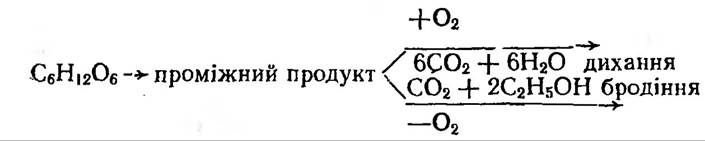
He was the first to demonstrate that pyruvic
acid is an intermediate product of all fermentations, which played a pivotal role in advancing our understanding of the chemistry of respiration and fermentation:
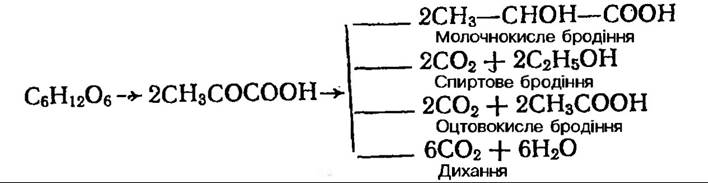
Pyruvic acid (PA) thus serves as the intermediate product of both fermentation and respiration that undergoes further transformation. Depending on The pathway of these transformations, a specific type of fermentation occurs or, in the presence of oxygen, complete oxidation to CO2 and H2O takes place (Fig. 84).
Kostychev's theoretical Conclusions regarding The Unity of fermentation and respiration have been corroborated by the research of numerous scientists.
The process of fermentation is a more ancient type of dissimilation than respiration. From an energetic standpoint, it is less efficient because generating the same amount of energy requires significantly more substrate during fermentation than during respiration. Indeed, during respiration, organic matter is completely converted into H2O and CO2, releasing a substantial amount of energy. In contrast, during fermentation, organic matter is not fully broken down, leading to the accumulation of various energy-rich products (alcohols, lactic acid, etc.). Oxygen availability ensures that the plant consumes considerably less energy substrate. This differing utilization of energetic material evolved over time and represents one of the most vital adaptations to living conditions.
This effect of oxygen—whereby carbohydrate consumption for aerobic respiration decreases while anaerobic respiration and The formation of anaerobic metabolites are suppressed—is known as the Pasteur Effect. Although all higher plants belong to the group of aerobic organisms, they are nevertheless capable of anaerobic respiration. This raises the question: What is the relationship between aerobic and anaerobic respiration, and how are they interconnected?
Some researchers believed that anaerobic respiration was a pathological process absent in higher plants under normal conditions. However, anaerobic respiration is characteristic of many Plant Tissues and can occur even with adequate air supply. This process is known to be particularly prominent in ripening fruits. When stored in bulk, one can detect the scent of ethyl alcohol released As a result of anaerobic respiration. Along with alcohol, anaerobic respiration also yields acetaldehyde, acetic acid, and lactic acid.
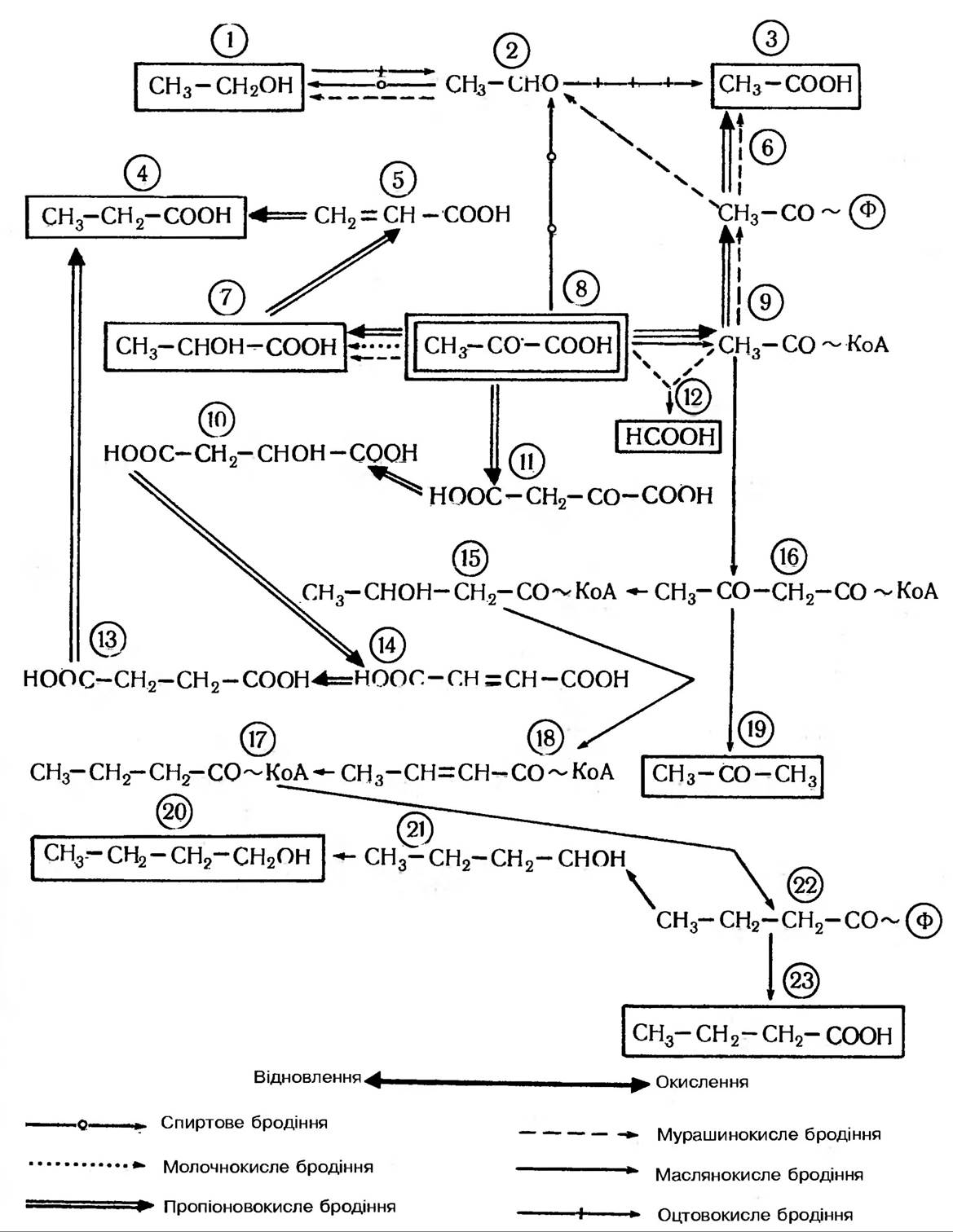
Fig. 84. Pathways of pyruvic acid transformation across various Types of fermentation: 1 — ethanol, 2 — acetaldehyde, 3 — acetic acid, 4 — propionic acid, 5 — acrylic acid, 6 — acetyl phosphate, 7 — lactic acid, 8 — pyruvic acid, 9 — acetyl-CoA, 10 — malic acid, 11 — oxaloacetic acid, 12 — formic acid, 13 — succinic acid, 14 — coumaric acid, 15 — b-hydroxybutyl-CoA, 16 — acetoacetyl-CoA, 17 — butyryl-CoA, 18 — crotonyl-CoA, 19 — acetone, 20 — n-butanol, 21 — butyraldehyde, 22 — butyryl phosphate, 23 — butyric acid
Subsequent breakthroughs in plant physiology and biochemistry provided a detailed clarification of the interplay between aerobic and anaerobic respiration.
Last update: 07/08/2026
Editorial and Educational Adaptation: This material has been compiled based on the primary/original source text. The project team performed an editorial review, corrected technical inaccuracies, structured sections, and adapted the content for an educational format.
What was processed:
- elimination of formatting defects (OCR errors, structural breaks, corrupted characters);
- editorial organization of content;
- standardization of terminology in accordance with academic sources;
- verification of factual statements against the original source text.
All mentions of the author, publication year, and origin of the primary text have been preserved in accordance with the source.