Plant Physiology - Musienko, M.M. 2001
Respiration
Respiratory substrates. Respiratory quotient
Dissimilation most commonly takes the form of Respiration, which involves the uptake of oxygen and the release of carbon dioxide. A distinction should be made between external respiration—the exchange of gases between the Organism and its environment— and internal respiration—intracellular biochemical processes accompanied by the release of energy.
CARBOHYDRATES serve as the primary substrate for respiration. Fats and Proteins are utilized mainly in the respiration of seedlings developing from seeds rich in fats or proteins. The breakdown of substrates during respiration is preceded by Hydrolysis: carbohydrates are broken down into Monosaccharides, fats into glycerol, and proteins into Amino Acids.
The overall equation for respiration can be represented as the breakdown of the substrate and The oxidation of hydrogen:
Class="center">
It is evident from the summary equation given above that the volumes of gases involved in carbohydrate oxidation are equal.
The ratio of released CO2 to absorbed O2 during respiration is termed the respiratory quotient; as seen from the equation above, the respiratory quotient for carbohydrates is equal to CO2/O2 = 1. If fats serve as the nutritional substrate, such as stearic acid, the overall respiration equation becomes:
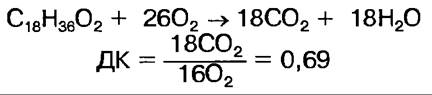
The respiratory quotient can deviate significantly from unity if the respiratory substrate is composed of proteins or fats rather than carbohydrates. If the substrate is rich in hydrogen ions, a portion of the atmospheric oxygen is used not only to oxidize carbon, but also to oxidize the excess hydrogen present in the substrate. This is why the respiratory quotient for fats is less than 1. During respiration relying on proteins, the RQ can also be less than unity, approximately 0.7–0.8. Conversely, if the substrate (for instance, C4H6O5 — malic acid) is rich in oxygen, the respiratory quotient exceeds 1:
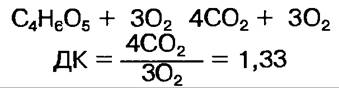
An increase in the RQ value is always observed when respiration is accompanied by Fermentation, since fermentation processes inherently involve the release of CO2 without the uptake of atmospheric oxygen. It is readily apparent that the lower the respiratory quotient, the greater the thermal effect of oxidation, and vice versa. Consequently, proteins and fats are characterized by a high thermal equivalent, whereas organic acids have a very low one.
Last update: 07/08/2026
Editorial and Educational Adaptation: This material has been compiled based on the primary/original source text. The project team performed an editorial review, corrected technical inaccuracies, structured sections, and adapted the content for an educational format.
What was processed:
- elimination of formatting defects (OCR errors, structural breaks, corrupted characters);
- editorial organization of content;
- standardization of terminology in accordance with academic sources;
- verification of factual statements against the original source text.
All mentions of the author, publication year, and origin of the primary text have been preserved in accordance with the source.