MEDICAL BIOLOGY, HUMAN ANATOMY, PHYSIOLOGY AND PATHOLOGY - Ya.I. Fedoniuk 2010
BIOLOGY
CHAPTER 1. BIOLOGICAL BASES OF HUMAN VITAL ACTIVITY
1.4. ONTOGENETIC LEVEL OF LIFE ORGANIZATION
1.4.3. Biology of Individual Development
Interrelation of growth and differentiation processes in the postnatal period
Growth is manifested in the progressive increase in the size and mass of the Organism due to the accumulation of organic matter. The following Types of Growth are distinguished: isometric, allometric, determinate (limited), and indeterminate (unlimited). Isometric growth refers to a process where a particular organ grows at the same rate as other PARTS OF THE body. In such cases, body proportions remain identical across different age periods. This type of growth occurs in fish. Allometric growth refers to a process where a specific organ grows at a different rate than the rest of the body. Consequently, the growth of the organism leads to changes in its shape and proportions (mammals). Indeterminate growth continues throughout the entire life span (Mollusks, amphibians, reptiles), whereas determinate growth stops upon reaching a certain age (insects, birds, mammals). Humans are characterized by allometric, determinate growth (Fig. 1.89).
Class="center">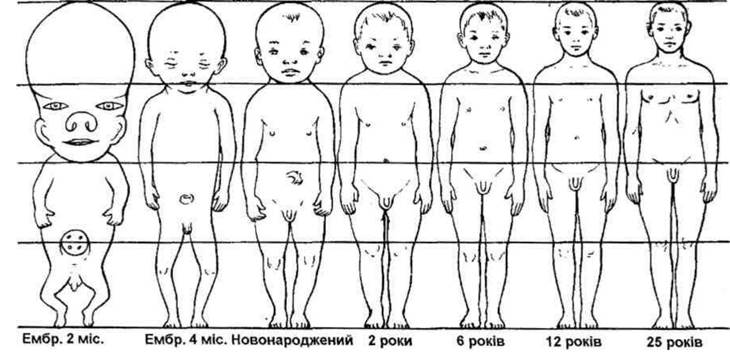
Fig. 1.89. Human growth is allometric (body proportions vary across different age periods) and determinate.
Ontogeny involves an alternation of growth and differentiation periods. Periods of growth depression are accompanied by intensified differentiation, and vice versa. Growth indicators change during the course of individual development. In humans, the most intensive postnatal growth is observed
During the first year of life, when the child's body length increases on average by 23-25 cm. In the second year of life, the growth rate slows down, yet remains relatively high (10-11 cm). Subsequently, growth decelerates further. From ages 11-12 in girls and 13-14 in boys up to 16-17 years, a final sharp acceleration in growth occurs (7-8 cm per year)—known as the pubertal growth spurt, which is associated with The process of sexual maturation.
Growth is a quantitative trait controlled by multiple genes (polygenic inheritance) and is also dependent on developmental environmental conditions. Genetic control of growth is evidenced by the fact that organism size is a species-specific trait. A direct correlation between growth and Nutrition has been established. During "famine" years, growth retardation is observed. GROWTH AND DEVELOPMENT are influenced by the entire complex of socio-economic factors surrounding the child. There are sex and racial differences in the reaction to changing living conditions. For instance, growth in girls is more resistant to malnutrition than in boys. Prolonged starvation in childhood leads Europeans to a decrease in overall body length without a disruption in proportions. In Japanese individuals under the same conditions, relative elongation of the torso and shortening of the legs occur, whereas in Africans, the opposite is observed.
Last update: 08/08/2026
Editorial and Educational Adaptation: This material has been compiled based on the primary/original source text. The project team performed an editorial review, corrected technical inaccuracies, structured sections, and adapted the content for an educational format.
What was processed:
- elimination of formatting defects (OCR errors, structural breaks, corrupted characters);
- editorial organization of content;
- standardization of terminology in accordance with academic sources;
- verification of factual statements against the original source text.
All mentions of the author, publication year, and origin of the primary text have been preserved in accordance with the source.