MODERN BOTANY - P. RAVEN - 1990
SECTION VI. REGULATION AND GROWTH RESPONSES
CHAPTER 24. REGULATION OF GROWTH AND DEVELOPMENT: PLANT HORMONES
Class="center">
For its growth, a plant requires sunlight, carbon dioxide obtained from the air, as well as Water and mineral components (including nitrogen) absorbed from the soil. All of these are used to build substances characteristic of the plant itself, with simple elements being transformed into complex organic molecules that make up living organisms. As noted in the previous section, growth is not merely an increase in the plant's mass and volume. The plant differentiates, develops, and acquires a definite shape, forming diverse Cells, Tissues, and Organs. How can a single Cell (a fertilized egg) become the source of the multitude of tissues and organs that form the remarkable individual known as a "normal" plant? Many details regarding The regulation of these processes are still unknown, but it is becoming clear that normal plant development depends on the interaction of internal and external factors. The main internal factors regulating Plant Growth and Development are chemical in nature and are the subject of this chapter. Certain external factors affecting growth—such as light, Temperature, day length, and gravity—are discussed in Chapter 25.
Fig. 24-1. Photoperiodism prompts many plant species to flower at the same time each year. Flowering occurs As a result of the interaction between external (environmental) and internal (hormonal) factors. Photograph of blooming cherry trees (Prunus) in Brooklyn, New York

Plant HORMONES play a fundamental role in the regulation of growth. The term "hormone" was introduced by animal physiologists to denote organic substances that are produced in one tissue and transported to another, where they elicit a specific physiological effect. Hormones are active in extremely small quantities. The SHOOT of a pineapple (Ananas comosus), for example, contains only six micrograms of indoleacetic acid, a common plant hormone, per kilogram of plant mass. One enterprising plant physiologist calculated that The ratio of hormone mass to shoot mass is comparable to the weight of a single needle in 20 tons of hay.
The word hormone is derived from the Greek word hormaein, meaning "to excite." However, it is now known that many hormones exert an inhibitory effect. Therefore, it might be better to view them not merely as stimulators, but as chemical regulators. Even this term requires clarification, as the response to a specific "regulator" depends not only on its composition (chemical Structure), but also on the receptivity of the recipient (tissue Specificity).
In the following sections, we will trace how our knowledge of plant hormones gradually accumulated. Accordingly, the Discussion begins with auxin, as its discovery provided the impetus for The Study of plant hormones.
Auxin
Some of the earliest experiments on plant growth regulation were performed by Charles Darwin and his son Francis and described in their work The Power of Movement in Plants, published in 1881. The Darwins systematically observed the movement (bending) of plants toward light (known as phototropism) using canary grass (Phalaris canariensis) and oat (Avena sativa) seedlings. They demonstrated that if the upper part of the coleoptile (a protective sheath-like structure enclosing the tip of a grass seedling) is covered with a foil cylinder or a Glass tube blackened with India ink, and the plant is illuminated from the side, the characteristic bending does not occur (Fig. 24-2). However, when transparent glass tubes were used, curvature occurred as usual. According to the Darwins, these experiments proved the existence of a "messenger" between the tip—that is, the tissue perceiving the light stimulus—and the rest of the coleoptile, where the growth curvature takes place. They further concluded: "We must therefore conclude that when seedlings are subjected to lateral light, some influence is transmitted from the upper to the lower part, causing the latter to bend."
Fig. 24-2. The Darwins' experiment. A. Seedlings bend normally toward the light. B. When the tip of the seedling is covered with an opaque cap, no bending occurs. Bending is observed if the seedling tip is covered with a transparent cap. C. When the cap is placed below the tip, the characteristic bend takes place. Based on these experiments, the Darwins concluded that under METABOLISM/18.html">The Influence of light, a "stimulus" causing the curvature is transmitted from the seedling tip to the underlying region where the bend normally occurs

In 1926, the Dutch plant physiologist Frits W. Went succeeded in isolating this "stimulus" from coleoptile tips. Went cut off the coleoptile tips of oat (Avena) seedlings and placed them for about an hour on Agar blocks so that the cut surfaces came into contact with the agar. (Agar is a gelatinous substance obtained from certain red Algae and used as a neutral growth medium.) Went then cut the agar into small blocks and placed them on one side of decapitated coleoptiles, which were kept in the dark throughout the experiment. Within an hour, he observed a distinct bending in the direction opposite to the side where the agar block was placed (Fig. 24-3). Agar blocks that had not been in contact with coleoptile tips caused no bending or only a slight curvature toward the side on which the block was placed. Agar blocks that Went had placed on fragments taken from the lower part of the coleoptile also showed no physiological effect.
Fig. 24-3. Went's experiment. A. Went removed the coleoptile tips from seedlings, placed them on agar, and kept them there for an hour. B. Went then cut the agar into small blocks, which he placed on one side of decapitated seedlings. C. Kept in the dark throughout the experiment, the seedlings gradually bent in the direction opposite to the side containing the agar block. Based on this, Went concluded that the "stimulus" causing the seedling to bend is chemical in nature and accumulates on the side opposite to the light

Through these experiments, Went demonstrated that the Influence of the coleoptile tip is due to the release of a chemical substance rather than a physical stimulation, such as an electrical one. Went named this chemical substance auxin, from the Greek word auxein, meaning "to increase."
The bending of the oat coleoptile away from the side bearing the auxin-containing agar block is caused by the asymmetrical distribution of auxin, which in turn promotes asymmetrical cell elongation in the coleoptile; the cells on the side with the block elongate more than the cells on the opposite side. The growing conditions of the oat seedlings and the placement of the agar block were standardized to such an extent that the angle of curvature (measured with a protractor) could be used to quantify The amount of auxin in the agar block. The application of this technique, known as the oat coleoptile curvature test, allowed researchers to isolate and identify the naturally occurring auxin, which was named indoleacetic acid (abbreviated as IAA). (A bioassay allows the Quantitative determination of a substance's concentration based on its effect on the growth of a corresponding Organism under controlled conditions.)
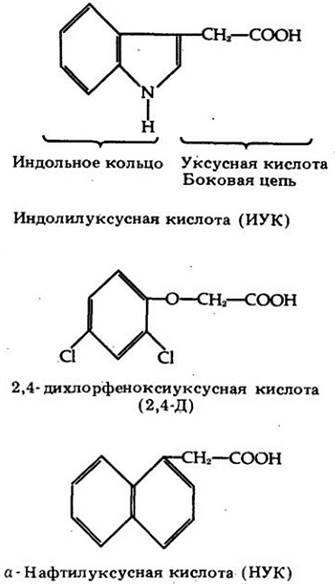
As seen in Fig. 24-4, IAA is very similar to The amino acid Tryptophan (see Fig. 3-14). Tryptophan is a precursor of IAA in the living plant; furthermore, four pathways of IAA Biosynthesis are known, each with its own intermediate. Different groups of plants utilize different pathways for The formation of IAA from tryptophan. In addition, some plants, such as corn (Zea mays), use different pathways at different Selection/3.html">Stages of development. Auxin is produced in the tips of grass coleoptiles and shoot apices. Although IAA has also been found in ROOT tips, there is much evidence indicating that it is transported there via Vascular Tissues from the root base. Large amounts of IAA may be present in embryos; furthermore, it has been detected in young leaves, flowers, and fruits.
Shortly after auxin was discovered and its role in regulating cell elongation was elucidated, its inhibitory effect on the growth of lateral buds was observed. For example, if the apical meristem of a bean plant is removed, the lateral buds begin to grow. However, if auxin is immediately applied to the cut surface, bud growth is suppressed. As in the phototropic response of oat seedlings, this apical dominance demonstrates an "interaction" between two plant tissues via IAA. Moreover, in both cases, the "stimulus" travels from the growing tip of the plant toward its base. This occurs because auxin is actively transported from the shoot apex toward the Base of the plant, i.e., in a basipetal direction. Movement takes place primarily through the tissue as a whole rather than through the xylem and phloem elements (vessels and sieve tubes, respectively). This transport is presumably related to the interaction between IAA and the Plasma Membranes of plant cells.
Auxin exerts diverse effects on a plant depending on the duration of exposure, the plant species, and especially the tissue type. Like many other physiologically active compounds, auxin is toxic at high concentrations. The weed-killing herbicide 2,4-D is a synthetic auxin, one of many manufactured for practical, widespread use (Fig. 24-4).
Fig. 24-4. Indoleacetic acid (IAA) is the best-known naturally occurring auxin. Dichlorophenoxyacetic acid (2,4-D) is a synthetic auxin widely used as a herbicide. α-Naphthaleneacetic acid (NAA), another synthetic auxin, is commonly applied to stimulate adventitious root formation in cuttings and to reduce fruit drop in orchards. Unlike IAA, synthetic Auxins are not easily degraded by plant and microbial Enzymes and are therefore better suited for Practical Applications
Auxin and Cell Differentiation
Auxin influences the differentiation of vascular tissue in growing shoots. If a sector is excised from a Coleus stem so as to cut and remove portions of the vascular bundles, new vascular tissues will form from the pith cells and establish connections with the bundles in the undamaged areas. Removing the leaves and buds above the cut delays the formation of these new cells. However, if IAA is applied to the remaining leaf petiole located just above the cut, vascular tissue formation resumes. Auxin plays a crucial role in connecting the vascular strands of developing leaves to the stem's vascular bundles.
Similar responses are observed in calluses. (A callus is a mass of undifferentiated cells that forms when a plant is wounded or when isolated cells are cultured in vitro.) When a lilac (Syringa) pith callus is grafted with a bud, vascular tissue begins to form within the callus. Vascular tissue also develops when the callus is grown on a medium containing auxin and sugar (sugar is necessary because a callus lacks photosynthesizing cells). R. Wetmore and coworkers demonstrated that by adjusting the sugar concentration in the medium, one can induce the formation of xylem alone, both xylem and phloem, or phloem alone. A low sucrose concentration (1.5% to 2.5%) promotes xylem formation, a high concentration (4%) promotes phloem formation, and an intermediate concentration encourages The Development of both tissues. This highlights the high sensitivity of growth regulators and draws attention to the vital fact that hormones never act independently, but always in conjunction with other substances or hormones.
Auxin and Cambium
In woody plants, auxin promotes cambial growth. When the Cells of the shoot meristematic zone begin to divide in the spring, auxin arriving from the shoot apex stimulates cambial Cell Division, as well as the Formation of secondary phloem and secondary xylem. At the time, these processes are also modulated within the plant organism by Other growth regulators.
Experiments using exogenous IAA and gibberellic acid show that in the intact plant, the interaction between auxins and Gibberellins determines the relative rates of secondary phloem and secondary xylem formation. For instance, both IAA and gibberellic acid individually stimulate cambial activity in many woody plants. However, in the absence of gibberellic acid, IAA stimulates the development of xylem exclusively. Phloem formation occurs under the influence of gibberellic acid alone, whereas maximal combined development of both xylem and phloem is observed only in the presence of both IAA and gibberellic acid.
Auxin and Root Growth
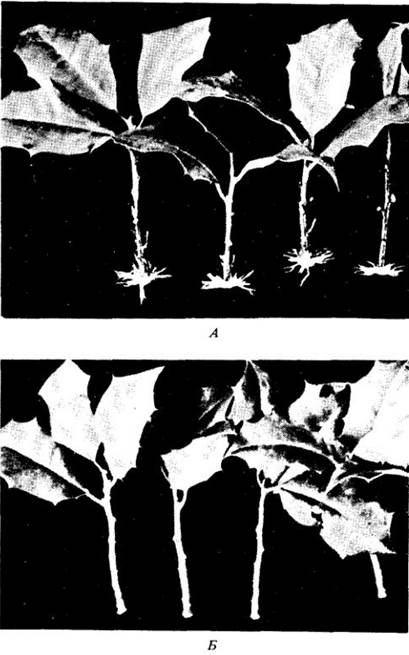
The first Practical Application of auxin was based on its ability to stimulate adventitious root formation in cuttings (Fig. 24-5). Treating cuttings with an auxin solution is particularly important for propagating woody plants in nurseries, as it allows them to be reproduced vegetatively on a large scale. However, applying high doses of auxin to already growing roots typically inhibits their further growth.
Fig. 24-5. Holly (A) cuttings treated with auxin 21 days before the photograph was taken. B. Untreated cuttings. Note the appearance of adventitious roots in the treated plants
Auxin and Fruit Growth
Auxin accelerates fruit growth. Typically, if a flower is unpollinated and Fertilization does not occur, the fruit fails to develop. In some plants, the fertilization of a single ovule is sufficient for normal fruit development; in others with multi-seeded fruits, such as apples or melons, fertilization of multiple ovules is necessary for the Ovary wall to develop and become fleshy. By treating the female parts of certain flowers with auxin, one can achieve parthenocarpic fruit production (from the Greek parthenos, meaning "virgin"), i.e., fruit that develops without fertilization, such as seedless tomatoes, cucumbers, and eggplants.
Additionally, auxin is present in developing seeds. In the garden strawberry (Fragaria ananassa), the seeds are located within achenes embedded in an enlarged receptacle, which is mistakenly referred to as the fruit. If the achenes are removed from the receptacle during its development, the receptacle stops growing. If a narrow ring of achenes is removed, the receptacle enlarges only in the area where the remaining achenes are attached. When an achene-free receptacle is treated with auxin, growth proceeds normally (Fig. 24-6).
Fig. 24-6. A. Normally developed strawberry "fruit" (Fragaria ananassa). B. All achenes removed. C. Three horizontal rows of achenes left intact. D. A single achene left intact. E. All achenes removed except three. If an auxin-containing paste is applied to the receptacle with its achenes removed, it will develop into a normal "fruit"

Auxin and Plant Organ Abscission
Auxin is produced in young leaves, but it does not appear to have a direct effect on The rate of leaf growth. Nevertheless, auxin influences abscission—the shedding of leaves or other plant parts. As leaves age, certain reusable ions and molecules, such as magnesium ions, Amino Acids (protein breakdown products), and sugars (starch Hydrolysis products), are transported back into the stem. Subsequently, at least in some plants, enzymes break down The Cell walls of the abscission zone at the base of the petiole (see Fig. 22-32). This involves the dissolution of the middle lamellae and the hydrolysis of Cellulose fibers. Cell divisions may precede leaf Separation; if they occur, the newly formed cell walls generally undergo degradation. Beneath the abscission layer, a protective layer consisting of healthy suberized cells forms, which isolates the leaf from the rest of the plant prior to shedding. Eventually, the leaf is held to the plant by only a few strands of vascular tissue, which may break as the parenchymal cells of the abscission zone expand. Along with other factors, abscission correlates with a decrease in the leaf's auxin content, and in many cases, it can be prevented by applying auxin.
The ability to regulate the abscission of leaves, flowers, and fruits is of great importance in agriculture. Auxin, and more recently Ethylene, are used to treat certain types of plants. For example, auxin prevents the dropping of leaves and berries in evergreen holly (Ilex aquifolium), thereby reducing transport losses. Auxin also prevents the premature drop of citrus fruits, resulting in higher yields of oranges and grapefruits. Conversely, high amounts of auxin induce increased ethylene production, which promotes fruit abscission. Consequently, auxin is used for fruit thinning in the cultivation of olives, apples, and other fruit trees.
Auxin and Weed Control
Synthetic auxins are widely used in agriculture for weed control. Economically, this remains the primary practical APPLICATION OF PLANT growth regulators worldwide today. Although A number of compounds are known, phenoxy auxins such as 2,4-D and its chemical derivatives account for roughly 20% of all compounds used for this purpose. The continued application of these substances depends on several factors, including their cost-effectiveness and potential or real risks to human health.
How Does Auxin Regulate Cell Elongation?
Auxin increases Cell wall plasticity. When The cell wall softens, the cell expands in size driven by turgor pressure. As turgor pressure decreases due to cell stretching, the cell absorbs more water and continues to enlarge until it encounters sufficient resistance from the cell wall (see Chapter 4).
Cell wall softening occurs as a result of complex interactions. One of the earliest manifestations of auxin action is A change in cellular metabolism that rapidly pumps protons out across The Plasma Membrane. The resulting acidification of the cell wall leads, through mechanisms not yet fully understood, to the hydrolysis of cross-links within the wall, thereby allowing cell elongation driven by turgor pressure. Testing this so-called "acid growth hypothesis" has led to significant progress in understanding auxin action. It is supported by diverse experimental evidence, including The Effect of auxin on proton efflux, acid solution-induced (pH 5.0 — 5.5) cell elongation (resembling the effect of auxin), and the inhibitory effect of neutral buffers (which prevent wall acidification) on auxin-induced cell elongation.
Although the "acid growth hypothesis" explains the initial phase of auxin-induced cell elongation, it cannot account for the hormone's longer-term effects on the plant. Indeed, most researchers now agree that There are two types of auxin action on cell elongation: a rapid, short-term effect driven by acid growth, and a second, prolonged effect associated with the Introduction/30.html">Regulation of Gene Expression. Specifically, auxin has been shown to induce the expression of at least 10 specific genes, presumably all of which are responsible for growth processes. Furthermore, auxin is known to affect Transcription. The influence of auxin on Gene Expression IN plants appears to be similar to the Action of Certain animal hormones.
The discovery of auxin stimulated the search for Other types of chemical substances that regulate plant growth because, by analogy with animals, it seemed unlikely that plant growth and development would be controlled by a single hormone alone. For instance, it was known that auxin inhibits the growth of lateral buds when applied to decapitated plants. Are there natural hormones that counteract the effects of auxin?
Folk Skoog and his colleagues at the University of Wisconsin developed a method for studying the Hormonal Regulation of Kidney growth in isolated Plant Tissues and organs cultured in test tubes. When a small piece of tobacco stem (Nicotiana tabacum) was placed on a culture medium containing sugar, Vitamins, and various salts, the cell divisions occurring on the cut surface led to the formation of an undifferentiated callus and occasionally to the formation of a shoot, i.e., a stem with leaves. The addition of a sufficient amount of auxin to the medium inhibited, as expected, the formation and growth of buds. On the other hand, adenine promoted bud formation in tissue culture and counteracted the inhibitory effect of auxin. The concentration of adenine required for bud formation was very high—too high, in fact, for adenine to be considered a hormone—which is why Skoog and his colleagues set out to search for substances with greater biological activity in experimental systems.
Initially, Skoog and his colleagues worked with coconut (Cocos nucifera), since van Overbeek and later F. Stewart with his research group had shown that coconut milk (which is a liquid endosperm) is a rich source of substances that promote tissue culture growth. After years of research, Skoog and his associates managed to achieve a thousandfold purification of the growth factor, but they were unable to isolate it. Changing the course of their research, the scientists then tested various purine-containing substances—primarily Nucleic Acids—hoping to discover new growth factors.
Pursuing this new path, Carlos O. Miller from Skoog's laboratory investigated samples of nucleic acids of known species specificity stored in the lab. He found that herring sperm DNA induced division in tobacco cells. New samples of herring sperm DNA were ordered, but to the researchers' astonishment, these fresh preparations did not work. Then, as a last resort, Miller turned to another old sample, and that one (!) proved to be active. Apparently, the factor found was merely a product of DNA degradation. Accordingly, the researchers concluded that various DNA preparations—old ones or those whose "Aging" was artificially induced by heating in an acidic solution—contained a cell division-inducing factor.
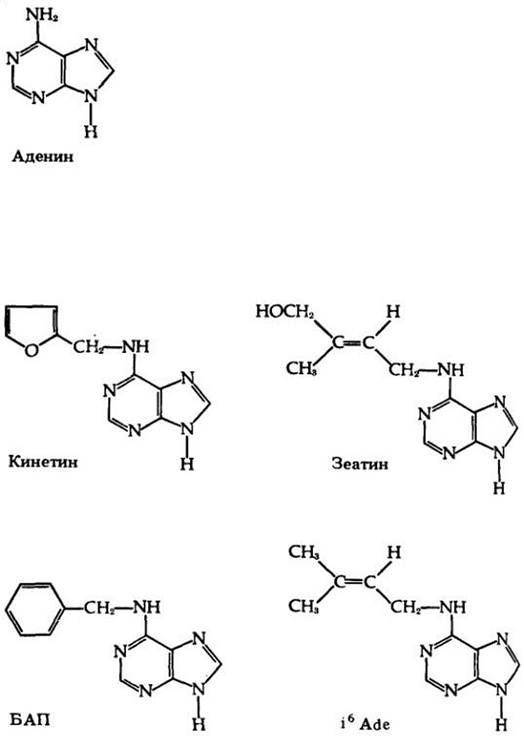
Miller, Skoog, and their coworkers finally succeeded in isolating the growth factor from a DNA preparation and determining its chemical nature. They named this substance kinetin and the class of growth regulators to which it belongs cytokinins, since they stimulate cytokinesis, i.e., cell division. As shown in Fig. 24-7, kinetin resembles the purine adenine, which can be considered its prototype. Kinetin, however, has not been found in plants and is not among the naturally occurring cytokinins. It has a relatively simple structure, and biochemists soon synthesized a number of Other Compounds with biological activities similar to those of cytokinins. Eventually, the first natural cytokinin was isolated from corn kernels (Zea mays) and named zeatin. It is considered the most active of the natural cytokinins; several even more active compounds have now been synthesized.
Fig. 24-7. Note the similarity between the purine adenine and these four cytokinins. Kinetin and 6-benzylaminopurine (BAP) are synthetic cytokinins commonly used in practice. Zeatin and i6Ade have been isolated from plants
Cytokinins have been isolated from many seed plants, where they are found primarily in actively dividing tissues, including seeds, fruits, and roots. These hormones are also found in sap—the fluid oozing from cut sites, breaks, and other wounds in many plants. Recently, cytokinins have been identified in two species of seedless plants: the horsetail Equisetum arvense and the fern Dryopteris crassirhizoma.
Although the practical application of cytokinins is not as widespread as that of auxins, they are of great importance for research into the regulation of plant development. Because the application of cytokinins is central to tissue culture experiments (see Appendix), they will undoubtedly play a very crucial role in future biotechnology. Treatment of lateral buds with cytokinin generally induces their growth even in the presence of auxin, thereby altering apical dominance.
Cytokinins and Cell Division
The Study of the interactions between auxins and cytokinins helps physiologists understand how plant hormones shape the characteristic structure of a given plant. Apparently, an undifferentiated plant cell can follow one of two paths: either it grows, divides, and grows and divides again, or it elongates without undergoing division. A cell that divides repeatedly remains essentially undifferentiated, or embryonic, whereas an elongating cell differentiates and becomes specialized. The addition of IAA to tobacco stem tissue culture caused rapid elongation and the formation of giant cells. The addition of kinetin alone produced little or no effect. IAA combined with kinetin promoted rapid division and the appearance of A large number of relatively small, undifferentiated cells. In other words, adding kinetin along with IAA (but not kinetin alone) switched the cells to a pathway of meristematic activity.
In another study using globe artichoke (Helianthus tuberosus) tissue culture, it was shown that Calcium Ions can influence the combined action of auxin and cytokinin. The combined application of IAA and low concentrations of kinetin promoted an increase in cell size, whereas the addition of Ca2+ to the culture medium caused a steady shift in growth processes from cell elongation to cell division. High concentrations of calcium inhibit cell wall stretching, causing the cell to change its developmental direction and divide. Thus, not only do hormones influence each other's activity, but non-hormonal factors such as calcium can also become involved in these complex interactions.
Cytokinins and Organ Formation in Tissue Cultures
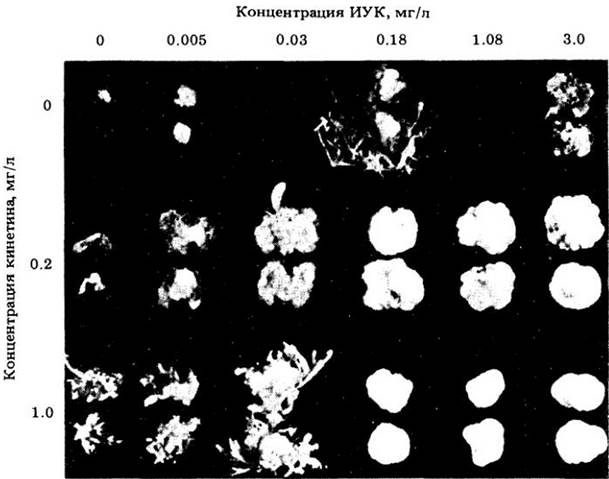
A high concentration of auxin promotes root formation in callus tissue. In tobacco pith callus tissue, appropriate concentrations of auxin and kinetin induce the formation of roots or buds: a high auxin content results in root formation, a high kinetin concentration forms buds, and when both hormones are present in roughly equal amounts, the callus continues to produce undifferentiated cells (Fig. 24-8).
Fig. 24-8. Effect of increasing IAA concentration at various kinetin levels on growth and Organogenesis in tobacco callus cultured on nutrient agar. As can be seen, little growth occurs without the addition of IAA or kinetin. Higher IAA concentrations promote root development but inhibit bud formation (the latter effect is also observed when IAA is used in combination with kinetin). As the kinetin concentration increases, bud development is enhanced, but the concentrations shown are too high to support root growth
Cytokinins and Leaf Senescence
In most species, leaves begin to yellow as soon as they are removed from the plant. This yellowing, associated with the loss of chlorophyll, can be prevented by treatment with cytokinins. If, for example, excised cocklebur (Xanthium strumarium) leaves are placed in pure water, they turn yellow in about 10 days. If kinetin (10 mg/L) is present in the water, chlorophyll is not degraded, and the leaf retains a fresh appearance. If a solution containing kinetin is applied in spots to excised leaves, those spots remain green while the rest of the leaf yellows. Moreover, if such a leaf contains 14C-labeled radioactive amino acids, one can observe that the amino acids migrate from other PARTS OF THE leaf into the zones treated with cytokinin. Such studies, conducted on radishes and other plants, led to the hypothesis that the senescence of leaves and possibly other plant parts occurs due to the gradual "switching off" of individual genes followed by the loss of the capacity to synthesize mRNA and protein. It has been suggested that cytokinins prevent this gene silencing and thereby promote the continued synthesis of enzymes and The production of compounds such as chlorophyll.
One explanation for how cytokinin prevents the senescence of individual leaves is that leaves do not normally synthesize enough kinetin to meet their own requirements. Thus, it remains unclear in which parts of the plant cytokinin is produced: most likely in the root or in the region of rapid cell elongation just below the shoot apex. Developing fruit is also known to become a site of cytokinin production, at least during the earliest stages of growth.
How Do Cytokinins Work?
Since the Isolation of the first cytokinins from nucleic acid preparations, plant physiologists have hypothesized that these hormones might somehow act in concert with nucleic acids. Transfer RNA (tRNA) molecules contain a number of unusual bases (see Fig. 8-8). In some cases, the natural cytokinin i6Ade (6N-isopentenyladenine), which is an unusual base, is incorporated into tRNA molecules. For example, i6Ade has been found in Serine and Tyrosine tRNA molecules near the anticodon. However, it remains unknown whether its presence and position in the tRNA molecule are related to The stimulation of cell division. It is known that the ultimate action of cytokinin brings about a change in gene expression, possibly at the transcriptional level of control.
Ethylene
The discovery of auxin led, more or less directly within a few years, to the isolation of kinetin and the elucidation of the effects of cytokinins on plant growth and development. On the other hand, the effect of ethylene on plants was known long before its connection to auxin was discovered and, consequently, long before it was considered a plant hormone.
The "botanical" history of ethylene, a simple hydrocarbon (H2C=CH2), dates back to the 19th century when city streets were lit by lamps burning coal gas. German scientists noticed that gas leaks from pipelines caused leaf drop in trees growing along the shady sides of city streets. As gas came to be used more extensively for street lighting, researchers in many other countries reported the same phenomenon.
In 1901, Dmitry Neljubov, a graduate student at the Botanical Institute of the St. Petersburg University, showed that the active component of coal gas is ethylene. Neljubov observed that when pea seedlings were exposed to coal gas, they began to grow horizontally. Of all the components of coal gas, only ethylene produced this effect, and it was active at air concentrations as low as 0.06 ppm. Neljubov's Conclusions were confirmed by other researchers, and it is now known that ethylene exerts a major influence on many, if not all, plant growth, developmental, and senescence processes.
Although ethylene is a gas under physiological conditions of temperature and pressure, it is soluble to some extent in the Cytoplasm. Ethylene is considered a plant hormone, first, because it is a natural metabolic product, and second, because it interacts with other plant hormones at trace concentrations. In particular, the action of ethylene can be observed during critical periods in a plant's life cycle, such as fruit ripening, fruit and leaf abscission, and senescence.
Today, ethylene is the easiest plant hormone to identify. Because it is a gas released directly by plant tissues, its analysis requires no extraction or gas chromatographic purification. Ethylene biosynthesis begins with a reaction between the amino acid Methionine and ATP, yielding S-adenosylmethionine, or SAM for short (Fig. 24-9). SAM is then cleaved into two compounds, one of which contains a three-carbon ring and is known as 1-aminocyclopropane-1-carboxylic acid (ACC). Subsequently, ACC is converted into ethylene, CO2, and ammonia through the action of tonoplast enzymes. This ACC-forming reaction appears to be significantly upregulated by high auxin concentrations, air pollution, and mechanical wounding.
Fig. 24-9. Methionine serves as the precursor for ethylene synthesis in all higher plant tissues. 1-Aminocyclopropane-1-carboxylic acid is the immediate precursor of ethylene. The pathway of ethylene biosynthesis is illustrated.

Ethylene and Fruit Ripening
As a fruit ripens, a series of physiological changes takes place. In fleshy fruits, chlorophyll breaks down, revealing other pigments that alter the fruit's color. At the same time, the flesh softens. These changes result from the enzymatic degradation of pectin, the primary component of the cell wall middle lamella. Once the middle lamella softens, cells can shift relative to one another. Concurrently, starches, organic acids, or—in the case of avocados (Persea americana)—oils are converted into sugars. These modifications make fruits conspicuous and palatable, attracting animals that consume them and thereby disperse their seeds.
During the ripening of many fruits, such as tomatoes, avocados, apples, and pears, cellular Respiration surges, accompanied by a sharp increase in oxygen uptake. This phase is termed the Climacteric, and such fruits are classified as climacteric fruits. (Fruits that exhibit a steady, gradual decline in respiration during ripening, such as citrus fruits, grapes, and strawberries, are called non-climacteric fruits.) Although the exact link between the climacteric rise and other ripening processes remains unclear, fruit maturation can be delayed by suppressing this respiratory burst. For example, cold temperatures inhibit respiration, preventing the climacteric rise in certain cold-stored fruits. Fruits can also be stored successfully for extended periods in a vacuum. Under such conditions, minimal oxygen availability suppresses cellular respiration, keeping ethylene levels—which otherwise trigger the climacteric rise—exceptionally low. Following the climacteric phase, senescence sets in, rendering the fruit highly susceptible to Fungi and other microorganisms.
In the early 1900s, many horticulturists practiced "curing" citrus fruits in rooms heated by kerosene stoves to improve their color and sugar content. (Long before this, the Chinese accelerated fruit ripening by fumigating them with incense.) It was initially assumed that the stove's heat promoted ripening. However, ambitious growers who installed more modern heating equipment were dismayed to find that this was not the case. Subsequent experiments revealed that the active agents were actually incomplete combustion products of kerosene, with ethylene being the most potent among them. Even minute atmospheric concentrations of ethylene, as low as 1 ppm (1 part in 106), accelerated the onset of the climacteric respiratory rise.
As early as 1910, it was reported that gases emitted by oranges accelerated the ripening of bananas; however, it took another 25 years to identify ethylene as a natural product synthesized by many fruits and plant tissues. Because the amounts of ethylene produced by plants are minuscule, researchers had to develop novel, highly sensitive techniques to demonstrate that ethylene production begins even before the climacteric rise, peaking during that respiratory surge. Since then, ethylene has been recognized as a natural plant growth regulator. It has been detected in the fruits (across all studied types), flowers, leaves, leafy stems, and roots of numerous plant species, as well as in certain fungi.
The effects of ethylene on fruit ripening have important practical applications. Most notably, it is used to accelerate the ripening of tomatoes that have been harvested green, stored ethylene-free, and treated with the hormone just prior to marketing. Ethylene is also employed to hasten the ripening of nuts and grapes.
Ethylene and Plant Organ Abscission
Ethylene promotes the abscission of leaves, flowers, and fruits in various plants. In leaves, ethylene likely activates enzymes that degrade cell walls in the abscission zone. In agriculture, ethylene treatments are used to facilitate the loosening of cherries, blackberries, grapes, and blueberries, thereby enabling efficient mechanical harvesting. It is also utilized for fruit thinning in large peach and plum orchards.
Ethylene and Floral Sex Determination
Ethylene appears to play a major role in determining floral sex in monoecious plants (those bearing separate male and female flowers on the same individual). For instance, in members of the squash family (Cucurbitaceae), high levels of gibberellins promote the formation of male flowers, whereas ethylene treatment induces female flowers. Research on cucumbers (Cucumis sativus) showed that female flower buds produce significantly more ethylene than male buds. Furthermore, cucumbers grown under short-day conditions—which favor female flower production—release more ethylene than those grown under long-day conditions. Consequently, in cucurbits, ethylene appears to participate in sex determination by increasing the proportion of female flowers.
Ethylene and Auxin
In a number of plant species, auxin at specific concentrations stimulates ethylene production. It is now believed that many physiological responses in fruits and flowers traditionally attributed solely to auxin are actually mediated by auxin-induced ethylene synthesis.
Cell shape and dimensions are regulated, in part, by the concerted action of auxin and ethylene, which influence cell elongation in opposing ways. For example, in garden peas (Pisum sativum), concentrations of IAA that promote the deposition of transversely oriented cell wall microfibrils lead to stem elongation while inhibiting radial expansion. Conversely, higher concentrations of IAA, which trigger enhanced ethylene synthesis and result in longitudinally oriented microfibrils, promote radial growth and stem thickening.
It is important to understand that the final shape and size of cells exposed to ethylene are the result of its interaction not only with auxin, but also with gibberellic acid and cytokinins. Furthermore, normal growth and development rely on the coordinated interplay of multiple
hormones, including cytokinins, gibberellins, Abscisic acid, as well as auxin and ethylene.
Abscisic Acid
The survival of a plant sometimes depends on its ability to restrict its own growth or reproductive activity. Following the discovery of growth-stimulating hormones, plant physiologists hypothesized the existence of growth-inhibiting counterparts. Finally, in 1949, it was established that dormant buds of ash trees and potatoes contain high levels of growth inhibitors that block the action of IAA on oat coleoptiles. When bud dormancy was broken, the concentration of this inhibitor decreased. Such inhibitors came to be known as dormins.
During the 1960s, various researchers reported the isolation of abscission-accelerating substances from leaves and fruits. One of these, termed abscisin, was chemically identified. In 1965, the Chemical Structure of one of the dormins was elucidated, proving to be identical to abscisin. This compound was subsequently named abscisic acid.
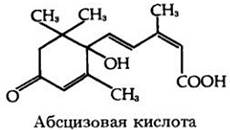
Abscisic acid (ABA) has been extracted primarily from the basal regions of fruit Ovaries, with cotton bolls (Gossypium) proving to be an exceptionally rich source. The highest concentrations of abscisic acid are typically found around the time of fruit abscission. Additionally, abscisic acid produced in the central parenchyma cells of the root cap plays a key role in the root gravitropic response (see p. 117).
Treating opening buds with abscisic acid converts them into winter buds, during which leaf primordia develop into protective bud scales. The inhibitory effect of ABA on buds can be overcome by applying gibberellin. The appearance of alpha-amylase—an enzyme induced by gibberellin in barley seeds (Hordeum vulgare)—is delayed by abscisic acid, which appears to suppress Protein Synthesis generally. Conversely, auxin appears to interact with the plasma membrane while simultaneously stimulating the Synthesis of specific Proteins. Thus, in its physiological effects, auxin acts as an antagonist to abscisic acid.
If a drop of abscisic acid is applied to a leaf, the treated area rapidly turns yellow while the rest of the leaf remains green. (Cytokinins, as we know, produce the opposite effect.) It remains unclear whether this response involves a direct or indirect action of the hormone.
Currently, abscisic acid has no practical applications, perhaps because its physiology and biochemistry remain insufficiently studied. In the future, it may become critically important for agriculture in arid regions. There is reason to believe that the resistance of certain plants to stress conditions, such as drought, is directly related to their ability to produce abscisic acid. Furthermore, abscisic acid is known to induce stomatal closure in certain plants, thereby preventing leaf water loss and reducing the plant's overall water requirement. If geneticists succeed in introducing the genes responsible for abscisic acid synthesis into the genotype of desired crops, it will become possible to breed new agricultural varieties adapted for growth in arid regions.
Gibberellins
Unlike Other Hormones, the discovery of gibberellins is unrelated to the discovery of auxin. Indeed, their investigation began completely independently of work on auxin.
In 1926—the same year Went performed his pioneering experiments with agar blocks—Kurosawa was studying a rice disease (Oryza sativa) in Japan known as "bakanae" (foolish seedling disease), in which plants grew rapidly, became spindly, pale, weak, and ultimately lodged. Kurosawa demonstrated that the disease is caused by a chemical substance secreted by the fungus Gibberella fujikuroi, which parasitizes rice seedlings. Based on the generic name of this fungus, the chemical substance was named gibberellin.
Gibberellin was isolated and chemically identified by Japanese biochemists in the 1930s, yet it attracted little attention for several decades. Then, in 1956, gibberellin was successfully extracted not only from the fungus but also from a plant (seeds of Phaseolus vulgaris). Following this, gibberellins were purified from numerous plant species and are now believed to be present in all plants. Gibberellins occur in all parts of the plant in varying concentrations, with their highest concentration found in immature seeds. To date, over 65 gibberellins have been isolated and identified. They differ little in structure (Fig. 24-10) and biological activity. The best-studied is gibberellic acid (GA3), which is produced by the fungus Gibberella fujikuroi.
Fig. 24-10. Three naturally occurring gibberellins (more than 65 are now known). Gibberellic acid (GA3) is found in significant concentrations in fungi and exhibits the highest biological activity in many experiments. Arrows indicate minor structural differences between the gibberellins GA7 and GA4

In intact plants, gibberellins exert a profound effect on stem elongation. A marked enhancement of shoot growth is the most general response observed in higher plants; stems frequently become long and thin, and leaves pale. Gibberellins stimulate both cell division and cell elongation, affecting both leaves and stems.
Gibberellins and Dwarf Mutants
The action of gibberellins is most clearly manifested when applied to single-gene dwarf mutants (Fig. 24-11). As a result, such plants become indistinguishable from normal, tall, non-mutant plants. In maize, for instance, four types of dwarf mutants have been identified, each impaired in specific stages of gibberellin biosynthesis. Currently, biochemical studies of hormones in these mutant plants have led to a very important Conclusion. Although maize plants contain nine different compounds that correspond in their action to gibberellins (i.e., eliciting growth responses), only the end product of this metabolic pathway can exert a direct effect. The other eight gibberellins must undergo further steps of biochemical conversion before they can trigger a growth response.
Fig. 24-11. The plant shown on the right was treated with gibberellin; the plant on the left served as a control. The experiment was conducted on dwarf mutants of the common bean (Phaseolus vulgaris)

Gibberellins and Seeds
Seeds of most plants remain dormant prior to germination. In some species, dormancy is broken by cold or light. For many species, including lettuce, tobacco, and wild oats, gibberellins can substitute for the cold or light required to break dormancy, thereby promoting embryo growth and seedling emergence. Characteristically, gibberellins stimulate cell elongation and thus facilitate root penetration through the growth-inhibiting seed coat or fruit wall. This action of gibberellin has at least one practical application: gibberellic acid accelerates seed germination and thereby ensures uniformity of the raw material used in barley malting for the brewing industry.
Gibberellins and Juvenility
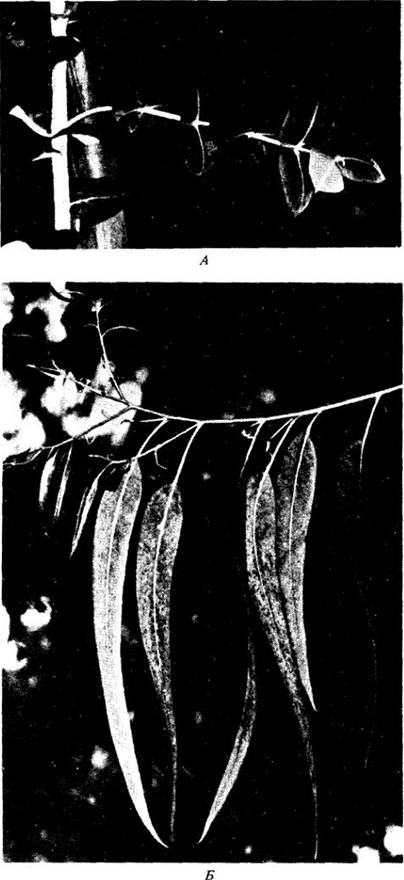
The juvenile stages of certain plants sometimes differ from adult forms in leaf shape. Among annual dicots, the bean (Phaseolus), in which young leaves are simple and older leaves are compound (trifoliate), provides a classic example of heterophily (see Fig. 19-2). Among perennials, many eucalyptus species (Eucalyptus) display striking differences between young and mature foliage (Fig. 24-12).
Fig. 24-12. Young (A) and mature (B) leaves of Eucalyptus globulus, illustrating the major differences found in this species. Juvenile leaves are more succulent and arranged oppositely. A single layer of palisade parenchyma lies beneath the upper epidermis. Mature leaves are rigid, arranged spirally, and hang downward. Both of their surfaces are exposed to light, and consequently, palisade parenchyma is located on both sides of the leaf blade
Ivy (Hedera helix), a perennial vine, represents another well-studied example. If adult ivy plants are climbing a house wall, compare their upper branches with the lower ones. The leaf shape and branch behavior will differ. Young branches root readily, whereas adult branches do not. Adult branches flower; juvenile ones do not. If the apical meristem of an adult branch is excised, axillary buds form and develop into new adult branches. However, if such a bud is treated with gibberellin, it develops into a typical juvenile branch.
Gibberellins and Flowering
Certain plants, such as cabbage (Brassica oleracea var. capitata), carrot (Daucus carota), and biennial henbane (Hyoscyamus niger), form rosettes prior to flowering. (Leaves develop within the rosette, but internodes do not elongate.) Flowering in such plants can be induced by exposing them to long-day conditions or cold treatment (as in biennials); these two factors can also be combined. Following adequate exposure, stems elongate—a phenomenon known as bolting—and the plant begins to flower. The application of gibberellin induces bolting and flowering without the requisite cold treatment or long-day exposure (Fig. 24-13). Stem growth is achieved through an increase in cell division frequency and the elongation of cells produced by these divisions. Thus, gibberellin can be used to rapidly obtain seeds from biennial plants. By treating crops such as cabbage with gibberellic acid, seeds can be produced in just a single growing season.
Fig. 24-13. Stem bolting in cabbage (Brassica oleracea var. capitata) induced by gibberellin treatment. The plant on the right was treated once a week for eight weeks

Gibberellins, Pollen, and Fruit Development
As has been demonstrated, gibberellins stimulate pollen germination and pollen tube growth in a number of plants, including lily, lobelia, petunia, and pea. Similar to auxin,
Gibberellins can induce the formation of parthenocarpic fruits in apples, currants, cucumbers, and eggplants. In citrus and peach trees, as well as almonds, gibberellins can accelerate fruit development in cases where auxin fails to do so. However, gibberellins are primarily used in table grape cultivation. In the USA, large quantities of gibberellic acid are consumed annually in the cultivation of grape varieties (Vitis vinifera) such as Thompson Seedless. This treatment results in larger berries and looser grape clusters (Fig. 24-14).
Fig. 24-14. Effect of gibberellic acid on the growth of Thompson Seedless grapes. A. Untreated cluster, remaining thin and compact. B. Cluster treated with gibberellic acid, which has become loose.

How do gibberellins work?
The most important studies on The Mechanism of gibberellin action were conducted simultaneously by scientists in Japan, Australia, and the USA. Detailed examination of The sequence of processes occurring during barley seed germination and early embryo development revealed the pivotal role that gibberellins play in this chain of events. Furthermore, these studies provided an exceptional demonstration of how hormones "bridge" the biochemistry and physiology of various plant tissues.
In the seeds of barley (Hordeum vulgare) and other cereals, There is a specialized endosperm cell layer known as the aleurone layer (see Fig. 19-4), located beneath the seed coat. The cells of the aleurone layer are rich in protein. When imbibed seeds begin to germinate, the embryo secretes gibberellins. In response, the cells of the aleurone layer synthesize hydrolytic enzymes, chief among which is alpha-amylase, which converts starch into sugars (Fig. 24-15). These enzymes break down the endosperm's stored nutrients into sugars and amino acids, which are absorbed by the scutellum and then transported to the growing parts of the embryo (Fig. 24-16). Thus, the embryo receives the substances necessary for growth precisely when they are needed.
Fig. 24-15. Treatment with gibberellin (GA3) promotes the release of sugar from the endosperm only in the presence of the aleurone layer. Indeed, the aleurone layer is the source of alpha-amylase, which breaks down the stored starch of the endosperm.

Fig. 24-16. Effect of gibberellin in barley seeds. A. Gibberellic acid (GA) produced in the embryo migrates to the aleurone layer, stimulating the synthesis of hydrolytic enzymes. These enzymes break down the stored endosperm starch into soluble, diffusible sugars and amino acids. These sugars and Amino acids are then absorbed by the scutellum (cotyledon) and transported to the shoot and root, promoting their growth. B. Each of these three seeds was cut in half and the embryo removed. 48 hours prior to photographing, the upper seed on the left was treated with plain water. The middle seed was treated with a gibberellin solution at a concentration of 1 ppb-1, and the bottom right seed was treated with gibberellin at a rate of 100 ppb-1. The breakdown of stored starch in the treated seeds is clearly visible.

Researchers believe that gibberellins activate certain genes that direct the synthesis of specific mRNA and enzymes. However, it has not yet been proven that gibberellins act directly on genes, although the synthesis of both RNA and enzymes has been noted. Regardless of the fine details of the mechanism of gibberellin action in aleurone cells, it is clear that they form a highly differentiated tissue adapted to meet (mediated by gibberellins) the demands of the growing embryo. It remains unknown whether the mechanism of gibberellin action is the same in seeds and other parts of the plant.
Conclusion
Hormones are vital chemical regulators of animal and plant growth that are produced in certain Tissues of the organism and transported to others, where they exert their physiological effects. Hormones are biologically active in extremely small quantities.
The natural hormone auxin is produced in the apical Meristems of shoots and the tips of coleoptiles. Auxin moves exclusively toward the base of the plant, where it regulates shoot and coleoptile elongation, promoting primarily cell expansion. Research shows that its effect on cell expansion is achieved indirectly by loosening the bonds of the cell wall cellulose fibrils, thereby allowing the cell to stretch. Auxin also plays a role in the differentiation of vascular tissues and induces cambial cell division. It inhibits lateral buds, thereby maintaining apical dominance. The same concentration of auxin that promotes stem growth inhibits primary root system growth. Auxin accelerates adventitious root formation in cuttings and delays the abscission of leaves, flowers, and fruits. In fruits, auxin secreted by seeds or pollen tubes stimulates ovary wall growth. It is hypothesized that its ability to exert such diverse effects depends on the varying sensitivity of target tissues to it.
Cytokinins, belonging to the second class of growth hormones, were discovered through their ability to accelerate cell division and bud formation in plant tissue culture. Structurally, they are similar to certain Components of nucleic acids. Cytokinins can act synergistically with auxins to induce cell division in vitro. In tobacco pith cell cultures, a high concentration of auxin promotes root formation, whereas a high concentration of cytokinin promotes bud formation. In intact plants, cytokinins promote lateral bud growth, acting as auxin antagonists. Cytokinins prevent leaf senescence by stimulating protein synthesis.
Ethylene is a gas produced as a byproduct of incomplete hydrocarbon combustion. At the same time, it is classified among natural growth regulators and triggers a series of distinct physiological responses, such as fruit ripening and plant organ abscission.
Abscisic acid, found in dormant buds and fruits, is a growth-inhibiting hormone. In a number of experiments, abscisic acid elicits effects opposite to those of all three growth-stimulating hormones.
Table 24-1. Plant Hormones (Phytohormones) and Their Actions
Name Auxin |
Chemical Nature Indole-3-acetic acid, phenylacetic acid |
Physiological Action and Role Apical dominance, gravitropism and phototropism, vascular tissue differentiation; inhibits abscission, stimulates ethylene synthesis, suppresses or stimulates (in pineapples) flowering, stimulates fruit development (parthenocarpic fruits), induces root formation on cuttings |
Cytokinin |
N6-adenine derivatives, phenylurea compounds |
Apical dominance, shoot growth, fruit development; delays leaf senescence |
Ethylene |
СН2 = СН2 |
Fruit ripening (especially climacteric fruits such as apples, bananas, avocados), leaf and flower senescence, plant organ abscission |
Gibberellin |
Gibberellic acid (GA3), GA1 |
Stimulation of flowering in long-day plants and biennials, shoot elongation; regulates enzyme synthesis in cereal seeds |
Abscisic acid |
ABA |
Stomatal closure; possibly required for plant organ abscission and maintenance of dormancy in certain species |
Gibberellins were first isolated from parasitic fungi that disrupt the normal growth of rice seedlings. Subsequently, they were found to be natural growth hormones in many plants. Treatment of dwarf plant mutants with gibberellins restores their normal growth, and in rosette plants, it induces bolting. Gibberellins stimulate cereal seed germination. In barley seeds, the embryo releases gibberellins, which promote the synthesis of several enzymes in the endosperm aleurone cells, including alpha-amylase, which converts starch into sugars. The sugar is utilized by the embryo and promotes seed germination.
The action of plant hormones largely depends on The properties of target tissues and their surrounding chemical environment. The major plant hormones and the physiological processes they control are summarized in Table 24-1.
Appendix. Plant Hormones, Tissue Culture, and Biotechnology
Advances in hormone research and DNA biochemistry have made genetic manipulation of plants possible. The term biotechnology is used to describe the practical Implementation of this capability. Among the most important biotechnological Methods is tissue culture, which has become feasible only thanks to currently developed concepts regarding growth-regulating hormones. In ideal cases, tissue culture is used to regenerate whole plants from single, genetically modified cells. Furthermore, tissue culture can be used to produce numerous identical copies (clones) of plants in a short period of time.
Currently, tissue culture is widely used for plant propagation via cloning, as the resulting individuals are genetically identical. Presently, tissue culture mainly employs three different propagation methods, each boasting its own achievements in developmental control, which can be modulated using plant hormones.
1. Regeneration from callus and/or protoplasts. Plants that can be propagated using this method are particularly valuable for biotechnology. Based on research conducted by Skoog and his coworkers, this technique involves The Use of cytokinins to induce shoot formation from an unorganized mass of parenchymal cells called a callus. The shoots are then treated with auxin to induce root formation, after which the developing plants can be transferred to soil. Regeneration from callus was first achieved in tobacco and subsequently in other members of the Solanaceae family, such as potatoes and petunias. Although some plants from other families (e.g., sunflowers, snapdragons, and mustard) can also be regenerated from callus, this method is not widely applicable.
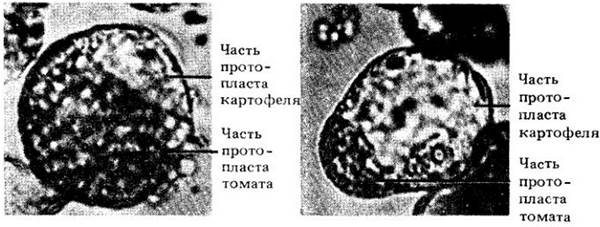
Fusable tomato and potato protoplasts. The tomato portion of the protoplast can be identified by the green Chloroplasts present in isolated tomato mesophyll protoplasts, whereas the potato portion is colorless because isolated potato protoplasts contain only proplastids. (Experiments by G. Melchers, M. D. Sacristán, and A. A. Holder. Professor Melchers is at the Max Planck Institute for Biology, Tübingen, FRG.)
Theoretically, any plant cell—provided it is not devoid of a nucleus or enclosed in a rigid, lignified wall—is potentially capable of developing into the organism from which it originated, a property known as totipotency. Groups of similar cells form tissues; tissues and tissue systems form
organs which, arranged in a specific spatial configuration, build up the organism. Plants can be regenerated in vitro through various pathways: from organ explants (root tips and shoot apices, lateral and adventitious buds, leaf primordia, developing embryos, bud scales, etc.); tissue explants (pith, cortex, epidermis, phloem, nucellus); cells (parenchyma, collenchyma, mono- or binucleate pollen grains); and protoplasts. The diagram presented here illustrates several pathways by which whole Plant Regeneration can be achieved

Currently, the most sophisticated application of tissue culture in biotechnology involves the regeneration of plants from protoplasts—cells whose cell walls have been enzymatically removed. Two approaches for utilizing protoplasts in plant genetics have been developed. The first involves the fusion of protoplasts from two different plants to form hybrid cells. This technique was first used to produce a tobacco hybrid, followed by interspecific hybrids of petunia, carrot, and potato, as well as intergeneric hybrids of potato and tomato—all members of the Solanaceae family.
The second approach employs the Ti Plasmids of crown galls induced by Agrobacterium tumefaciens, or some other DNA injection method, to introduce specific genes into protoplasts. Tissue culture is subsequently used to regenerate plants from individual protoplasts. This branch of Genetic Engineering has already been applied to produce herbicide-resistant tobacco and sunflower plants (see Ch. 30).
2. Somatic Embryogenesis. In an experiment conducted by F. C. Steward of Cornell University, tissue culture was utilized to produce carrot embryos from single root cells. This Procedure, termed somatic embryogenesis because the embryo develops from vegetative (i.e., somatic) cells, demonstrates the remarkable totipotency of plant cells. Totipotency is the inherent ability of a single cell to execute the genetic program required for the development of an entire organism. From this perspective, somatic embryogenesis offers great potential for the clonal propagation of plants and has already been successfully applied to corn, wheat, and sorghum.
3. Shoot propagation. This technique relies on the ability of cytokinins to promote shoot growth and counteract auxin in the regulation of apical dominance. Growing shoot tips are placed in a culture medium with a sufficiently high cytokinin concentration, not only to sustain shoot growth but also to stimulate the development of lateral buds in the leaf axils. In this way, a shoot can be propagated by culturing it in vitro for several weeks. Once transplanted, the individual shoots can be used for further propagation or rooted after treatment with auxin. Toshio Murashige of the University of California, Riverside, made particularly significant contributions to the development of this method. The technique is commonly used for the propagation of ferns, orchids, and woody plants of the families Ericaceae (the heath family, which includes rhododendrons, azaleas, and kalmias) and Rosaceae (the rose family, which includes apples, roses, and strawberries).
Last update: 07/08/2026
Editorial and Educational Adaptation: This material has been compiled based on the primary/original source text. The project team performed an editorial review, corrected technical inaccuracies, structured sections, and adapted the content for an educational format.
What was processed:
- elimination of formatting defects (OCR errors, structural breaks, corrupted characters);
- editorial organization of content;
- standardization of terminology in accordance with academic sources;
- verification of factual statements against the original source text.
All mentions of the author, publication year, and origin of the primary text have been preserved in accordance with the source.