Genetics - A. V. Sivolob 2008
Gene Expression
Protein Synthesis
Transfer RNA
tRNA molecules consist of 74–95 (most commonly 76) NUCLEOTIDES. Within the molecule, complementary double-stranded stems and hairpin loops form at the ends, following a pattern universal to all tRNAs (Fig. 2.3). The terminal segments of the chain merge into a double-stranded stem, with four nucleotides at the 3' end remaining unpaired. The 3'-terminal CCA triplet is standard for all tRNAs; The amino acid is covalently attached to the ribose of the terminal adenosine, which is why this region is called the acceptor stem.
Class="center">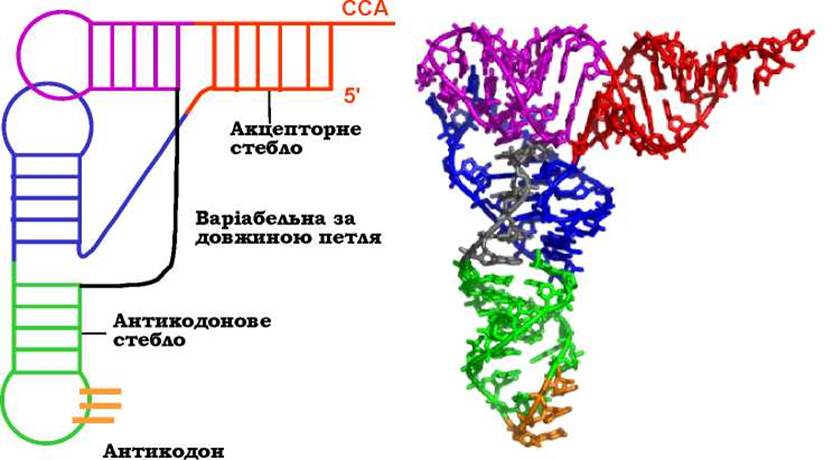
Fig. 2.3. Diagram and three-dimensional Structure of tRNA. Generated using PyMOL; structure code in the Protein Data Bank: 6TNA. Structural elements are color-coded identically on both the left and right panels.
Four double-stranded stems merge pairwise to form two Double helices oriented approximately perpendicularly to each other (Fig. 2.3). As a result, the tRNA molecule adopts an L- or inverted L-shape featuring two arms of different lengths: an amino acid is accepted at the end of one arm (the acceptor arm), while the anticodon is located at the end of the other—within the anticodon loop (the anticodon arm).
A specific type of tRNA corresponding to a particular amino acid is designated with a superscript index, such as tRNAAla. If the tRNA molecule carries an amino acid, this aminoyl-tRNA is denoted as Ala-tRNAAla. The general designation for aminoacylated tRNAs is aa-tRNA.
tRNA molecules are the products of METABOLISM/31.html">Transcription of corresponding genes, some of which are present in multiple copies—about 500 active tRNA genes in The Human Genome and 87 in the E. coli genome. The total number of tRNA types involved in Protein Synthesis is approximately 40 (for example, all human tRNA genes can be divided into 49 families based on their anticodon properties). Since there are more tRNA types than Amino Acids, a single amino acid can correspond to multiple tRNAs; such tRNAs are called isoaccepting tRNAs. Conversely, there are fewer tRNA types than codons, meaning a single tRNA can recognize several synonymous codons. This is achieved through wobble base pairing between the first position of the anticodon and the third position of the codon—the position where synonymous codons primarily differ (Fig. 2.1). Specifically, U and G can recognize two nucleotides each in the third codon position, whereas I (inosine—a non-canonical nitrogenous base frequently found in the first position of the anticodon) recognizes three nucleotides (Table 2.1).
Table 2.1. Correspondence between nucleotides in the first position of the anticodon and the third position of the codon
|
Anticodon |
Codon |
|
C |
G |
|
A |
U |
|
U |
A, G |
|
G |
U, C |
|
I |
U, C, A |
The order in which Amino acids are incorporated into the polypeptide chain during protein synthesis depends entirely on the nucleic acid interactions between the codon and the anticodon; the amino acid carried by the tRNA is not recognized by the ribosome in any way. Therefore, the charging of a specific amino acid by its corresponding tRNA molecule (and strictly the correct one) is one of the most critical steps in protein synthesis: the overall accuracy of protein synthesis directly depends on the precision of this aminoacylation process. The attachment of amino acids to tRNAs is catalyzed by Aminoacyl-tRNA synthetases (aaRSs). Each of the 20 types of these Enzymes (corresponding to the number of amino acids) Functions as a precision molecular device that ensures highly accurate amino acid charging of the appropriate tRNAs, with an average error rate of approximately 10-6.
Last update: 11/08/2026
Editorial and Educational Adaptation: This material has been compiled based on the primary/original source text. The project team performed an editorial review, corrected technical inaccuracies, structured sections, and adapted the content for an educational format.
What was processed:
- elimination of formatting defects (OCR errors, structural breaks, corrupted characters);
- editorial organization of content;
- standardization of terminology in accordance with academic sources;
- verification of factual statements against the original source text.
All mentions of the author, publication year, and origin of the primary text have been preserved in accordance with the source.