Biological Chemistry - Berezov T. T., Korovkin B. F. 1998
Protein Biosynthesis
Translation and general requirements for protein synthesis in a cell-free system
Aminoacyl-tRNA synthetases
It has been experimentally proven that all living Cells contain specific Enzymes that catalyze the activation of Amino Acids and their binding to specific tRNAs. All of these enzymes have been isolated in pure form from E. coli, sequenced, and their three-dimensional Structure has been determined for A number of them.
All of them were found to be sensitive to SH-group Reagents and require the presence of Mg2+ ions. The enzymes exhibit absolute reaction Specificity, as they recognize only one specific L-amino acid or one tRNA. For those amino acids for which two or more tRNAs have been discovered (see below), the corresponding aminoacyl-tRNA synthetase catalyzes the aminoacylation of all these tRNAs. This circumstance is extremely important, because later in Protein Synthesis, the "recognition" of aminoacyl-tRNA is based not on The Nature of The amino acid, but on the Chemical Nature of the tRNA anticodon. It is believed that the molecule of each aminoacyl-tRNA synthetase contains at least 3 binding sites: for the amino acid, tRNA, and ATP; the enzymes are also very sensitive to amino acid analogs, which inhibit the activation of the corresponding amino acids. Some enzymes consist of a single polypeptide chain, while others consist of two or four homologous or heterogeneous subunits.
Recently, aminoacyl-tRNA synthetases have been divided into 2 classes based on differences in their primary and tertiary structures, as well as the specific mechanism of the catalyzed reaction. The first Class includes enzymes that catalyze the synthesis of aminoacyl-tRNAs for the following amino acids: Arg, Val, Gln, Glu, Ile, Leu, Met, Tyr, Trp, Cys; the second class includes Ala, Asn, Asp, His, Gly, Lys, Pro, Ser, Thr, Phe. It has been found that class I enzymes transfer the aminoacyl group first to the 2'-OH group of the terminal adenylic acid residue, and then shift it to the 3'-OH group (via a transesterification reaction), whereas class II enzymes catalyze The transfer of the aminoacyl group directly to the 3'-OH group of the terminal adenylic nucleotide.
Aminoacyl-tRNA synthetases contain Histidine in their active center, the imidazole ring of which is involved in ATP binding via Mg2+ ions. As noted above, these enzymes have the highest affinity for specific tRNA molecules, although the precise mechanism by which the enzymes recognize the appropriate RNA remains unclear. At the same time, these enzymes are characterized by low molar activity (the turnover number does not exceed a few hundred catalytic acts per minute).

Fig. 14.3. Structure of tRNA.
a - general structure of various tRNAs; b - Spatial Structure of tRNA.
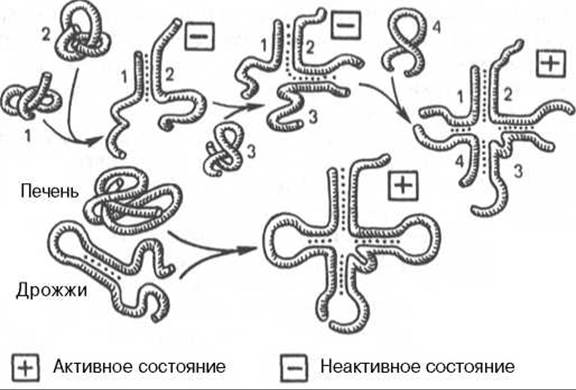
Fig. 14.4. Maturation of valine tRNA (according to A.A. Bayev). The numbers indicate fragments of the tRNA molecule.
Last update: 06/08/2026
Editorial and Educational Adaptation: This material has been compiled based on the primary/original source text. The project team performed an editorial review, corrected technical inaccuracies, structured sections, and adapted the content for an educational format.
What was processed:
- elimination of formatting defects (OCR errors, structural breaks, corrupted characters);
- editorial organization of content;
- standardization of terminology in accordance with academic sources;
- verification of factual statements against the original source text.
All mentions of the author, publication year, and origin of the primary text have been preserved in accordance with the source.