Plant Physiology - Musiyenko M.M. 2001
General principles of plant growth and morphogenesis regulation
Cytokinins
The discovery of cytokinins is closely linked to plant tissue culture research. Back in 1950–1955, it was observed that callus Cells in sterile culture stop dividing after a certain period of growth on a nutrient medium.
F. Skoog and C. Miller (University of Wisconsin, USA) attempted to induce division in mature tobacco pith cells in vitro. In intact plants, these cells increase in size but never divide. However, when coconut milk is added to the medium, they begin to
divide. Experimenting with various compounds, F. Skoog noticed that adenine in the presence of Auxins slightly stimulates Cell Division. Subsequent tests on Nucleic Acids, which contain adenine, revealed that adding DNA derivatives to the nutrient medium can restore cell division.
In 1956, an active principle (6-furfurylaminopurine) that induces cell division was isolated and named kinetin. Although kinetin has not been detected in plant Tissues, substances with similar biological activity turned out to be widespread in plants and were named cytokinins. This term has a physiological rather than a chemical meaning. A cytokinin is a substance that stimulates cell division in plant callus cultures growing on a nutrient medium containing essential organic and Mineral Substances along with exogenous auxin at an optimal concentration. It was not until 1963 that a cytokinin was first identified, isolated from unripe corn seeds and named zeatin. Later, Zachau (1966) and subsequently Skoog established that cytokinins are present in all types of tRNA. Cytokinins have been found in A wide variety of plant tissues, being particularly abundant in ROOT apices, xylem sap, germinating seeds, ripening fruits, and crown gall tumors caused by Agrobacterium tumefaciens infection. Cytokinin levels are also quite high in the root nodules of nitrogen-fixing organisms.
Similar substances have been found in various microorganisms, Algae, ferns, mosses, horsetails, and higher plants. Zeatin is considered the most active natural cytokinin, although even more active compounds have now been synthesized (Fig. 177).
Class="center">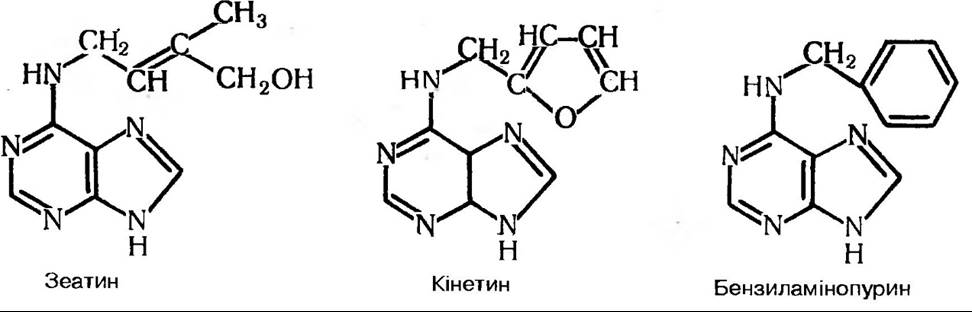
Fig. 177. Cytokinins
The pathway of zeatin Biosynthesis in the plant Organism is as follows:
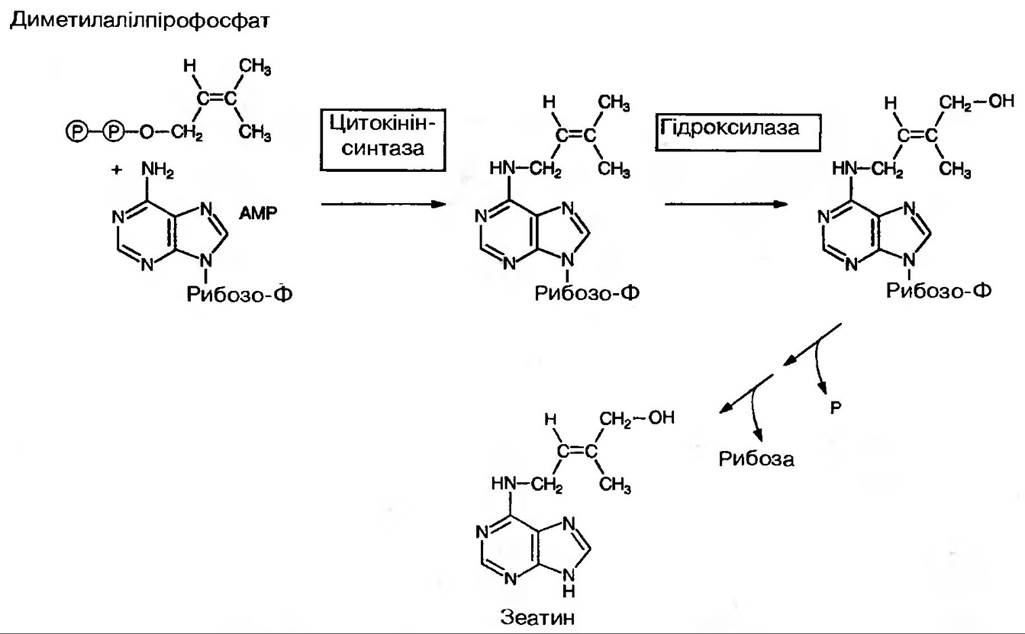
Unripe fruits, seeds, and Meristems are particularly rich in them. The primary site of synthesis is the apical root meristems. There is evidence that they are also synthesized in ripening fruits and seeds. Cytokinins present in tRNA are synthesized in all living plant cells, within such compartments as the Cytoplasm and METABOLISM/14.html">Chloroplasts, and possibly in Mitochondria. Cytokinins from the roots are most likely passively transported to above-ground Organs via the xylem. As for cytokinins synthesized in other PARTS OF THE plant, they may not be transported at all.
Like adenine, natural cytokinins occur in the form of ribonucleosides and ribonucleotides, which are likely precursors of free cytokinins. Bound cytokinins in the form of ribotides or ribosides serve as TRANSPORT AND STORAGE forms. Synthetic cytokinins such as kinetin and benzyladenine are widely used in scientific research because the higher The activity of a natural cytokinin, the more difficult it is to obtain.
The pathways of cytokinin synthesis remain largely understudied. Plant tissues are capable of breaking down cytokinins, leading to a loss of their activity. The enzyme that catalyzes this process has been isolated from corn seeds; it is active only in the presence of oxygen, and has therefore been given the general name cytokinin oxidase.
There are various bioassays for cytokinins based on:
·the ability of cytokinins to stimulate growth by cell elongation in isolated leaves or cotyledons, for example, in radishes;
·The stimulation of growth in aquatic plants, such as Lemna minor;
·the acceleration of growth in stem segments or coleoptiles;
·the ability of cytokinins to induce cell division in cell cultures;
·the specific property of cytokinins to delay leaf senescence processes;
·the ability of cytokinins to stimulate The biosynthesis of pigments, such as chlorophyll in cucumber cotyledons.
Physiological Action of Cytokinins
A variety of Physiological effects of cytokinins are known, but they can all be broadly divided into two groups:
·stimulation of cell division and differentiation,
·delay of senescence processes.
Cytokinins induce cell division, but strictly in the presence of auxins (Fig. 178).
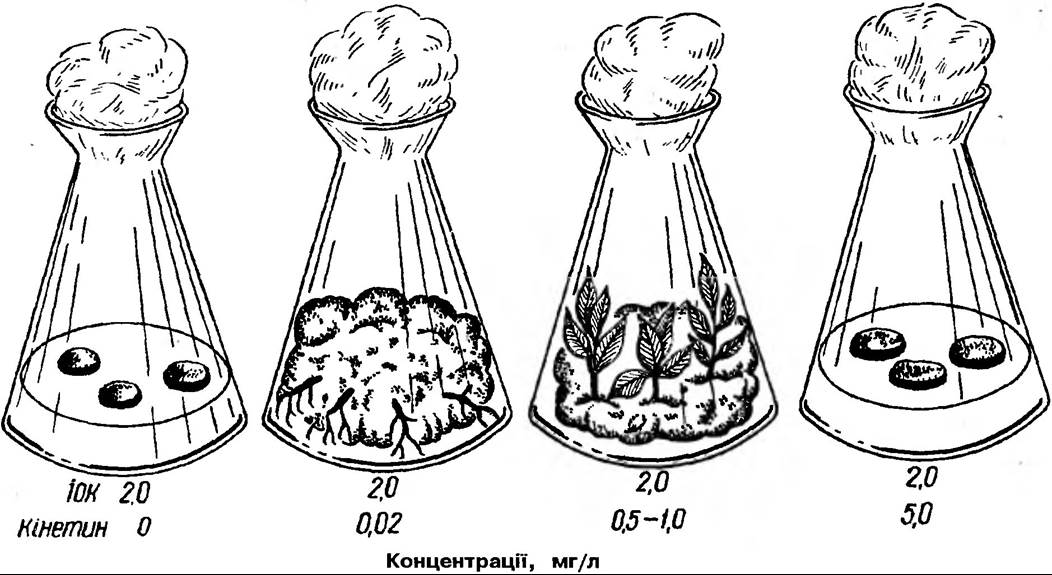
Fig. 178. Combined effect of IAA (2 mg/L) and kinetin on the growth and differentiation processes in tobacco stem pith callus
They act as specific mitotic stimulators. Cytokinins play a vital role in Cell Differentiation and Organogenesis in tissue culture. For instance, in tobacco pith callus tissue, appropriate concentrations of auxins and kinetin induce The formation of roots or shoots. High concentrations of auxin favor root formation, whereas high kinetin concentrations stimulate bud development. When both Hormones are supplied in equal amounts, the callus remains an undifferentiated mass of cells.
The foundation of cytokinin growth effects is primarily the acceleration of cell division, which is associated with enhanced DNA Synthesis. They induce bud formation, can overcome auxin-induced bud dormancy, and promote seed germination.
Cytokinins trigger a general stimulation of metabolism, notably the synthesis of RNA and Proteins. They delay senescence by helping to maintain steady levels of proteins and nucleic acids—likely by slowing down their degradation and preserving the integrity of cell membranes.
Similar to auxins, cytokinins exhibit an attractant effect, meaning they enhance the translocation of metabolites toward tissues enriched with these hormones.
Cytokinins prevent chlorophyll breakdown and structural degradation in excised leaves. They influence chloroplast ultrastructure and the formation of internal membranes and grana, making their presence an essential prerequisite for normal leaf development and the maintenance of sink strength. Kinetin-treated leaves remain green for extended periods. Photosynthetic intensity increases in leaves treated with cytokinins. The synthesis of ribulose-1,5-bisphosphate carboxylase—the key enzyme of the dark reactions of Photosynthesis—is activated, and Photophosphorylation rates are enhanced.
At THE MOLECULAR LEVEL, cytokinins complex with specific protein receptors to enhance RNA polymerase activity and Chromatin template activity. This leads to an increase in polyribosome numbers and the activation of Protein Synthesis, including certain Enzymes (such as nitrate reductase). It is well established that the ultimate action of cytokinins alters Gene Expression, likely at the transcriptional level. There is also evidence indicating their involvement in The transport of potassium, H+, and Ca2+ ions.
Because the application of cytokinins is a cornerstone of plant tissue culture experiments, they are of paramount importance for various biotechnological processes.
Last update: 07/08/2026
Editorial and Educational Adaptation: This material has been compiled based on the primary/original source text. The project team performed an editorial review, corrected technical inaccuracies, structured sections, and adapted the content for an educational format.
What was processed:
- elimination of formatting defects (OCR errors, structural breaks, corrupted characters);
- editorial organization of content;
- standardization of terminology in accordance with academic sources;
- verification of factual statements against the original source text.
All mentions of the author, publication year, and origin of the primary text have been preserved in accordance with the source.