BIOCHEMISTRY - L. Stryer - 1984
VOLUME 1
PART I. CONFORMATION AND DYNAMICS
CHAPTER 6. INTRODUCTION TO ENZYMOLOGY
6.3. The Activity of Certain Enzymes is Regulated
Some Enzymes are synthesized as inactive precursors and converted into their active state at a physiologically appropriate time and place. Digestive enzymes serve as a classic example of this type of regulation. For instance, trypsinogen is synthesized in the Pancreas and activated in the Small Intestine, where peptide bond Cleavage yields the active form, Trypsin (Fig. 6.4). This same regulatory mechanism is employed repeatedly in the cascade of enzymatic reactions leading to Blood clotting. Catalytically inactive precursors of Proteolytic Enzymes are called proenzymes, or zymogens.
Class="center">Fig. 6.4. Activation of a proenzyme via the Hydrolysis of specific peptide bonds

Another mechanism for regulating enzymatic activity involves the covalent attachment of a small auxiliary group to the enzyme—the so-called covalent modification mechanism. Specifically, the activity of enzymes that synthesize or degrade Glycogen is regulated by The addition of a phosphoryl group to specific Serine residues (Section 16.11).
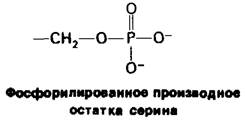
Such modifications can be reversed by hydrolysis. Both the addition and removal of phosphoryl and other modifying groups are catalyzed by specific enzymes.
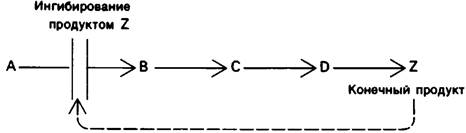
A different type of regulation operates in many metabolic pathways leading to the synthesis of small molecules, such as Amino Acids. In these pathways, The enzyme catalyzing the first step of Biosynthesis is subject to inhibition by the final product of the pathway (Fig. 6.5). Feedback inhibition (or end-product inhibition) is well illustrated by The biosynthesis of isoleucine in Bacteria. The conversion of Threonine to isoleucine takes place in five steps, the first of which is catalyzed by threonine deaminase. When the concentration of isoleucine reaches a sufficiently high level, the enzyme is inhibited because isoleucine binds to a regulatory (rather than catalytic) site on the enzyme. This Enzyme Inhibition is mediated by reversible allosteric interactions. When the isoleucine concentration drops below a certain threshold, threonine deaminase regains its activity, and isoleucine synthesis resumes.
Fig. 6.5. Feedback inhibition of the first enzyme in a metabolic pathway through the Reversible Binding of the end product
The Specificity of certain enzymes is under physiological control. A particularly interesting example of this is lactose synthesis in the mammary gland (Fig. 6.6). Lactose synthase, the enzyme that catalyzes lactose synthesis, consists of two subunits: a catalytic subunit and a modifying subunit. The catalytic subunit on its own is incapable of synthesizing lactose; its role is to catalyze The transfer of galactose to a protein containing a covalently linked carbohydrate chain.
Fig. 6.6. The synthesis of lactose—a sugar composed of glucose and galactose residues—is catalyzed by an enzyme containing both a catalytic subunit and a subunit that modifies substrate specificity. In the absence of the modifying subunit, the catalytic subunit catalyzes a different reaction
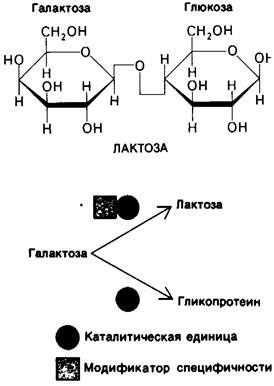
The modifying subunit alters the Specificity of the catalytic subunit so that the latter begins transferring galactose to glucose instead, thereby producing lactose. The concentration of the modifying subunit is under hormonal control. During Pregnancy, the mammary gland synthesizes the catalytic subunit, while the level of the modifying subunit remains very low. At birth, hormone levels in the blood change dramatically, triggering the synthesis of large quantities of the modifying subunit. The modifying subunit then associates with the catalytic subunit to form the active lactose synthase complex, which produces vast amounts of lactose. Thus, it is evident that Hormones can exert physiological effects by altering Enzyme Specificity.
Last update: 06/08/2026
Editorial and Educational Adaptation: This material has been compiled based on the primary/original source text. The project team performed an editorial review, corrected technical inaccuracies, structured sections, and adapted the content for an educational format.
What was processed:
- elimination of formatting defects (OCR errors, structural breaks, corrupted characters);
- editorial organization of content;
- standardization of terminology in accordance with academic sources;
- verification of factual statements against the original source text.
All mentions of the author, publication year, and origin of the primary text have been preserved in accordance with the source.