BIOCHEMISTRY - L. Stryer - 1984
VOLUME 1
PART I. CONFORMATION AND DYNAMICS
CHAPTER 6. INTRODUCTION TO ENZYMOLOGY
Chemical Reactions in biological systems rarely proceed in the absence of a catalyst. Specialized Proteins called Enzymes serve as such catalysts. All enzymes exhibit remarkably high catalytic power and Specificity. Furthermore, The activity of many enzymes is subject to regulation. In addition, A number of enzymes are directly involved in the transformation of Various Forms of energy. Let us examine these distinctive METABOLISM/8.html">Properties of Enzymes, which are of paramount importance for biological processes.
6.1. Enzymes Have Enormous Catalytic Power
Enzymes accelerate reactions by a factor of at least a million. In fact, in the absence of enzymes, The rate of most reactions in biological systems is virtually unnoticeable. Even such a simple reaction as the Hydration of carbon dioxide.
Without an enzyme, The transport of CO2 from Tissues to the Blood and then into the air of the pulmonary alveoli would be incomplete. Carbonic anhydrase, which catalyzes this reaction, is among the most active enzymes known. Each molecule of carbonic anhydrase is capable of hydrating 105 molecules of CO2 per second. The rate of the CO2 hydration reaction in the presence of the enzyme is 107 times higher than in its absence.
6.2. Enzymes Have High Specificity
Enzymes are highly specific both with respect to the reaction they catalyze and with respect to substrates, i.e., the substances participating in the reaction. Each enzyme catalyzes a single chemical reaction or a few very similar reactions. The degree of substrate specificity is usually high and sometimes virtually absolute.
Let us consider Proteolytic Enzymes as an example. They catalyze the Hydrolysis of a peptide bond:
Class="center">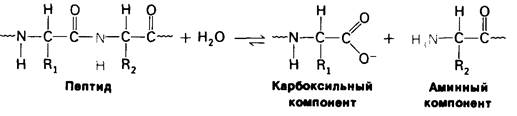
is catalyzed by the enzyme:
CO2 + H2O ⇄ H2CO3.
Many proteolytic enzymes catalyze a different but similar reaction, namely the hydrolysis of an ester bond:

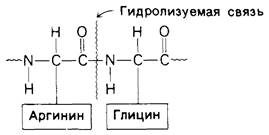
Proteolytic enzymes vary widely in their degree of substrate specificity. For instance, subtilisin, synthesized by a certain bacterial species, cleaves peptide bonds regardless of The Nature of the adjacent side chain. On the other hand, Trypsin, as already mentioned in Chapter 2, exhibits high specificity in that it cleaves peptide bonds formed by the carboxyl groups of Lysine and Arginine only (Fig. 6.1). Thrombin, which participates in Blood Coagulation, exhibits an even higher specificity than trypsin. It cleaves only those peptide bonds formed by the carboxyl group of arginine and the amino group of Glycine (Fig. 6.2).
Fig. 6.1. Specificity of trypsin
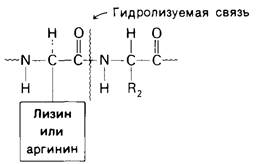
Fig. 6.2. Specificity of thrombin (a blood-clotting factor)
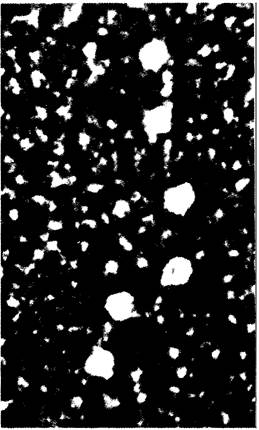
Another example of the high degree of Enzyme Specificity is DNA polymerase I. This enzyme synthesizes DNA by linking together four types of nucleotide Building Blocks of DNA. The nucleotide sequence in the synthesized DNA chain is determined by the nucleotide sequence in another DNA chain that acts as a template (Fig. 6.3). DNA polymerase I is remarkably accurate in carrying out the instructions given by the template. In the synthesized DNA chains, an incorrectly incorporated nucleotide occurs less than once in a million.
Fig. 6.3. Electron micrograph of DNA polymerase I molecules (white spherical particles) bound to a filamentous synthetic DNA template
Last update: 06/08/2026
Editorial and Educational Adaptation: This material has been compiled based on the primary/original source text. The project team performed an editorial review, corrected technical inaccuracies, structured sections, and adapted the content for an educational format.
What was processed:
- elimination of formatting defects (OCR errors, structural breaks, corrupted characters);
- editorial organization of content;
- standardization of terminology in accordance with academic sources;
- verification of factual statements against the original source text.
All mentions of the author, publication year, and origin of the primary text have been preserved in accordance with the source.