Chemistry and Biology of Proteins - F. Haurowitz 1953
Interaction of proteins with water
Hydration
Hydration refers to the interaction of Water molecules with the molecules of a dry substance or a solute. In living organisms, the substances that bind water are predominantly Proteins; since water serves as the universal medium for biological reactions, the great importance of protein hydration needs no special proof. The literature on this subject contains many contradictory data. This is because the Hydration of dry and dissolved proteins has been studied by various authors using different Methods. For instance, some researchers investigated the hydration of "dry" protein, by which they meant an air-dry preparation, whereas others used genuinely dry, water-free preparations in their studies. It is well known that dry proteins bind water even when exposed to air of normal humidity, and failing to account for this circumstance can lead to serious errors.
The phenomenon of hydration is due to the polar properties of water molecules. The electronic formula of water shows that the center of gravity of negatively charged electrons lies closer to the oxygen atom than to the positively charged nuclei of the hydrogen atoms (Fig. 20). On the other hand, the center of gravity of positive charges is closer to the hydrogen atoms. Molecules in which the centers of gravity of positive and negative charges do not coincide are called polar molecules or dipoles. Fig. 21 shows that dipoles are invariably attracted by ions. In The first phase of the process, an ion attracts the oppositely charged pole and repels the like-charged pole with an equal force; In the second phase, the attraction is stronger than the repulsion because the attracted pole is located closer to the ion than the repelled one. These same factors determine the attraction between two dipoles (Fig. 22).
Forces acting between dipoles are less effective at large distances than forces acting between an ion and a dipole; however, it is precisely these forces that ensure the mutual association of water molecules. The action of these same forces also explains why water has a higher boiling point compared to analogously structured substances such as H2S or H2Se.
The phenomenon of hydration is based on the binding of water dipoles by ions or ionic groups, or by dipoles or polar groups. Both solid and dissolved substances are capable of undergoing hydration. Sometimes this results in The formation of hydrates of a definite stoichiometric composition. A well-known example is the hydration of copper sulfate. Anhydrous copper sulfate attracts moisture from the air and converts into the hydrated form CuSO4∙ 5Н2O.
Class="center">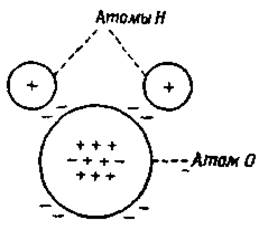
Fig. 20. Electronic formula of water.
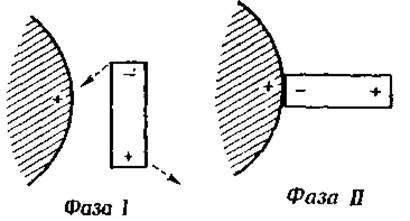
Fig. 21. Mutual attraction of a dipole and a positively charged ionic group.
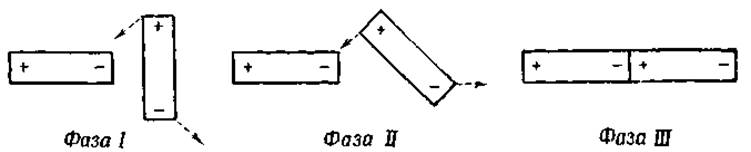
Fig. 22. Association of dipoles.
When the components of any compound bind to one another, their capacity for free movement is partially lost. As a result, the volume of a hydrated molecule is always smaller than the sum of the volumes of its components; in other words, hydration is accompanied by a decrease in total volume. This reduction can be determined by measuring the volume before and after the reaction. More precisely, it can be determined by measuring the density D, i.e., the weight in grams of 1 ml. The reciprocal of density, i.e., the volume occupied by 1 g of a substance, is called the specific volume, Vуд. = 1/D.
To better visualize the relationships among the various Factors influencing the hydration process, let us examine the volume changes observed during the hydration of copper sulfate. The density of anhydrous copper sulfate is 3.58, and its specific volume is 1/3.58 = 0.28; the density of the pentahydrate (CuSO4∙ 5H2О) is 2.29, and its specific volume is 1/2.29 = 0.436. Hence, the volume of 1 mole of anhydrous copper sulfate (mol. wt. 159.6) is 159.6∙0.28 = 44.5 ml; the volume of 5 moles of water is 5∙18 ml = 90 ml. The total volume occupied by 1 mole of anhydrous copper sulfate and 5 moles of water should be 44.5 + 90 = 134.5 ml. However, in reality, the volume occupied by 1 mole of the pentahydrate is 249.7∙0.436 = 109 ml (where 249.7 is the Molecular Weight of the pentahydrate). The decrease in volume upon combining 1 mole of copper sulfate with 5 moles of water is 134.5 — 109 = 25.5 ml.
When attempting to determine the true volumes occupied by copper sulfate molecules and water molecules, A number of difficulties arise. Let us clarify this with an example. We might assume that the reduction in total volume upon the Formation of the pentahydrate occurs at the expense of the volume of anhydrous copper sulfate. Then, we can subtract the magnitude by which the total volume decreased from the volume occupied by anhydrous copper sulfate, obtaining an apparent volume of 44.5 — 25.5 = 19 ml per 1 mole of copper sulfate. Alternatively, we can subtract the decrease in total volume from the volume occupied by 5 moles of water, assuming that their volume contracted by 25.5 ml (i.e., from 90 ml to 64.5 ml), so that the apparent molar volume of water would be 64.5/5 = 12.9 instead of 18 ml per 1 mole, and its apparent density would be 18/12.9 = 1.4 g per 1 ml. It is clear, however, that neither of these two assumptions is correct. In reality, the volume reduction occurs because all components of CuSO4∙ 5Н2O—water molecules, copper ions, and sulfate ions—lose their ability to move freely in space across all three dimensions.
In Protein Chemistry, we frequently encounter the need to determine either the degree of hydration of dry proteins in a water vapor atmosphere or the degree of hydration of proteins dissolved in large amounts of water. In both cases, the total volume of the protein–water system will be less than the sum of the volumes of the dry protein and the added water. Since small Changes in the system's volume are difficult to measure, researchers usually determine density changes, which can be measured very precisely using a pycnometer. If the density of the protein–water system is denoted by D, and the specific volume (i.e., the volume occupied by 1 g of the system) by Vyд., then Vуд. will be equal to 1/D. The density of protein solutions is determined by weighing them in a pycnometer of a precisely known volume V. If the weight of the solution is denoted by P and the volume of the pycnometer by V, the density of the solution will be D = у,
As is evident from the above, determining the density of protein solutions presents no special difficulties. Difficulties arise, however, when measuring the density of dry proteins or moist protein preparations. Many proteins undergo Denaturation upon drying, which makes it impossible to use these preparations for hydration studies. This difficulty could be overcome by first determining the density of moist crystals or a protein solution and then drying the protein. Nevertheless, the main challenge associated with determining the density of dry or moist protein remains. One method used for this purpose involves placing the test protein into a pycnometer, weighing it, and then filling the pycnometer with a liquid of known density. Naturally, water cannot serve as such a filling liquid because water will increase the degree of hydration; nor can ethanol, acetone, and ether be used, as they are capable of attracting water and would therefore decrease the degree of hydration. Benzene, bromobenzene, and other hydrophobic liquids are usually employed for this purpose. But even under these conditions, the results obtained are not entirely satisfactory because, firstly, Protein Denaturation occurs at the water–solvent interface, and secondly, a small amount of water still dissolves in these Solvents. In addition, suspending dry protein in an organic liquid introduces tiny air bubbles that reduce the accuracy of the determination.
Another method used to determine density is based on measuring the Sedimentation Rate of protein particles in aqueous salt solutions of varying density [1]. The Structure/127.html">Interpretation of Results obtained by this method is complicated by the fact that proteins associate not only with water but also with salts (see Chapter V). The density values obtained by this method actually pertain to hydrated protein-salt complexes rather than to hydrated proteins.
These few remarks are sufficient to demonstrate the major experimental difficulties encountered when determining the density of dry or hydrated proteins. In many cases, interpreting the obtained results also presents a challenge. Due to the impossibility of determining the exact amounts of hydrated protein and free water in a protein–water system, a special thermodynamic concept—the partial specific volume—has been introduced, to the determination of which researchers usually resort.
Let us consider a system consisting of nБ moles of protein and nВ moles of water. We can view the total volume V of the system as the sum of the volumes of the two components forming the system. Suppose that 1 mole of protein occupies a volume vБ, and 1 mole of water occupies a volume  Then the total volume will be

are called partial molar volumes. Since the molecular weight of proteins is not always known, partial molar volumes  are frequently replaced by partial specific volumes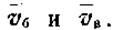
Their relationship to Vуд. is defined by the equation

where gб and gв are the amounts of protein and water, respectively, in 1 g of the mixture. Obviously, gб+gв = 1 g. Equation (1) contains only two unknowns  since Vуд, gб, and gв can be determined. The values of these unknowns can be found by varying The ratio of the components in the protein–water system (=gб/gв) and plotting the dependence of Vyд. on g6. The resulting curve shows that the partial specific volume of a protein depends on its concentration. To find the approximate value of
  one must determine the slope (tangent of the angle of inclination) of this curve [2].
Another, less precise approach is based on an arbitrary assumption that the partial specific volume of water remains constant and vб is always equal to 1.0. Then equation (1) takes a more simplified form:

where (vb)a.b is the apparent specific volume of the protein.
It must be emphasized that neither the partial specific volume  nor the apparent specific volume (vb)a.b reflects the true volume occupied by the protein in the protein–water system. In obtaining these data, the assumption was made that the volume of the protein–water system equals the sum of the volumes of the aqueous and protein phases; consequently, the presence of hydrated protein molecules was not taken into account. Therefore, we are not justified in calculating the degree of hydration from
  or (vb)a.,b. Nevertheless, the results obtained by this method are important for evaluating data obtained by other techniques and for calculating protein molecular weights from ultracentrifugation sedimentation rates (see Chapter IV).
Last update: 06/08/2026
Editorial and Educational Adaptation: This material has been compiled based on the primary/original source text. The project team performed an editorial review, corrected technical inaccuracies, structured sections, and adapted the content for an educational format.
What was processed:
- elimination of formatting defects (OCR errors, structural breaks, corrupted characters);
- editorial organization of content;
- standardization of terminology in accordance with academic sources;
- verification of factual statements against the original source text.
All mentions of the author, publication year, and origin of the primary text have been preserved in accordance with the source.