BIOCHEMISTRY - L. Stryer - 1984
VOLUME 1
PART I. CONFORMATION AND DYNAMICS
CHAPTER 6. INTRODUCTION TO ENZYMOLOGY
6.10. Vmax and Км Can Be Determined Using Various Substrate Concentrations
If an enzyme operates According to the simple scheme presented in equation (1), it is straightforward to determine its Michaelis constant Kм and maximum velocity Vmax by measuring the reaction velocity at various substrate concentrations. It is convenient to transform the Michaelis-Menten Equation into a form that yields a straight line graphically. For this purpose, equation (15) is expressed in terms of reciprocals:
Class="center">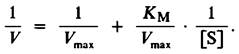 (16)
(16)
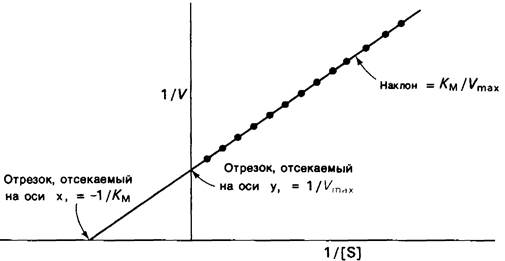
By plotting 1/V versus 1/[S], we obtain a straight line whose intercept with the ordinate gives 1/Vmax, and whose slope is equal to Kм/Vmax (Fig. 6.13).
Fig. 6.13. Representation of enzyme reaction kinetics on a double-reciprocal plot: 1/V expressed as a function of 1/[S]. The slope of the curve is equal to K/M/Vmах, the intercept with the y-axis corresponds to 1/Vmах, and the intercept with the X-axis = 1 /Км
6.11. Significance of Км and Vmах Values
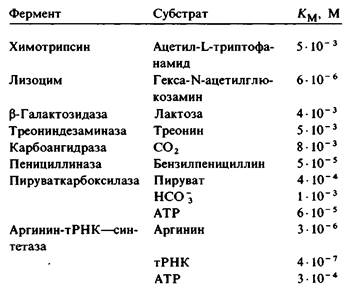
Kм varies over a wide range of values for different Enzymes (Table 6.1). For most enzymes, the value of Kм lies within the range of 10-1 to 10-6 M. The Kм value of an enzyme depends on The Nature of the substrate as well as on environmental conditions such as Temperature and Ionic strength. The Michaelis constant Kм has two distinct meanings. First, Kм is the Substrate Concentration at which half of the enzyme's active sites are occupied. If Kм is known, one can calculate the fraction of occupied active sites ƒES for any substrate concentration:
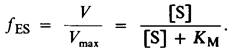 (17)
(17)
Table 6.1. Kм Values of Some Enzymes
Second, Kм is related to the rate constants of individual catalytic steps presented in equation (1). According to equation (7), Kм is equal to (к2+к3)/к1. Let us consider the extreme case where к2 is much greater than к3, i.e., the dissociation of the ES complex into E and S occurs much faster than The formation of E plus the reaction product. Under these conditions (к2 » к3)
 (18)
(18)
The dissociation constant of the ES complex is described by the equation
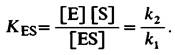 (19)
(19)
In other words, if к3 is much smaller than к2, then Kм is equal to the dissociation constant of the ES complex. Under this condition, Kм serves as a measure of the Stability of the ES complex: a high Kм indicates weak substrate binding, whereas a low Kм indicates strong enzyme-substrate interaction. It should be emphasized once again that the value of Kм can be used to assess the affinity of an enzyme for its substrate only under the condition that к2 is significantly greater than к3. In reality, this is true in many, though not all, cases.
The maximum velocity Vmax reflects the turnover number of the enzyme if the concentration of active sites (ET) is known, since
Vmax = kз [EТ]. (20)
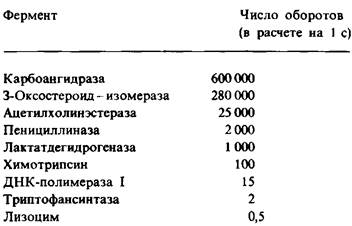
For example, at full substrate saturation, dissolved Carbonic anhydrase at a concentration of 10-6 M catalyzes the formation of 0.6 M Н2СО3 per second. Hence, к3 = 6 • 10-5 s-1. The kinetic constant к3 is called the turnover number. The turnover number of an enzyme is the number of substrate molecules converted into product per unit time when the enzyme is fully saturated with substrate. The turnover number of 6 • 105 s-1, characteristic of carbonic anhydrase, is the largest known. Each successive catalytic event takes place after an interval equal to 1/k3, which for carbonic anhydrase amounts to 1.7 µs. The turnover number of most enzymes utilizing physiological substrates lies within the range of 104 per second (Table 6.2).
Table 6.2. Maximum Turnover Numbers of Some Enzymes
Last update: 06/08/2026
Editorial and Educational Adaptation: This material has been compiled based on the primary/original source text. The project team performed an editorial review, corrected technical inaccuracies, structured sections, and adapted the content for an educational format.
What was processed:
- elimination of formatting defects (OCR errors, structural breaks, corrupted characters);
- editorial organization of content;
- standardization of terminology in accordance with academic sources;
- verification of factual statements against the original source text.
All mentions of the author, publication year, and origin of the primary text have been preserved in accordance with the source.