BIOCHEMISTRY - L. Stryer - 1984
VOLUME 1
PART I. CONFORMATION AND DYNAMICS
CHAPTER 6. INTRODUCTION TO ENZYMOLOGY
6.9. The Kinetics of Many Enzymes Is Described by the Michaelis-Menten Model
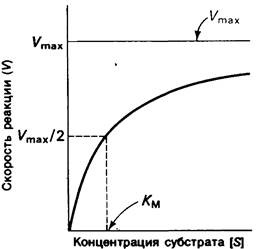
For many Enzymes, The rate of catalysis, V, thus depends on the Substrate Concentration, [S], as shown in Fig. 6.12. At a constant Enzyme Concentration and low values of [S], V is almost directly proportional to [S]. At high values of [S], V is nearly independent of [S]. In 1913, Leonor Michaelis and Maud Menten proposed a simple model to account for this kinetics. Their primary premise was that The formation of a specific enzyme-substrate complex is a necessary intermediate step in catalysis. The model they proposed, which describes the kinetic properties of many enzymes in the simplest terms, is as follows:
Class="center">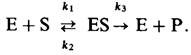 (1)
(1)
Fig. 6.12. Plot of reaction velocity V versus substrate concentration [S] for an enzyme obeying Michaelis-Menten kinetics (Vmах - maximum velocity, Км - Michaelis constant)
Enzyme E combines with substrate S to form an ES complex; the rate constant for this process is k1. The Fate of the ES complex can unfold in two ways: it can either dissociate into E and S with a rate constant of k2, or undergo further transformation to yield product P with a rate constant of k3. It is postulated that the reaction product P does not turn back into the starting substrate S; this condition is met in the Cytology/cytology/16.html">Early stages of the reaction, before the product concentration reaches a significant level.
How is the rate of catalysis related to the concentrations of substrate and enzyme and the rates of individual reaction steps? To begin with, the rate of an enzymatic reaction is equal to the product of the concentration of the ES complex and the constant k3:
V = к3 [ЕS]. (2)
Let us express [ES] in terms of known quantities. The rates of formation and breakdown of ES are:
Rate of ES formation = k1 [Е] [S]. (3)
Rate of ES breakdown = (к2 + к3) [ЕS]. (4)
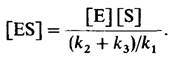
Let us determine the rate of catalysis under steady-state conditions. Steady-state conditions are characterized by the fact that the concentration of intermediates remains constant, whereas the concentrations of starting Materials and final products change. This occurs when the rate of Synthesis of the ES complex equals the rate of its breakdown. If the left-hand sides of equations (3) and (4) are equal to each other, then the right-hand sides are equal as well, i.e.,
k1 [Е] [S] = (к2 + к3) [ЕS]. (5)
Let us rearrange this equation:
 (6)
(6)
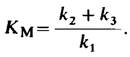
Equation (6) can be simplified by introducing a new constant, Км, called the Michaelis constant:
 (7)
(7)
Substituting Км into equation (6):
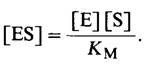 (8)
(8)
Let us consider the numerator in the last expression. The concentration of unbound substrate [S] is practically equal to the total substrate concentration, provided that the enzyme concentration is much lower than the substrate concentration. The concentration of unbound enzyme [E] is equal to the total enzyme concentration Eт minus the concentration of the ES complex:
[Е]=[ЕТ]-[ЕS]. (9)
Substituting this expression into equation (8):
[ЕS] = ([Ет] — [ЕS]) [S]/KМ (10)
Solving equation (10) for [ЕS] yields
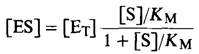 (11)
(11)
or
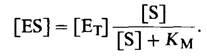 (12)
(12)
Substituting expression (12) into equation (2):
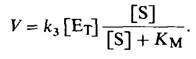 (13)
(13)
The maximum reaction velocity Vmах is reached when the active sites of the enzyme are saturated with the substrate, i.e., when [S] is much higher than Kм; under this condition, [S]/([S] + Км) approaches unity. Consequently,
Vmax = kз [Ет]. (14)
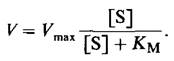
Substituting this expression into expression (13), we obtain the Michaelis-Menten Equation:
 (15)
(15)
This equation corresponds to the kinetic data presented in Fig. 6.12. At low substrate concentrations, when [S] is much lower than Kм, V = [S] Vmax/Км, meaning the velocity is directly proportional to the substrate concentration. At high substrate concentrations, when [S] is much greater than Kм, V = Vmax, i.e., the reaction velocity is maximal and independent of the substrate concentration.
The value of Kм is evident from equation (15). If [s] = Км, then V = Vmax/2. Thus, Км is equal to the substrate concentration at which the reaction velocity is half-maximal.
Last update: 06/08/2026
Editorial and Educational Adaptation: This material has been compiled based on the primary/original source text. The project team performed an editorial review, corrected technical inaccuracies, structured sections, and adapted the content for an educational format.
What was processed:
- elimination of formatting defects (OCR errors, structural breaks, corrupted characters);
- editorial organization of content;
- standardization of terminology in accordance with academic sources;
- verification of factual statements against the original source text.
All mentions of the author, publication year, and origin of the primary text have been preserved in accordance with the source.