Human Biochemistry, Volume 1 - Murray R. 1993
Structure and Function of Proteins and Enzymes
Enzymes: Kinetics
Enzyme Concentration
In many cases, it is not enough to know that a given enzyme is present in the system; information about its quantity is also required. Under certain conditions, The rate of an enzymatic reaction is directly proportional to The amount of enzyme (Ch. 7).
This is not always the case, as can be illustrated by a forward reaction occurring under equilibrium conditions. Even if we know that the forward reaction is indeed taking place, its apparent rate will seem to be zero because the reverse reaction proceeds at the same rate. However, when an enzymatic reaction is just beginning, the product is virtually absent, and the reverse reaction does not occur.
Furthermore, at the initial stage of the reaction, the Substrate Concentration corresponds to its initial amount. Therefore, the rate at the beginning of the reaction, i.e., its initial velocity (v), will be directly proportional to the enzyme concentration [Enz] (Ch. 7).
An enzyme is a reactant that combines with a substrate to form an enzyme-substrate complex Enz — S, which decomposes into the free enzyme and product P. In its simplest form, this can be written as
Class="center">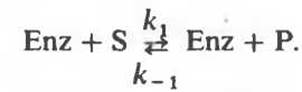
Note that although the term [Enz] is included in the rate equations for both the forward and reverse reactions:
Rate1 = k1[Enz][S],
Rate-1 = k-1[Enz][P],
the expression for the Equilibrium Constant no longer contains [Enz]:

Thus, the enzyme concentration has no effect on the equilibrium constant. Keq is independent of how equilibrium is reached—whether with or without the enzyme (recall the value of ∆G°). The enzyme alters The pathway of the reaction, but not the final (equilibrium) concentrations of reactants and products, on which Keq and ∆G° depend.
Last update: 06/08/2026
Editorial and Educational Adaptation: This material has been compiled based on the primary/original source text. The project team performed an editorial review, corrected technical inaccuracies, structured sections, and adapted the content for an educational format.
What was processed:
- elimination of formatting defects (OCR errors, structural breaks, corrupted characters);
- editorial organization of content;
- standardization of terminology in accordance with academic sources;
- verification of factual statements against the original source text.
All mentions of the author, publication year, and origin of the primary text have been preserved in accordance with the source.