Human Biochemistry, Volume 1 - Murray R. 1993
Structure and Functions of Proteins and Enzymes
Enzymes: Kinetics
Equilibrium Constant
Since all Chemical Reactions are reversible, for the reverse reaction (relative to the one where n molecules of A react with m molecules of B)
Class="center">AnBm→ nA + mB
the corresponding expression for the reaction rate is given by
Reaction rate ∝ [AnAm].
Reversibility is indicated by double arrows:
nA + mB ⇄ AnBm.
This expression should be read as: n molecules of A and m molecules of B are in equilibrium with AnBm. The proportionality sign ∝ can be replaced by an equal sign by introducing a proportionality constant k characteristic of the reaction in question. In the general case,
nA + mB ⇄ AnBm
the expressions for The rate of the forward reaction (Rate1) and the reverse reaction (Rate-1) take the form
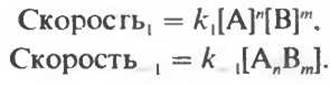
When the rates of the forward and reverse reactions are equal, the system is said to be in equilibrium:
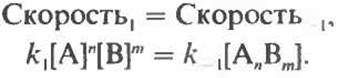
Hence
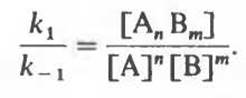
The ratio of k1 to k-1 is called the equilibrium constant, Keq. The following properties of a system at equilibrium should be kept in mind:
1 Strictly speaking, molar activities should be used instead of molar concentrations.
1. The equilibrium constant is equal to the ratio of the rate constants of the forward and reverse reactions, k1/k-1.
2. At equilibrium, the rates of the forward and reverse reactions (but not their rate constants) are equal.
3. Equilibrium is a dynamic state. Although there is no net change in the concentrations of reactants and products at equilibrium, A and B are constantly being converted into AnBm, and vice versa.
4. If the equilibrium concentrations of A, B, and AnBm are known, the numerical value of the equilibrium constant can be determined.
Relationship between the equilibrium constant and the Standard Free energy change (∆G°) of a reaction
The equilibrium constant is related to ∆G by the expression
∆G = -RTln Keq.
Here, R is the gas constant and T is the absolute Temperature. Since their values are known, knowing the numerical value of Keq allows one to find ∆G°. If the equilibrium constant is greater than one, the reaction proceeds spontaneously, i.e., in the direction it is written (from left to right). If the equilibrium constant is less than one, the reverse reaction proceeds spontaneously. Note, however, that while the equilibrium constant indicates the direction in which a reaction can proceed spontaneously, it does not indicate whether the reaction will occur rapidly. In other words, it says nothing about the height of the reaction's energy barrier (∆GF; see above). This is because Keq determines only ∆G°. Reaction rates depend on the height of the energy barrier, not on the magnitude of ∆G°.
Most factors that affect the rates of enzymatic reactions exert their effect by altering the local concentrations of the reactants.
Last update: 06/08/2026
Editorial and Educational Adaptation: This material has been compiled based on the primary/original source text. The project team performed an editorial review, corrected technical inaccuracies, structured sections, and adapted the content for an educational format.
What was processed:
- elimination of formatting defects (OCR errors, structural breaks, corrupted characters);
- editorial organization of content;
- standardization of terminology in accordance with academic sources;
- verification of factual statements against the original source text.
All mentions of the author, publication year, and origin of the primary text have been preserved in accordance with the source.