Biochemistry of Amino Acids - A. Majster 1961
Natural Amino Acids
General Properties of Amino Acids
Chemical Reactions
The Chemical reactions characteristic of Amino Acids are of fundamental importance for the synthesis, identification, and characterization of amino acids isolated from natural products and utilized in biochemical research. Furthermore, many of The amino acid reactions encountered by organic chemists are analogous to those occurring within living Cells. The chemical properties of amino acids of primary interest from a biochemical perspective are discussed below. The chemistry of amino acids is covered in greater detail in the monographs by Clarke [115], Block [116], Hau [109], and Desnuelle [117]. Amino acids possessing a primary amino group react with nitrous acid to yield the corresponding hydroxy acid and release nitrogen:
Class="center">
This reaction serves as the basis for the Van Slyke nitrous acid method for amino acid determination; the evolved nitrogen can be measured gasometrically [118, 119] or manometrically [120].
In the reaction with nitrous acid, Proline and hydroxyproline do not yield nitrogen, whereas Cysteine, cystine, and glutamic acid produce it in quantities exceeding the equimolecular amount.
The reaction of amino acids with ninhydrin is of major importance for the detection of amino acids on chromatograms and for their quantitative determination. Most amino acids react with ninhydrin to form carbon dioxide, ammonia, and the corresponding aldehyde [121—123]:
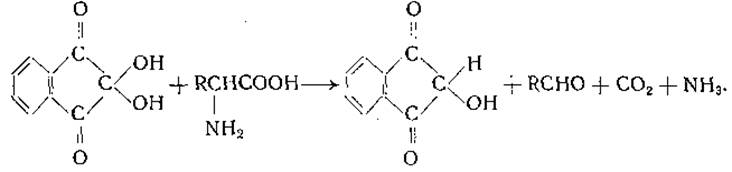
The resulting ammonia, carbon dioxide, and aldehyde can be quantitatively determined. In addition, one can measure the intensity of the blue-violet color of "Ruhemann's purple" (indandione-2-N-2'-indanonyl enolate) formed by the reaction of ammonia with ninhydrin and the ninhydrin reduction product (indanone-enediol) [124—126]; the formula for "Ruhemann's purple" is as follows:
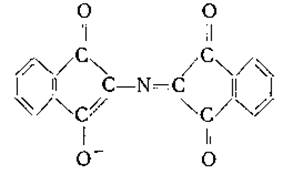
The reaction of aspartic acid with ninhydrin releases two molecules of carbon dioxide, while proline and hydroxyproline yield a yellow color with ninhydrin but do not form ammonia. Peptides of glutamic and aspartic acids possessing free α-carboxyl and α-amino groups, unlike α-glutamyl and α-aspartyl peptides, react with ninhydrin to form CO2 and ammonia.
The amino groups of Amino acids can be acylated using various Reagents, such as acetyl chloride, benzoyl chloride, chloroacetyl chloride, phthalic anhydride, and carbobenzoxy chloride. The latter reagent, introduced into practice by Bergmann and Zervas [127], has proven to be especially valuable for protecting the amino group during Peptide Synthesis:

The carbobenzoxy group can be readily removed by catalytic hydrogenation [127], as well as by Treatment with hydrogen bromide in glacial acetic acid [128], phosphonium iodide [129], or metallic sodium in liquid ammonia [130].
Of significant importance is the formation reaction of 2,4-dinitrophenyl (DNP) Amino Acid Derivatives:
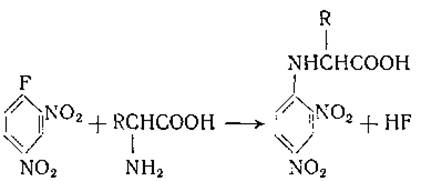
Dinitrophenyl derivatives of amino acids are relatively stable during acid Hydrolysis; this property, along with other features of these derivatives, makes it possible to use them for determining the N-Terminal Groups of Proteins AND PEPTIDES.
Abderhalden and Stix [131] were the first to obtain dinitrophenyl amino acid derivatives by boiling alkaline amino acid solutions with 1-chloro-2,4-dinitrobenzene. The corresponding fluoro derivative, recommended by Sanger [132, 133], reacts with amino acids in a bicarbonate solution at room Temperature and is therefore practically more convenient. All N-dinitrophenyl amino acid derivatives are yellow-colored, which facilitates their identification on chromatograms. Some amino acids react with more than one mole of the reagent; for instance, both the α- and ω-amino groups of Lysine and Ornithine, the imidazole nitrogen of Histidine, the phenolic group of Tyrosine, and the sulfhydryl group of cysteine react with 1-fluoro-2,4-dinitrobenzene. Consequently, these amino acids form bis-dinitrophenyl derivatives.
Sanger found that the free amino groups of proteins react with 1-fluoro-2,4-dinitrobenzene at a slightly alkaline pH and room temperature. He successfully hydrolyzed dinitrophenyl protein derivatives under conditions where the bonds between the dinitrophenyl group and the amino acids remain intact. Using this method, it is possible in many cases to determine the number of open peptide chains in a protein molecule and establish The Nature of the N-terminal residues. This method provides insight into the lysine content of proteins, as fluorodinitrobenzene reacts with the free ε-amino groups of lysine incorporated into the protein. The dinitrophenyl derivative method has been of immense assistance in elucidating The Structure of the protein molecule; one of the most prominent Examples was Sanger's successful application of this method in determining the STRUCTURE OF THE Insulin molecule (p. 27).
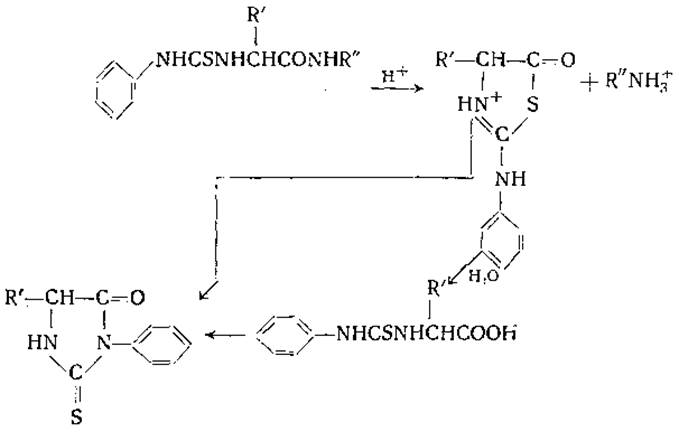
Other Methods are also employed to determine The Nature and number of terminal groups in proteins. Edman [134] utilized the reaction between the amino group and phenyl isothiocyanate, which yields phenylthiocarbamylamino derivatives. Phenylthiocarbamyl peptides are cleaved by the action of acids to form the thiohydantoin of the corresponding N-terminal amino acid. The direct product of the acid Cleavage of a phenylthiocarbamyl peptide is the corresponding 2-anilino-5-thiazolinone. The thiazolinone hydrolyzes to form a phenylthiocarbamyl amino acid, which cyclizes into thiohydantoin.
In a non-aqueous medium, thiazolinone can convert directly into thiohydantoin via an intramolecular rearrangement:
p-Iodobenzenesulfonyl chloride (pipsyl chloride) also reacts with the amino groups of proteins. The method based on this reaction has been used to determine N-terminal groups [135].

The free carboxyl groups of proteins are more difficult to determine than free amino groups. One approach proposed for this purpose involves converting the carboxyl group into an alcohol group [136]. By treating a protein or peptide with an alcoholic solution of hydrogen chloride or diazomethane, free carboxyl groups are converted into esters, and the ester groups are subsequently reduced to alcohols using lithium borohydride (LiBH4). Upon acid hydrolysis of material treated in this manner, aspartic acid residues yield homoserine lactone, while glutamic acid residues appear as α-amino-δ-hydroxyvaleric acid. Glutamine and asparagine residues present in the original protein molecule are converted into the corresponding dicarboxylic acids upon hydrolysis. One METHOD FOR DETERMINING C-terminal residues is based on The Use of carboxypeptidase (from pancreatic juice), which specifically cleaves off the C-terminal amino acid. This method suffers from several drawbacks, one of which is that the enzyme may cleave the amino acid residue adjacent to the C-terminal group as well. Descriptions of other methods used to determine terminal groups in Proteins can be found in Fox's review [137].
The conversion of amino acid esters into alcohols was mentioned above. Amino acid esters were widely used by Fischer for the Separation of Amino Acids and the synthesis of peptides. In A number of cases, the use of benzyl esters of amino acids has proven most useful, as they are easily cleaved by catalytic reduction as well as by saponification. Amino acid esters serve as intermediates in the preparation of the corresponding amides, hydroxamic acids, hydrazides, and azides.
Reduction of an amino acid carboxyl group to a methyl group is achieved by converting the corresponding alcohol into a di-O,N-p-toluenesulfonyl derivative; the latter is reduced with lithium aluminum hydride to the N-p-toluenesulfonyl derivative of the desired amine [138].
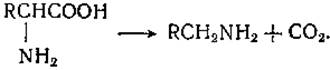
When amino acids are heated in a dry state or in high-boiling Solvents, they undergo decarboxylation [139], yielding the corresponding amine. This reaction is analogous to the enzymatic Decarboxylation of amino Acids (p. 199):
Heating amino acids can lead to The formation of diketopiperazines. Amino acid esters may also convert into the corresponding diketopiperazines. For instance, Glycine methyl ester spontaneously transforms into diketopiperazine in an aqueous solution:
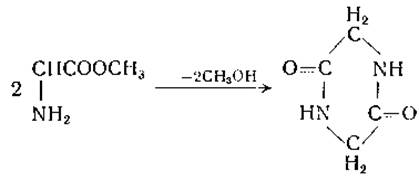
The reaction proceeds more readily with glycine methyl ester than with glycine esters of higher alcohols [140]. Trace amounts of diketopiperazines have been detected in protein hydrolysates; it is possible that the cyclization of amino acids occurs during Protein Hydrolysis or the isolation of amino acids.
In alkaline solutions, amino acids react with carbon dioxide to form carbamido acids, which can be precipitated as salts:
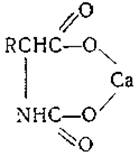
Some of these exhibit low solubility and have been utilized for isolating amino acids. Upon boiling aqueous solutions of carbamido acid salts, they decompose [141, 142]. The carbamido bond plays a well-known role in the Transport of Carbon dioxide by the Blood.
The preparation of phosphoamide derivatives of amino acids has been described in the literature [143, 144]. Amino acids (glycine, glutamic acid, Alanine, tyrosine) are treated with phosphorus oxychloride in an alkaline suspension of magnesium hydroxide, and the reaction product is isolated as the magnesium salt. Although the resulting products were not fully characterized, the N/P ratios corresponded to the theoretically calculated values. These synthetic products are hydrolyzed by dilute acids and phosphatase preparations.
Phosphocarboxylic derivatives of Certain amino acids have also been obtained. The first to be prepared was ß-aspartyl phosphate; Black and Wright [145] synthesized this compound in solution using the following reactions. The $\alpha$-benzyl ester of N-carbobenzoxy-L-aspartic acid ß-chloride reacted with a mixture of silver phosphate and phosphoric acid to yield the corresponding ß-phosphate. Subsequently, the benzyl and carbobenzoxy groups were removed via catalytic hydrogenation. Katchalski and Pecht [146] obtained phosphocarboxylic derivatives of a series of amino acids by condensing the silver salt of a carbobenzoxyamino acid with dibenzyl chlorophosphonate. After removing the blocking groups by treatment with dry hydrogen bromide, the amino acid phosphoanhydrides were obtained as oils containing 70–90% of the pure product. Katchalski and Pecht also synthesized $\gamma$-glutamyl phosphate using a method analogous to that of Black and Wright [145], with the exception that Acetylation was employed to protect the amino group; the acetyl residue was subsequently cleaved enzymatically at pH 7 [147].
Chantrenne synthesized carbobenzoxyglycylphenyl phosphate by reacting carbobenzoxyglycyl chloride with the disilver salt of phenyl phosphate. Carbobenzoxyglycylphenyl phosphate reacts with amino acids at neutral pH to form the corresponding peptides. Furthermore, Chantrenne achieved the synthesis of hippuric acid from dibenzoyl phosphate and glycine [148–150].
Last update: 06/08/2026
Editorial and Educational Adaptation: This material has been compiled based on the primary/original source text. The project team performed an editorial review, corrected technical inaccuracies, structured sections, and adapted the content for an educational format.
What was processed:
- elimination of formatting defects (OCR errors, structural breaks, corrupted characters);
- editorial organization of content;
- standardization of terminology in accordance with academic sources;
- verification of factual statements against the original source text.
All mentions of the author, publication year, and origin of the primary text have been preserved in accordance with the source.