Biochemistry of Amino Acids - A. Majster 1961
Natural Amino Acids
General Properties of Amino Acids
Physicochemical Properties of Amino Acids
Although a detailed Structure/133.html">Discussion of amino acid chemistry is beyond The Scope of this book, it is appropriate to examine those properties that are of biochemical interest.
All the common Amino Acids found in Proteins are white crystalline solids that are stable in the solid state at ordinary temperatures (about 25°). Upon heating to relatively high temperatures (usually within a range spanning a few degrees), they decompose (Table 2). Amino acids do not have sharp melting or decomposition points, so determining these points is of limited value for characterizing amino acids. As a rule, Amino acids are stable In aqueous solutions; autoclaving such solutions at 100—200° for a short time (0.5—2 hours) causes no noticeable decomposition. Glutamine is an exception to this rule; autoclaving at neutral pH leads to its complete cyclization into the ammonium salt of pyrrolidonecarboxylic acid. Glutamic acid also cyclizes when heated in aqueous solutions, but much more slowly than glutamine. The stability of amino acids during the acid and alkaline Hydrolysis of Proteins was discussed above (p. 24).
1 The Optical Properties of amino acids are discussed on pp. 79—96.
Class="center">Table 2 Some properties of Amino Acids Commonly Found in Proteins *
|
Amino acid |
Decomposition point, °C [109] |
Solubility, per 100 g of Water [109] |
pK'1 (СООН) [114] |
pK'(NH+3)[114] |
рK'3 [111] |
P |
|
297 |
16.51 (16.72 DL) |
2.34 |
9.69 |
6.0 |
||
|
238 |
2.17 |
9.04 |
12.48 (guanidine) |
10.7 |
||
|
Asparagine |
236 |
3.11 (28°) |
2.02 |
8.80 |
5.4 |
|
|
Aspartic acid |
270 |
0.500 (0.775 DL) |
1.88 |
3.65 (СООН) |
9.60 (NH+3) |
2.7 |
|
Valine |
315 |
8.85 (7.09 DL) |
2.32 |
9.62 |
5.4 |
|
|
277 |
4.29 |
1.82 |
6.00 (imidazole) |
9.17 (NH3+) |
7.1 |
|
|
290 |
24.99 |
2.34 |
9.60 |
5.9 |
||
|
Glutamine |
185 |
3.6(18°) |
2.17 |
9.13 |
5.1 |
|
|
Glutamic acid |
249 |
0.843 (2.054 DL) |
2.19 |
4.25 (СООН) |
9.67 (NH3+) |
3.2 |
|
Isoleucine |
284 |
4.117(2.011 DL) |
2.36 |
9.68 |
6.0 |
|
|
Leucine |
337 |
2.19 (1.00 DL) |
2.36 |
9.60 |
5.9 |
|
|
224 |
2.18 |
8.95 (a) |
10.53 (e-NHA) |
9.3 |
||
|
283 |
3.35 (DL) |
2.28 |
9.21 |
5.9 |
||
|
Hydroxyproline |
270 |
36.11 |
1.92 |
9.73 |
52 |
|
|
222 |
162.3 |
1.99 |
10.96 |
6.8 |
||
|
228 |
5.023 (DL) |
2.21 |
9.15 |
5.6 |
||
|
344 |
0.045 (0.351 DL) |
2.20 |
9.11 |
10.07 (ОН) |
5.6 |
|
|
253 |
20.5 (DL) |
2.71 |
9.62 |
6.8 |
||
|
282 |
1.14 |
2.38 |
9.39 |
5.6 |
||
|
178 |
1.96 |
8.18 |
10.28 (SH) |
5.6 |
||
|
(hydrochloride) |
(30°) |
5.8 |
||||
|
Cystine |
261 |
0.011 [0.0326 DL (19°)] |
< 1.00 (30°) |
1.7 (СООН) |
рК3 = 7.48 (NH+3) pK4 = 9.02 (NH3+) |
4.6 |
|
Phenylalanine |
284 |
2.965 (1.29DL) |
1.83 |
9.13 |
5.4 |
* Data refer to L-amino acids (unless another form is specified in the table). Solubility, pK, and pI were measured at 25° (unless otherwise indicated in the table).
It is interesting to note that free tryptophan is relatively stable in acidic solutions, whereas tryptophan incorporated into a protein is oxidized during acid hydrolysis of the protein.
The Solubility of Amino acids in water varies widely (see Table 2) [109]. Cystine and tyrosine have the lowest solubility, while proline and hydroxyproline have the highest. Proline is the only amino acid that is readily soluble in alcohol (about 1.6 g per 100 ml at 20°). The solubility of Most amino acids in absolute alcohol is very low [110]; however, even at these low concentrations (0.0003—0.002 M), Some amino acids can be detected in alcoholic solutions using the highly sensitive ninhydrin reaction.
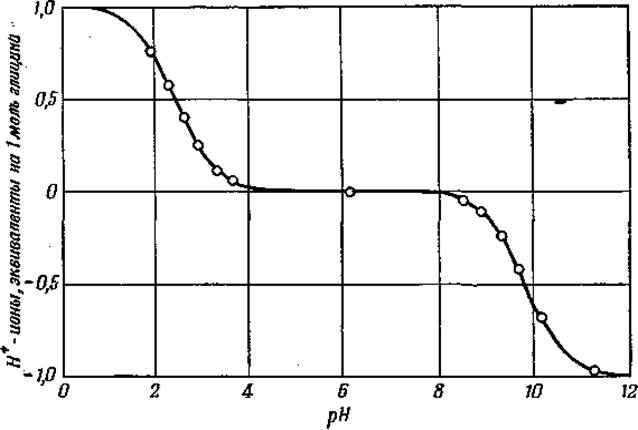
Fig. 3. Dissociation curve of glycine [113].
As a rule, hydrochlorides of neutral Amino Acids and dihydrochlorides of basic amino acids are more soluble in water than the corresponding free amino acids; most amino acid hydrochlorides are readily soluble in alcohol. Sodium salts of amino acids (and disodium salts of dicarboxylic amino acids) are also much more soluble in both water and alcohol than the free amino acids. Tyrosine and cystine are known to be very sparingly soluble in water within the pH range of 2.5 to 9, but their solubility increases at lower or higher pH values. The solubility of amino acids in aqueous media is affected by the presence of salts. Like proteins, some amino acids exhibit increased solubility upon The addition of salts. For instance, the solubility of cystine increases in the presence of ammonium sulfate; with a further increase in the Ionic strength of the solution, cystine is "salted out" from the solution [111]. The solubility of amino acids is discussed in more detail in reviews by Edsall and Scatchard [112], as well as by Cohn and Edsall [110].
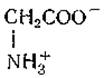
In aqueous solutions, amino acids exist as dipolar ions (zwitterions); for example, the glycine molecule can be represented as follows:
According to Brønsted, an acid is defined as a substance that can donate a proton, and a base as a substance that can accept a proton. The titration curve of glycine with Hydrochloric acid and sodium hydroxide has 2 inflection points (Fig. 3) [113]. Thus, glycine can react as both an acid and a base; in other words, it is an ampholyte:
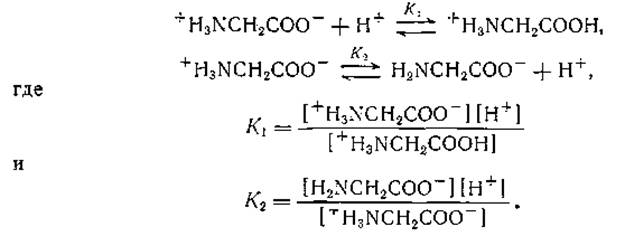
For glycine, рК'1 = 2.34 and рК'2 = 9.60 (it is standard practice to list the pK' values of amino acids in order of decreasing acidity). Since the pK' of acetic acid is 4.8, it is clear that the presence of the NH+3 group in the glycine molecule increases the acidity of its carboxyl group. This can be explained by the fact that the NH+3 group promotes the repulsion of the hydrogen ion from the carboxyl group. Acylation of the amino group of glycine decreases the degree of dissociation of the carboxyl group; for example, the pK'1 values for acetylglycine and chloroacetylglycine are 3.60 and 3.37, respectively. For glycinamide, pK'2 = 7.93, whereas for glycine, pK'2 = 9.60.
The dissociation curves of amino acids whose molecules contain more than two dissociating groups exhibit additional inflection points. For example, the pK' values for histidine are 1.82 (carboxyl), 6.00 (imidazole), and 9.17 (NH+3).
The isoelectric point (pI) of an amino acid is defined as the pH at which The amino acid molecule is electrically neutral; at this pH, the amino acid does not migrate in an electric field. The pI value for glycine is 5.97; however, its titration curve (see Fig. 3) shows that glycine remains in the isoelectric state over a fairly wide pH range. The isoelectric point for a monocarboxylic amino acid can be found by dividing the sum of pK'1 and pK'2 by 2. For amino acids with three dissociating groups, the pI can be determined with good accuracy as the average of the two predominant pK' values. The pK' values for the dissociation of the guanidine group of arginine, the phenolic group of tyrosine, and the sulfhydryl group of cysteine are 12.48, 10.07, and 10.78, respectively. For a more detailed discussion of this topic, the reader is referred to the review by Edsall [114]. The pK' values for amino acids commonly found in proteins are listed in Table 2.
Last update: 06/08/2026
Editorial and Educational Adaptation: This material has been compiled based on the primary/original source text. The project team performed an editorial review, corrected technical inaccuracies, structured sections, and adapted the content for an educational format.
What was processed:
- elimination of formatting defects (OCR errors, structural breaks, corrupted characters);
- editorial organization of content;
- standardization of terminology in accordance with academic sources;
- verification of factual statements against the original source text.
All mentions of the author, publication year, and origin of the primary text have been preserved in accordance with the source.