Human Biochemistry, Volume 1 - Murray R. 1993
Metabolism of Proteins and Amino Acids
Conversion of Amino Acids into Specialized Products
Tyrosine
Tyrosine is a precursor of adrenaline and noradrenaline, which are synthesized in Cells of neural origin. During The production of melanin in melanocytes and noradrenaline in Nerve Cells, DOPA serves as an intermediate; however, the hydroxylation of tyrosine in different Cell types is catalyzed by distinct Enzymes. Tyrosine hydroxylase is a copper-independent enzyme, yet, much like phenylalanine hydroxylase, it Functions with the participation of tetrahydrobiopterin. It catalyzes The formation of DOPA in Neurons and adrenal cells as an intermediate on the pathway to noradrenaline and adrenaline (Fig. 32.10). DOPA decarboxylase, a Pyridoxal phosphate-dependent enzyme, catalyzes the synthesis of dopamine. The latter undergoes further hydroxylation mediated by dopamine-ß-oxidase, a copper-containing enzyme believed to utilize Vitamin C in the reaction producing noradrenaline. In The adrenal medulla, the enzyme phenylethanolamine-N-methyltransferase uses S-adenosylmethionine to methylate the primary amino group of noradrenaline, thereby yielding adrenaline (Fig. 32.10).
Class="center">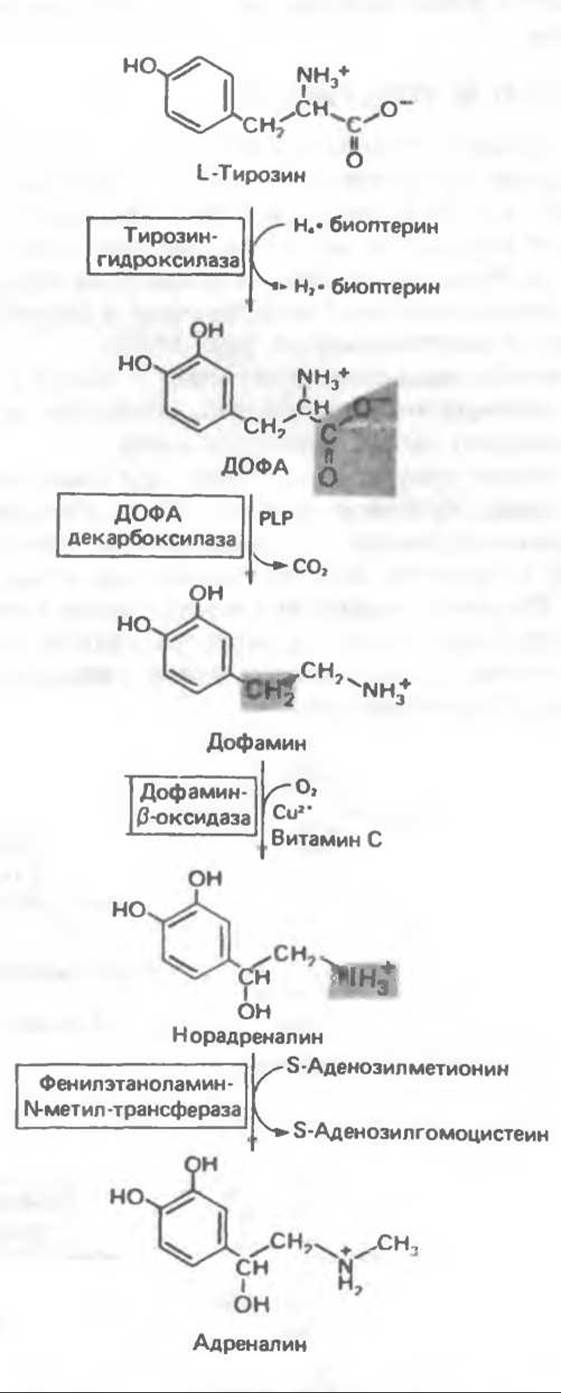
Fig. 32.10. Conversion of tyrosine to adrenaline and noradrenaline in neurons and adrenal cells. PLP – pyridoxal phosphate.
Tyrosine also serves as a precursor for the THYROID Hormones triiodothyronine and thyroxine (see Chapter 46).
Tyrosine is excreted in the urine both in its free form and as a sulfate conjugate; the formation of such conjugates is typical for most Phenolic Compounds excreted in urine.
Last update: 06/08/2026
Editorial and Educational Adaptation: This material has been compiled based on the primary/original source text. The project team performed an editorial review, corrected technical inaccuracies, structured sections, and adapted the content for an educational format.
What was processed:
- elimination of formatting defects (OCR errors, structural breaks, corrupted characters);
- editorial organization of content;
- standardization of terminology in accordance with academic sources;
- verification of factual statements against the original source text.
All mentions of the author, publication year, and origin of the primary text have been preserved in accordance with the source.