Biochemistry: The Chemical Reactions of Living Cells, Volume 2 - D. Metzler 1980
Coenzymes: specialized natural reagents
Thiamine diphosphate
Pyridoxal phosphate
The phosphoric aldehyde form of Vitamin B6, pyridoxal phosphate (pyridoxal-P, or PLP), is essential for numerous Enzymes that catalyze Amino Acid and amine conversion reactions. The number of such reactions is immense, making pyridoxal phosphate undeniably one of the most versatile natural catalysts. The first to be discovered was the Transamination reaction—a process that holds a central place in Nitrogen METABOLISM.
Class="center">1. Transamination [33]
In 1937, Alexander Braunstein and Maria Kritzmann described a novel reaction whereby amino groups could be transferred from one carbon Skeleton to another. For instance, the amino group of glutamic acid is transferred to the carbon skeleton of oxaloacetic acid, yielding aspartic acid and a-ketoglutarate:
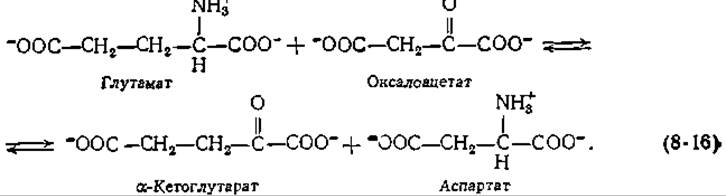
Braunstein envisioned the widespread occurrence and significance of this transamination process in the nitrogen metabolism of living organisms. A series of aminotransferases (transaminases) catalyzing such conversions was discovered, with glutamate typically serving as one of the reactants.
Several years later, Snell reported the non-enzymatic conversion of pyridoxal to pyridoxamine (Supplement 8-D) upon heating with glutamate, and noted that this process was likewise a transamination. He hypothesized that pyridoxal might be part of the coenzyme required by transaminases. This hypothesis was soon confirmed, and the coenzyme was identified as pyridoxal-5'-phosphate (Fig. 8-5). Around the same time, Gunsalus and coworkers reported that The activity of Tyrosine decarboxylase produced by lactic acid Bacteria was abnormally low when pyridoxine was absent from the nutrient medium. The addition of pyridoxal along with ATP led to an increase in decarboxylase activity, synthesizing PLP, which was shown to be the required coenzyme. It soon became evident that PLP also Functions in many other enzyme systems.
Supplement 8-D
The Vitamin B6 Family: Pyridoxine, Pyridoxal, and Pyridoxamine

The existence of a new vitamin was concluded in 1934, when it was observed that rats fed a vitamin-free purified diet supplemented with thiamine and riboflavin developed facial dermatitis—"rat pellagra." In 1938, pyridoxine (the standard commercially available form of vitamin B6) was isolated and synthesized. Soon, studies on the Nutritional Requirements of lactic acid bacteria revealed the existence of other natural forms of the new vitamin that promoted the growth of certain strains of these bacteria much more effectively than pyridoxine. In 1944, Snell identified these unknown substances as the amine pyridoxamine and the aldehyde pyridoxal.
Pyridoxal could be obtained from pyridoxine by mild oxidation, and pyridoxamine from pyridoxal (via transamination) by heating with glutamic acid in solution. In fact, these simple experiments were what led Snell to the correct Structure OF THE new vitamin B6 forms.
Acid-base reactions and the Tautomerism of pyridoxine were discussed earlier in Ch. 4, Sec. B, 3 and B, 4.
Daily Requirement. Vitamin B6 is widely distributed in foods, and symptoms of severe deficiency of this vitamin in humans are rarely observed. In most cases, an adult seems to require about 1.5–2 mg of vitamin B6 per day, and children about 0.4 mg per day. However, the latter figure may be close to the lower limit of normal. In some instances, the onset of convulsions has been attributed to the partial destruction of vitamin B6 present in milk. Convulsions are observed when the vitamin B6 content drops to approximately 50% of its normal level in human milk.
In animal Tissues and animal-derived products, vitamin B6 is present primarily as pyridoxal, pyridoxamine, and their phosphate esters. The lability of the aldehyde accounts for the ease with which the vitamin is destroyed by excessive heat or light. Meanwhile, plant tissues contain predominantly pyridoxine, which is more stable. Phosphorylated forms of vitamin B6 can undergo interconversions within Cellsa,b. Pyridoxine-5'-phosphate can be oxidized to PLP, and the latter undergoes transamination to PMP.
There are clinical reports of infants with an abnormally high demand for vitamin B6 (2–10 mg/day), and A number of rare Metabolic Disorders are knownc-e in which specific enzymes, such as cystathionine synthetase, exhibit a reduced affinity for PLP. Patients with these disorders also benefit from higher doses of the vitamin. Cases of excessively high excretion of vitamin B6 are also known; a striking example is a strain of laboratory mice that require twice the normal amount of vitamin B6 and die in convulsions shortly after vitamin B6 is removed from their dietc.
a Snell E. E., Haskell В. E. (1970). Compr Biochem., 21, 47—71.
б Johansson S., Lindstedt S., Tiselius H.-G. (1974). J. Biol. Chem., 249, 6040—6046.
в Mudd S. H. (1971). Fed. Proc, Fed. Am. Soc. Exp. Biol, 30, 970—976
г Bell R. R., Haskell В. E. (1971). Arch. Biochem Biophys., 147, 588—601.
д Pascal T. A. Gaull G. Е., Beratis N. G., Gillam В. M., Tatian H. H., Hirschhorn К. (1975). Science, 190, 1209—1211.
Last update: 06/08/2026
Editorial and Educational Adaptation: This material has been compiled based on the primary/original source text. The project team performed an editorial review, corrected technical inaccuracies, structured sections, and adapted the content for an educational format.
What was processed:
- elimination of formatting defects (OCR errors, structural breaks, corrupted characters);
- editorial organization of content;
- standardization of terminology in accordance with academic sources;
- verification of factual statements against the original source text.
All mentions of the author, publication year, and origin of the primary text have been preserved in accordance with the source.