Biochemistry of Amino Acids - A. Majster 1961
General Biochemistry and Physiology of Amino Acid Metabolism
Transamination
The Significance of Transamination Reactions in Amino Acid Metabolism
The widespread occurrence of transamination reactions and the participation of numerous Amino Acids in them highlight the crucial significance of these reactions in METABOLISM. The Role of transamination in the Oxidative Deamination of L-Amino Acids and urea synthesis in mammals was discussed above (p. 171). The possibility of replacing essential a-amino acids in the diet of growing animals with the corresponding ketoacids is determined by the presence of active transaminases in the Organism (p. 137). It was demonstrated relatively recently that young rats grow at approximately the same rate when fed a synthetic diet containing 10 Essential Amino Acids and glutamic acid, as well as a diet in which 5 essential amino acids (leucine, isoleucine, valine, phenylalanine, and Methionine) are replaced by the corresponding ketoacids and an equivalent nitrogen source [321]. These findings indicate that the total transase activity in the rat organism is very high; since Protein Synthesis requires the simultaneous presence of all amino acids, the aforementioned facts suggest that the specified five a-ketoacids rapidly undergo transamination.
1 The existence of such reactions remains unproven. In extracts of "pyridoxamine phosphate transaminase" from E. coli [R. B. Beecheya, F. C. Happold, Biochem. J., 66, 520 (1957)], The conversion of pyridoxamine phosphate to Pyridoxal phosphate occurs via oxidative deamination rather than transamination, whereas the reaction mistakenly assumed by the authors to be the transamination of pyridoxal phosphate actually consists in the enzymatic dephosphorylation of pyridoxal phosphate (J. Turner, personal communication, 1959). According to recent data by Senez (1960), non-enzymatic transamination between pyridoxamine phosphate and a-ketoacids is observed in bacterial extracts; this explains the activation of certain Bacterial Amino Acid Decarboxylases by ketoacids. — Ed. note.
Attempts to establish a direct link between transamination reactions and processes such as protein synthesis, growth, and development have been unsuccessful [255, 257, 322–320]. Experiments on rats have yielded interesting data on The Effect of Anterior Pituitary Hormones and hypophysectomy on tissue transamination reactions. Administration of the anterior pituitary hormone causes an increase in aspartate-glutamate transaminase activity in the Liver (but not in the Kidneys) of hypophysectomized rats and rats maintained on a restricted diet, but has no effect on The activity of this enzyme in The Liver and kidneys of adult healthy females [327]. The same hormone causes an increase in Alanine-glutamate transaminase activity (but not aspartate-glutamate transaminase) in the liver of young rats and a decrease in the activity of this enzyme in adult males [328]. Administration of cortisone increases aspartate-glutamate transaminase activity in the kidneys and Heart Muscle of mice and decreases the activity of this enzyme in the liver [329]. A decrease in the activity of aspartate-glutamate and, particularly, alanine-glutamate transaminase is observed in rats maintained on a low-protein diet [330]. The interpretation of these effects is currently difficult; in any case, such observations provide insight into several questions that remain to be resolved.
The activity of serum aspartate-glutamate transaminase is normally very low; it increases significantly in certain diseases, notably in myocardial infarction. This phenomenon, which has diagnostic value, is discussed in Chapter V.
Braunstain and Bychkov [331] hypothesized in 1939 that the oxidative deamination of certain L-amino acids [332] can be explained by the combined action of transaminases—which catalyze transamination between a-amino acids and a-ketoglutaric acid—and Glutamate dehydrogenase (p. 175).
Class="center">
Since these reactions are reversible, it should be expected that amination of a-ketoacids can also occur via this mechanism. The question of the existence of reversible amination Enzymes for amino acids other than glutamic acid requires further study. The view that such mechanisms exist is shared by Cedrangolo [333], who obtained data indicating the direct oxidation of alanine by enzyme preparations from the liver and kidneys. Enzyme preparations obtained from the liver and kidneys of B6-avitaminotic rats exhibit a reduced capacity for the deamination and transamination of L-aspartic acid and L-alanine, whereas the activity of glutamate dehydrogenase in these preparations remains at a normal level [334]. In this regard, observations by Fincham [335] are of considerable interest, demonstrating that a mutant strain of Neurospora crassa lacking glutamate dehydrogenase is unable to assimilate ammonia, whereas any of a large group of amino acids Supports mold growth when added to the nutrient medium instead of glutamic acid.
At the same time, evidence indicates the presence of alternative pathways for the amination and Deamination of Amino acids in certain organisms (see, for example, [336–339]). For instance, it was found that under certain conditions in Brucella abortus, 75% of alanine is formed via transamination, while the remainder is produced through other mechanisms. Direct amination of Pyruvate occurs in this microorganism, although it is not the sole pathway for alanine synthesis. Reports also exist on the direct enzymatic amination of pyruvate in Bacillus subtilis (p. 191).1.
1 Cells of Bacillus subtilis and many other spore-forming aerobes (bacilli) do not contain glutamate dehydrogenase: in these microorganisms, and partly in other Gram-positive Bacteria possessing a reversibly functioning L-Alanine Dehydrogenase, ammonia assimilation occurs via reductive amination of pyruvic acid followed by transamination between alanine and ketoglutaric acid [Shen, San-Chung, Hun Mun-min, and A. E. Braunstain, Biokhimiya, 24, 929, 957 (1959)]; the presence of alanine dehydrogenase in Gram-negative bacteria, higher plants, and animals, assumed by some authors, cannot be considered proven. — Ed. note.
In recent years, it has become evident that the Biosynthesis AND DEGRADATION processes of many amino acids proceed with the participation of transamination reactions. Intermediate reactions of individual Amino acid metabolism are discussed in Chapter IV; here we shall limit ourselves to a brief Structure/133.html">Discussion of the general Functions of transamination processes in Intermediary Metabolism.
The reversible formation of alanine, glutamic acid, and aspartic acid from their corresponding a-ketoacids—which arise in The Citric Acid Cycle—occurs via transamination. Transamination reactions serve as intermediates in The biosynthesis of A number of Other Amino Acids (e.g., isoleucine, valine, leucine, phenylalanine, Tyrosine, etc.) in microorganisms. In Escherichia coli, at least three transaminases participate in Amino acid biosynthesis [272]:
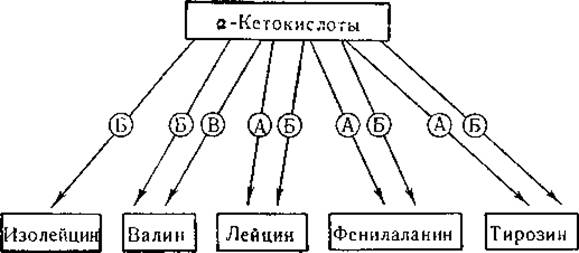
Transaminases A and B take part in the biosynthesis of phenylalanine, tyrosine, and leucine; enzyme preparation A is more active toward aromatic amino acids, although its activity toward leucine is also quite high. Valine formation is catalyzed by enzymes B and W; isoleucine is synthesized solely with the participation of enzyme B. Consequently, The formation of each of the listed amino acids, except for isoleucine, is ensured by two transaminases. It is hardly surprising that the only E. coli mutant strain found to have a defect at the transamination stage proved incapable of synthesizing isoleucine specifically.
Transamination reactions are linked to the processes of tyrosine degradation in the organism (p. 418), the biosynthesis of Ornithine (p. 344) and Histidine (p. 388), and the metabolism of glutamine and asparagine (p. 215). During Cysteine dissimilation, transamination reactions occur at three stages:
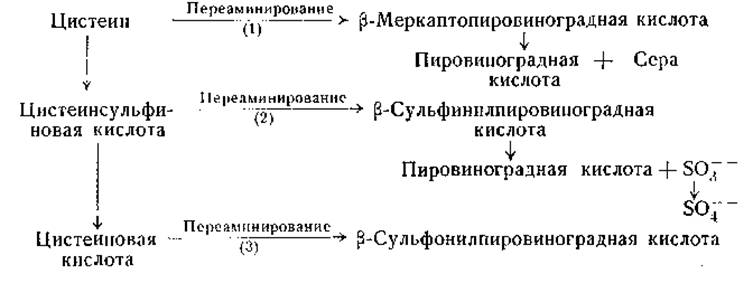
Reaction (1) represents an intermediate step in one of the mechanisms of enzymatic cysteine desulfuration; in the presence of reducing substances, hydrogen sulfide is formed instead of elemental sulfur. In reaction (2), a-ketoglutaric, oxaloacetic, and pyruvic acids can serve as amino group acceptors. The reaction between cysteinesulfinic acid and a-ketoglutarate is likely catalyzed by aspartate-glutamate transaminase. According to some reports, reaction (3) is catalyzed by a specific enzyme [340], although it is known that purified preparations of pig heart aspartate-glutamate transaminase [269, 274] are capable of carrying out reactions involving cysteinesulfinic acid.
The transamination of kynurenine and 3-hydroxykynurenine leads to the formation of kynurenic and xanthurenic acids, respectively [341–344]. When studying pig liver kynureninase, it was found that in the presence of pyruvate or ketoglutarate in the experimental samples, kynurenic acid is formed from kynurenine [344, 345]. Later, using a Pseudomonas strain, the transamination reaction between kynurenine and a-ketoglutarate was studied, yielding kynurenic and glutamic acids. The formation of kynurenic acid is evidently explained by the spontaneous cyclization of the presumed intermediate product of this reaction—o-aminobenzoylpyruvic acid:
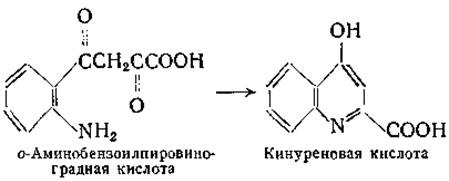
This reaction is closely related to the cyclization reaction of a-keto-ε-aminocaproic acid [288]:
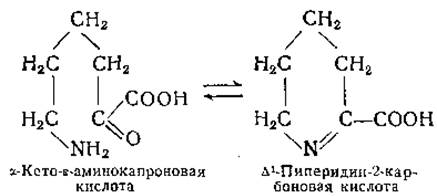
Unlike the latter reaction, the formation of kynurenic acid proceeds irreversibly due to the creation of a stable aromatic ring. The transamination of kynurenine competes with its Cleavage by kynureninase; both reactions require Pyridoxal phosphate as a coenzyme. In experiments with rat liver extracts, these enzyme systems were successfully separated [346]; at pH 6.3, the activity of rat liver kynureninase is significantly reduced compared to that of kynurenine transaminase [347]. Kynurenine transaminase has also been detected in rat kidneys [347]. The physiological function of Kidney kynurenine transaminase is not entirely clear, since no appreciable Conversion of Tryptophan into kynurenine or kynurenic acid occurs in kidney tissue, and under normal conditions the kynurenine content in the Blood is negligible [344, 348]. The formation of xanthurenic acid from 3-hydroxykynurenine also occurs via transamination ([344, 349] and p. 405). Kynurenine transaminase preparations also act on 5-hydroxykynurenine; the end product of the transamination reaction in this case is 6-hydroxykynurenic acid [349, 350].
The number of direct proofs regarding the participation of Lysine in transamination reactions is small; however, investigations into the metabolism of this amino acid have yielded data indicating its conversion into the corresponding a-keto derivative via transamination [351] (see p. 431); transamination reactions involving 5-aminovaleric acid—a potential product of lysine metabolism—have also been described [308, 309]. Transamination reactions play a role in the metabolism of y-aminobutyric acid, ß-alanine, and 3,5-diiodotyrosine [352]. In Bacillus subtilis, B. anthracis, and possibly other microorganisms of this group, D-transaminase apparently plays a role in the formation of D-glutamic acid, which is necessary for the synthesis of extracellular D-Polyglutamic acid (see p. 265).
In the metabolism of certain plants, Transamination reactions between y-methyleneglutamic acid and oxaloacetic, a-ketoglutaric, or pyruvic acids apparently play a significant role [357], as supported by the presence of y-methyleneglutamic acid [353, 354] and a-keto-y-methyleneglutaric acid [355, 356] in plant Tissues.
The formation of oxyaspartic acid As a result of a transamination reaction between oxaloglycolic (dihydroxufumaric) and glutamic acids was described relatively recently. This enzymatic reaction has been detected in various animal tissues, including Brain, liver, and kidney tissues [259].
There are reports in the literature on the formation of amino acids via the enzymatic transfer of amino groups from adenine, guanine, cytosine, and pyridoxamine to a-ketoglutaric acid in E. coli enzyme preparations [358, 359], as well as amino groups from guanine, adenosine, guanosine, and adenylic acid to glyoxylic or glycolic acid in liver slices [360]. The conversion products of the purine and pyrimidine derivatives were not investigated in these cases. It is unlikely that typical transamination reactions occurred here; The Nature of the described transformations remains unclear.
It must be taken into account that transamination reactions may involve compounds that are not amino acids, such as glucosamine, phosphoric esters of certain CARBOHYDRATES, Glutathione, and other Peptides. Herbst and Schimin [361] observed the non-enzymatic conversion of pyruvoyl-alanine to alanylalanine; these data suggest the possible existence of analogous enzymatic reactions. There have been reports in the literature on the enzymatic transamination of peptides [322], but these works were criticized due to the unreliability of the Analytical Methods used [255, 257, 260, 277]. The transamination of ß-oxalacetylamino acids with the formation of ß-aspartyl peptides has been described [154] (p. 223).
Although transamination plays a vital role in the Synthesis and degradation of many amino acids, it has been found that the metabolism of Certain amino acids capable of undergoing transamination (e.g., tryptophan, methionine, phenylalanine) apparently proceeds predominantly via other pathways. It should be borne in mind that our current views on the "major" Metabolic pathways are not definitive and are subject to change; moreover, quantitatively minor transformations may play a crucial physiological role. The Conversion of the α-keto analogue of valine into pantoic acid in Escherichia coli [362] is an example of a "secondary" transformation leading to the formation of an essential metabolite. The presence of phenylacetylglutamine in the urine of healthy individuals suggests that phenylalanine is partially converted in the body into phenylpyruvic acid (p. 421). For the Mechanism of Enzymatic transamination, see p. 247.
1 Upon careful experimental verification, observations concerning transamination reactions involving aminopurines and aminopyrimidines were not confirmed (A. Schein and E. Brown, Biochem. J. 67, 594, 1957). — Ed. note.
Last update: 06/08/2026
Editorial and Educational Adaptation: This material has been compiled based on the primary/original source text. The project team performed an editorial review, corrected technical inaccuracies, structured sections, and adapted the content for an educational format.
What was processed:
- elimination of formatting defects (OCR errors, structural breaks, corrupted characters);
- editorial organization of content;
- standardization of terminology in accordance with academic sources;
- verification of factual statements against the original source text.
All mentions of the author, publication year, and origin of the primary text have been preserved in accordance with the source.