Biological Chemistry - Berezov T. T., Korovkin B. F. 1998
Hormones
Pituitary Hormones
Lipotropic hormones (LPH, lipotropins)
Among the Anterior Pituitary Hormones whose structures and Functions have been elucidated over the past decade, lipotropins—specifically ß- and y-LPH—deserve special mention. The Introduction/19.html">Primary Structure of sheep and pig ß-lipotropin has been studied in the greatest detail; its molecules consist of 91 amino acid residues and exhibit significant Species Differences in their Amino acid sequences. The biological properties of ß-lipotropin include fat-mobilizing, corticotropic, melanocyte-stimulating, and hypocalcemic activities, as well as an Insulin-like effect manifested by an increased rate of glucose utilization in Tissues. It is suggested that the lipotropic effect is mediated through the adenylate cyclase—cAMP—protein kinase system, the final step of which involves the phosphorylation of inactive triacylglycerol lipase. Once activated, this enzyme hydrolyzes neutral fats into diacylglycerol and free Fatty acids (see Chapter 11).
* The gonadotropin group also includes human chorionic gonadotropin (hCG), a glycoprotein synthesized by placental Cells.
These biological properties are not due to ß-lipotropin itself, which lacks hormonal activity, but rather to its degradation products formed via Limited proteolysis. It has been found that biologically active Peptides with opiate-like activity are synthesized in Brain tissue and the intermediate lobe of the Pituitary Gland. The structures of some of these peptides are presented below:
Class="center">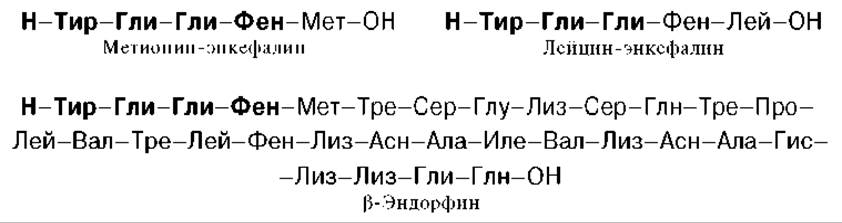
A structural feature common to all three compounds is the tetrapeptide sequence at the N-terminus. It has been proven that ß-endorphin (31 Amino Acids) is formed through the proteolysis of a larger pituitary hormone, ß-lipotropin (91 amino acids); the latter, along with ACTH, is derived from a common precursor—a prohormone termed proopiomelanocortin (making it a preprohormone) with a molecular mass of 29 kDa and 134 amino acid residues. The Biosynthesis and release of proopiomelanocortin in the anterior pituitary are regulated by hypothalamic corticotropin-releasing hormone. In turn, further Processing of ACTH and ß-lipotropin, specifically via limited proteolysis, yields a- and ß-melanocyte-stimulating hormones (a- and ß-MSH), respectively. Using DNA Cloning techniques and Sanger's nucleic acid sequencing method, several laboratories have deciphered The nucleotide sequence of the proopiomelanocortin mRNA precursor. These studies can serve as a basis for the targeted production of novel biologically active hormonal therapeutics.
Presented below are the Peptide Hormones derived from ß-lipotropin through specific proteolysis.
ß-Lipotropin segment |
Peptide hormone |
1-58 |
Y-Lipotropin |
41-58 |
ß-MSH |
61-65 |
Met-enkephalin |
61-76 |
a-Endorphin |
61-77 |
y-Endorphin |
61-79 |
δ-Endorphin |
61-91 |
ß-Endorphin |
Given the pivotal role of ß-lipotropin as a precursor to these hormones, the primary structure of porcine ß-lipotropin (91 amino acid residues) is given below:
H-Glu-Leu-Ala-Gly-Asp-Pro-Pro-Glu-Pro-Ala-Arg-Asp-Pro-Glu-Ala-Pro-Ala-Glu-Gly-Ala-Ala-Ala-Arg-Ala-Glu-Leu-Glu-Tyr-Gly-Leu-Val-Ala-Glu-Asp-Glu-Asp-Ala-Glu-Lys-Lys-Asp-Glu-Gly-Pro-Tyr-Lys-Met-Glu-His-Phe-Arg-Trp-Gly-Ser-Pro-Pro-Lys-Asp-Lys-Arg-Tyr-Gly-Gly-Phe-Met-Thr-Ser-Glu-Lys-Ser-Gln-Thr-Pro-Leu-Val-Thr-Leu-Phe-Lys-Asn-Ala-Ile-Val-Lys-Asn-Ala-His-Lys-Lys-Gly-Gln-OH
The heightened interest in these peptides, particularly enkephalins and endorphins, stems from their exceptional ability to relieve pain, much like morphine. This field of research—the search for novel natural peptide hormones and/or their targeted biosynthesis—holds great promise for the advancement of physiology, neurobiology, neurology, and clinical medicine.
Last update: 06/08/2026
Editorial and Educational Adaptation: This material has been compiled based on the primary/original source text. The project team performed an editorial review, corrected technical inaccuracies, structured sections, and adapted the content for an educational format.
What was processed:
- elimination of formatting defects (OCR errors, structural breaks, corrupted characters);
- editorial organization of content;
- standardization of terminology in accordance with academic sources;
- verification of factual statements against the original source text.
All mentions of the author, publication year, and origin of the primary text have been preserved in accordance with the source.