Human Anatomy and Physiology (with Age-Related Characteristics of the Child's Body) - M.R. Sapin, V.I. Sivoglazov 2002
Nervous system
Brain
Higher nervous activity
The activity of the Cerebral Cortex is directed toward the continuous analysis and synthesis of incoming signals (nerve impulses) received by the brain from various Organs, systems, and apparatuses. In the course of this analytical activity, all stimuli perceived by the body are differentiated in the cortex according to their specific features, intensity, and nature of impact.
The synthetic activity of the cerebral cortex ensures the integration of signals coming from various analyzers, Sensory Organs, and functional centers of The Nervous System. This synthetic activity of the human brain is made possible by numerous and diverse associative connections between different PARTS OF THE Central nervous system.
Based on the analysis and synthesis of incoming information, behavioral acts of varying complexity are generated. These behavioral acts may include defense against danger, foraging for food when hungry, actions ensuring survival, and many others. Depending on the information transmitted via sensory pathways to the higher centers of the brain, appropriate decisions are made and executed through various actions. At any given moment, the Organism and its brain focus all their attention on the primary task, temporarily Setting aside less critical matters. The activity of the brain and its higher centers is directed toward achieving ultimate goals. If necessary, additional information is retrieved from the environment or from the "stores" of memory. Functional systems operate within behavioral reactions. Nerve impulses travel from receptors through neuronal chains of reflex arcs to effectors (working organs), and from them back via a reflex loop that carries new feedback signals about execution and goal achievement. The analytical and synthetic activities of the cerebral cortex are not isolated processes; they are interconnected and occur through the interaction and functional unity of different brain regions, analyzers, and associative systems.
Motivation and emotion. Motivation (drives) and emotions play a significant role in human life and behavior. Their influence on complex human behavioral acts is immense. This concerns the fulfillment of vital bodily needs, such as feeding, drinking, sexual, and maternal Functions, as well as feelings of anxiety, fear, and others. Many actions are performed with a certain emotional tone, accompanied by elevated or depressed mood. These functions of motivation and emotion, along with the Maintenance of the body's internal environment, are managed and controlled by the Limbic System and the Hypothalamus. The limbic system, sometimes called the visceral brain due to its major role in regulating autonomic functions, includes structures of the olfactory brain (olfactory bulb, olfactory tract, etc.), the cingulate and dentate gyri, the hippocampus, the fornix, and several others. In the limbic system and the hypothalamus, specific brain areas have been identified where damage or stimulation (in animals) triggers an uncontrollable feeding response (the "hunger center") or, conversely, food refusal (the "satiety center").
Centers for Water seeking ("thirst centers"), sexual drive, aggression, depression, and others have been discovered. The limbic system has extensive connections with other brain regions, particularly the subcortical nuclei (ganglia), the hypothalamus, and the reticular formation. Under the Influence of the cerebral cortex, it regulates the Functions of the cardiovascular, respiratory, digestive, and other systems directly involved in METABOLISM and the replenishment of energy reserves.
Types of the nervous system
Nervous reactions in different individuals vary in strength, mobility, and balance. These individual characteristics are determined by the relationship between the processes of Excitation and Inhibition. Based on these three criteria, primarily the strength of nervous processes, strong and weak types of the nervous system have been identified.
Types of the nervous system (according to I.P. Pavlov):
Class="center">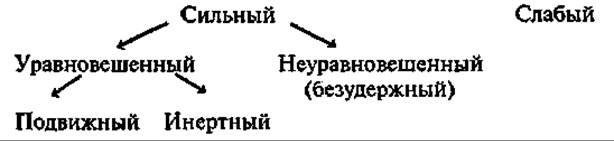
The strong type of the nervous system can be unbalanced or balanced. The unbalanced type of the nervous system is characterized by increased excitability and explosiveness, where excitatory processes predominate over inhibitory ones.
The balanced type of the nervous system can vary in the mobility of nervous processes, the speed of response, and behavioral adaptation. With a mobile type of nervous processes, rapid reorientation is possible in response to changing life circumstances. With an inert type of the nervous system, adapting one's activity is difficult and proceeds slowly.
Interestingly, the types of nervous system identified by I.P. Pavlov correspond to the Classification of human temperaments proposed 2500 years ago by the famous ancient physician Hippocrates. He classified people by temperament into choleric (unbalanced, easily excited), sanguine (balanced, with a lively, mobile nervous system—optimists), phlegmatic (balanced, calm, deliberate, inert), and melancholic (weak type of nervous system, gloomy, depressed, eternal skeptics).
The type of nervous system is inherited from parents, but it is significantly influenced by the environment. Character traits are formed throughout an individual's life.
A weak type can develop when a child is raised in overprotective, "greenhouse" conditions, where adults make all decisions, prevent any independent action, and stifle initiative. Shielding a child from difficulties and environmental influences, even with an innate strong type of nervous system, can lead to The Development of purely passive-defensive reactions.
Setting excessively difficult, overwhelming tasks can cause overstrain of cortical processes of excitation or inhibition, leading to breakdowns in nervous activity and neuroses. Human mental functions are impaired by the effects of alcohol and drugs, which severely disrupt the mechanisms of nervous processes.
Regular, quality rest is essential for normal life and recovery. This rest is provided by sleep, which is a physiological need of the body. The alternation of sleep and wakefulness is vital for life. A person spends approximately one-third of their life asleep. If deprived of sleep, a person experiences heightened sensitivity, Muscle weakness, and even mental disorders. The required duration of sleep changes with age. After birth (up to 4—5 мес), infants sleep 17—18 hours a day. By 5—6 years of age, sleep duration decreases to 9—11 hours, and by 16—20 years, to 8 hours. After age 20, sleep ranges from 5 to 8 hours a day. Often, a person may need an additional daytime nap.
During sleep, a person loses connection with the external environment, and consciousness is turned off. Sensory organs do not perceive normal external stimuli. Conditioned reflex activity is completely inhibited, muscle tone decreases, Blood pressure and body Temperature drop, and breathing becomes slower.
I.P. Pavlov viewed sleep as protective inhibition that spreads across the CEREBRAL CORTEX AND subcortex, protecting Nerve Cells from overfatigue and exhaustion.
During sleep, its depth changes. The deepest ("fast") sleep is usually observed in the first one to two hours and then recurs every 60—80 minutes throughout the entire sleep period, lasting for about half an hour. In the intervals between deep sleep, sleep is even and calm; it is called "slow" sleep. During deep sleep, a person is difficult to awaken; at this time, they often experience dreams, which, as I.M. Sechenov believed, are various combinations of past impressions.
REVIEW AND SELF-control questions:
1. Explain the anatomical and functional criteria used to classify the PATHWAYS OF THE BRAIN AND SPINAL cord.
2. Indicate which areas of the cerebral cortex receive nerve impulses from the pathways of pain, temperature sensitivity, Touch, pressure, muscle-joint sensation, Vision, Hearing, taste, and smell.
3. Describe what you know about The Structure of the pyramidal and extrapyramidal pathways.
4. Identify the locations of various centers in the cerebral cortex, including the analyzers for spoken and written speech.
5. Explain which Reflexes are called unconditioned and which are conditioned. How do these reflexes form?
6. Explain your understanding of the analytical and synthetic activities of the cerebral cortex.
7. Describe the centers of motivation and emotion, and the Structure and function of the limbic system.
8. Describe the types of Higher Nervous Activity and The Significance of heredity and upbringing in their formation.
9. Explain what sleep is and what phases of sleep are identified.
Last update: 10/08/2026
Editorial and Educational Adaptation: This material has been compiled based on the primary/original source text. The project team performed an editorial review, corrected technical inaccuracies, structured sections, and adapted the content for an educational format.
What was processed:
- elimination of formatting defects (OCR errors, structural breaks, corrupted characters);
- editorial organization of content;
- standardization of terminology in accordance with academic sources;
- verification of factual statements against the original source text.
All mentions of the author, publication year, and origin of the primary text have been preserved in accordance with the source.