Biochemistry - The Chemical Reactions of Living Cells, Volume 2 - D. Metzler 1980
Coenzymes — special naturally occurring specialized reagents
Coenzyme A and phosphopantetheine
Structure and function of coenzyme A
Coenzyme A has a highly complex Structure (Fig. 8-1). Its "handle" is an AMP moiety with an additional phosphate group at the 3'-hydroxyl. The phosphate at the 5'-carbon atom forms an anhydride (pyrophosphate) linkage with another phosphoric acid molecule, which in turn is esterified with pantoic acid. Pantoic acid is attached to $\beta$-Alanine, and the latter to $\beta$-mercaptoethylamine via amide bonds, with the reactive —SH group positioned at the end of a long (1.9 nm) and relatively flexible chain.
Coenzyme A can be hydrolyzed by cleaving it into pantethine, pantetheine-4'-phosphate, and pantothenic acid (Fig. 8-1). All three of these compounds are growth factors. Pantetheine is required for the growth of Lactobacillus bulgaricus, an Organism residing in milk (and responsible for converting milk into yogurt). This bacterium, which obtains preformed pantetheine from milk, has lost The ability to synthesize this compound itself; however, it is capable of converting pantetheine into CoA. Pantetheine-4'-phosphate is required by Acetobacter suboxydans, and pantothenic acid is a vitamin (Addendum 8-B). Although CoA was originally discovered as the "coenzyme of Acetylation," it is now known to perform much broader Functions. It is required (in the form of acetyl-CoA) in The Tricarboxylic Acid Cycle, in the $\beta$-Oxidation of Fatty acids, and in countless other metabolic transformations. In recognition of the vital role of CoA in biochemistry as a whole and the profound impact its discovery had on stimulating further research, Lipmann was awarded the Nobel Prize in 1953.
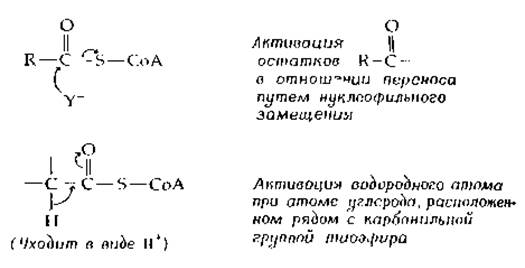
Two distinct chemical functions of CoA, which were discussed previously in Chapter 7 (Section D, 5; 3, 5 and K, 1), are illustrated in Table 8-1.
Class="center">Table 8-1. Two biochemical functions of CoA
Addendum 8-B
Pantothenic Acid
The recognition of pantothenic acid as a vitamin originated from studies investigating The Role of the "vitamin B2 complex" in preventing dermatitis in chicks. Investigations into the Nutrition of Yeast and lactic acid Bacteria also pointed to the existence of novel, yet unidentified growth factors. By 1938, it became clear that all these activities were due to a single acidic substance present in most natural Materials. Soon, the new vitamin was isolated and characterized. It was named pantothenic acid due to its ubiquitous distribution in nature.
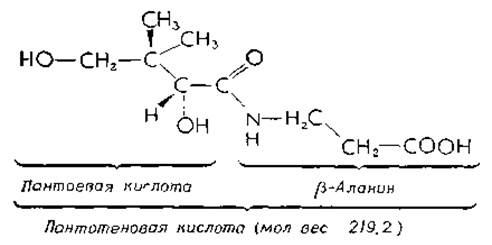
Within Cells, pantothenic acid is incorporated into the CoA molecule. The reactive center of CoA (Fig. 8-1) is the —SH group, while the $\beta$-alanine portion of the pantothenic acid molecule forms part of the flexible linker to which the —SH group is attached. It remains an enigma why pantoic acid is so essential for life—a small, oddly shaped molecule that The Human Body cannot synthesize. Some Enzymes act on simple derivatives of CoA that lack both the nucleotide component and pantoic acid. However, our bodies must harbor specific enzymes that depend on the unique structure of pantoic acid. Perhaps the hydroxyl group participates in some way in enzyme binding. It is also possible that the two methyl groups are involved in forming a "trialkyl latch" (Chapter 6, Section D, 7), which serves as part of a highly intricate "joint" or arm for the —SH-bearing "handle."
Physical properties: a white substance that crystallizes poorly. The commercially available preparation is typically the calcium salt of pantothenic acid.
Daily requirement: 10–15 mg. Pantothenic acid deficiency leads to apathy, depression, adrenal insufficiency, and Muscle weakness. $\omega$-Methylpantothenic acid acts as a specific antagonist.
Last update: 06/08/2026
Editorial and Educational Adaptation: This material has been compiled based on the primary/original source text. The project team performed an editorial review, corrected technical inaccuracies, structured sections, and adapted the content for an educational format.
What was processed:
- elimination of formatting defects (OCR errors, structural breaks, corrupted characters);
- editorial organization of content;
- standardization of terminology in accordance with academic sources;
- verification of factual statements against the original source text.
All mentions of the author, publication year, and origin of the primary text have been preserved in accordance with the source.