Biochemistry, Vol. 2 - A. Lehninger 1985
Bioenergetics and Metabolism
Fatty Acid Oxidation in Animal Tissues
Oxidation of Fatty Acids with an Odd Number of Carbon Atoms
Although most natural Lipids contain Fatty acids with an even number of carbon atoms, fatty acids with an odd number of carbon atoms are present in significant amounts in the lipids of many plants and certain marine organisms. In addition, large quantities of the 3-carbon propionic acid are produced in the rumen of cattle and other ruminants during carbohydrate Digestion. This propionate is absorbed into the bloodstream and oxidized in The Liver and other Tissues. Long-chain fatty acids with an odd number of carbon atoms are oxidized via the same sequence of reactions as even-chain fatty acids, through the successive removal of two-carbon units from the carboxyl end. However, in the final cycle of oxidation, the substrate is an acyl-CoA with five carbon atoms in its acyl group. Its oxidation and final Cleavage yield acetyl-CoA and propionyl-CoA. Acetyl-CoA is, of course, oxidized via The Citric Acid Cycle. As for propionyl-CoA, much like propionyl-CoA from other sources, it undergoes somewhat unusual enzymatic transformations. First, propionyl-CoA is carboxylated to form the D-stereoisomer of methylmalonyl-CoA (Fig. 18-11) by a biotin-containing enzyme called propionyl-CoA carboxylase. In this reaction, bicarbonate serves as the precursor of the new carboxyl group, and the energy required to form the new covalent bond is supplied by the pyrophosphate cleavage of ATP to AMP and pyrophosphate:
Class="center">Propionyl-CoA + ATP + CO2 →
→ D-methylmalonyl-CoA + AMP + PPi.
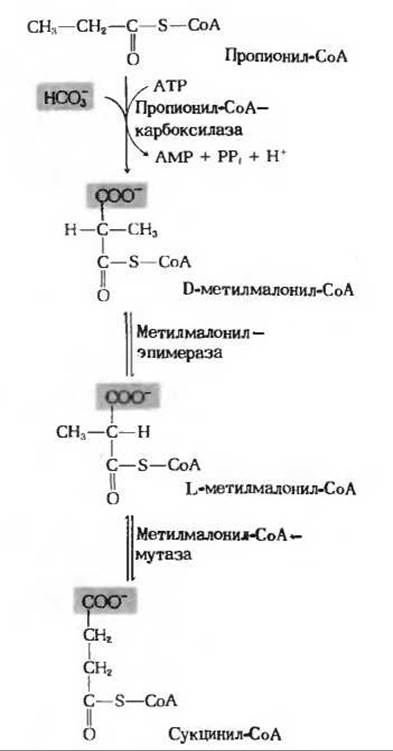
Fig. 18-11. Carboxylation of propionyl-CoA to form D-methylmalonyl-CoA and Conversion of the latter into succinyl-CoA. See also Fig. 18-12.
Mg2+ ions are also required for the reaction. The reaction product, D-methylmalonyl-CoA, is epimerized (Section 11.3) by methylmalonyl epimerase to yield the corresponding L-stereoisomer (Fig. 18-11):

L-Methylmalonyl-CoA is then converted into succinyl-CoA via a quite unusual intramolecular rearrangement (Fig. 18-11): this intramolecular rearrangement is catalyzed by methylmalonyl-CoA mutase, which requires deoxyadenosylcobalamin—the coenzyme form of vitamin B12, or cobalamin (Section 10.11)—as a coenzyme:

Succinyl-CoA is ultimately converted into oxaloacetate via The Citric Acid cycle.
It might seem that this metabolic pathway, in which propionyl-CoA is converted into succinyl-CoA, is an overly cumbersome route for such a transformation. One might well expect succinyl-CoA to be formed in a single step by The addition of CO2 to the 3-carbon atom of the propionyl group of propionyl-CoA. Instead, Cells have chosen a different path. First, CO2 is added to the 2-carbon atom, and moreover, from the "wrong" side. After the epimerase moves the CO2 to the "correct" side of the 2-carbon atom to form L-methylmalonyl-CoA, one might naturally expect The transfer of the carboxyl group from the 2-carbon atom of the propionyl group to the 3-carbon atom (Fig. 18-12). Instead, a bulky group such as —CO—S—CoA is migrated with the participation of a complex coenzyme, deoxyadenosylcobalamin. Apparently, here too, the complexity is explained by the fact that cells adopted a roundabout way to solve a difficult chemical problem.
The reaction catalyzed by methylmalonyl-CoA mutase is quite fascinating.
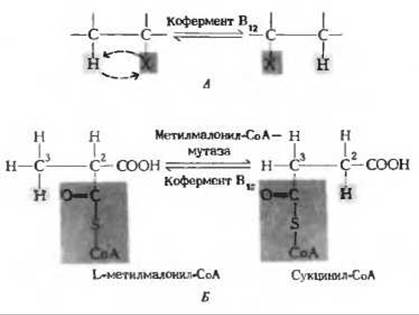
Fig. 18-12. Intramolecular rearrangement in the reaction catalyzed by methylmalonyl-CoA mutase. Coenzyme B12 participates in reactions in which a hydrogen atom is exchanged for a group X attached to an adjacent carbon atom, A. Model of the reaction. B. Reaction catalyzed by methylmalonyl-CoA mutase.
It consists of the exchange of the —CO—S—CoA group (Fig. 18-12)—which in the starting propionyl group of methylmalonyl-CoA is attached to the 2-carbon atom—for a hydrogen atom bonded to the 3-carbon atom. This is one of those relatively rare enzymatic reactions in which an alkyl group (free or substituted) is exchanged for a hydrogen atom at an adjacent carbon atom. All Enzymes that catalyze unusual reactions of this type contain 5'-deoxyadenosylcobalamin (Section 10.11). In this connection, we should recall that impaired intestinal absorption of vitamin B12 leads to pernicious anemia. Methylmalonyl-CoA is an intermediate not only in The oxidation of odd-chain fatty acids but also in the oxidative degradation of Three Amino Acids: Methionine, valine, and isoleucine (Section 19.7). Several Inherited Disorders of methylmalonyl-CoA METABOLISM are known in humans, typically manifesting in early childhood. For example, a genetic defect such as the reduction or complete absence of methylmalonyl-CoA mutase activity occurs, in which methylmalonyl-CoA cannot be converted into succinyl-CoA. As a result, all further metabolic transformations of methylmalonic acid are blocked, causing it to accumulate in large quantities in the Blood and urine, which leads to a drop in blood pH. This condition is known as methylmalonic acidemia. In some patients, improvement can be achieved by administering large doses of vitamin B12. This is possible when the genetic defect results from a reduced rate of the enzymatic reaction that converts vitamin B12 into its active coenzyme form. However, there are other patients with methylmalonic acidemia in whom the genetic defect affects the protein moiety of the methylmalonyl-CoA mutase molecule. Administration of vitamin B12 brings no relief to such patients; in these cases, the disease can be fatal.
Last update: 06/08/2026
Editorial and Educational Adaptation: This material has been compiled based on the primary/original source text. The project team performed an editorial review, corrected technical inaccuracies, structured sections, and adapted the content for an educational format.
What was processed:
- elimination of formatting defects (OCR errors, structural breaks, corrupted characters);
- editorial organization of content;
- standardization of terminology in accordance with academic sources;
- verification of factual statements against the original source text.
All mentions of the author, publication year, and origin of the primary text have been preserved in accordance with the source.