Human Biochemistry, Volume 1 - Murray R. 1993
Metabolism of Proteins and Amino Acids
Catabolism of the Carbon Skeletons of Amino Acids
Conversion of the Carbon Skeletons of Common L-a-Amino Acids into Amphibolic Intermediates
The conversion of amino acid carbon skeletons into amphibolic intermediates was established through nutritional studies conducted between 1920 and 1940. These findings, corroborated and expanded by research using labeled Amino Acids from 1940 to 1950, shaped the current understanding of the interconversions among the carbon skeletons of fats, CARBOHYDRATES, and Proteins. They demonstrated that Amino acids can be converted either into carbohydrates (13 amino acids), into fats (one amino acid), or into both carbohydrates and fats (5 amino acids) (Table 31.1). Although a detailed explanation of these interconversions was not available at the time, it was nonetheless established that they do indeed occur. The schematic pathways of these processes are illustrated in Fig. 31.1.
In the subsequent Structure/133.html">Discussion, individual amino acids will be grouped According to the amphibolic intermediate that serves as the end product of their Catabolism. An early stage in Amino Acid Catabolism, often the initial reaction, is the removal of the a-amino nitrogen. Typically (though not always; exceptions include Proline, hydroxyproline, and Lysine), this is accomplished via Transamination. Once cleaved, the nitrogen enters the general metabolic pool. Depending on the body's requirements, it can be reutilized in anabolic processes (such as Protein Synthesis) or, if present in excess, converted into urea and excreted (see Chapter 30). In most cases, the remaining carbon Skeleton is simply an oxidized hydrocarbon and cannot be readily identified as a specific amino acid derivative. It undergoes further degradation into amphibolic intermediates through reactions analogous to the Catabolic pathways of other oxidized Hydrocarbons (e.g., straight-chain or branched Fatty acids). The analogy with other metabolic pathways, particularly fatty acid METABOLISM (see Chapter 24), is remarkably striking. For instance, the carbon skeletons of branched-chain amino acids (leucine, isoleucine, and valine) are degraded via reactions similar to those involved in fatty acid catabolism.
Class="center">Table 31.1. Fate of the carbon skeleton of common L-a-amino acids
|
Converted to amphibolic intermediates that serve as precursors for |
|||
|
Glycogen ("glucogenic" amino acids) |
fat ("ketogenic" amino acids) |
glycogen or fat ("glucogenic" or "ketogenic" amino acids) |
|
|
Ala |
Hyp |
Leu |
Не |
|
Arg |
Met |
Lys |
|
|
Asp |
Pro |
Phe |
|
|
Cys |
Ser |
Trp |
|
|
Glu |
Thr |
Tyr |
|
|
Gly |
Val |
||
|
His |
|||
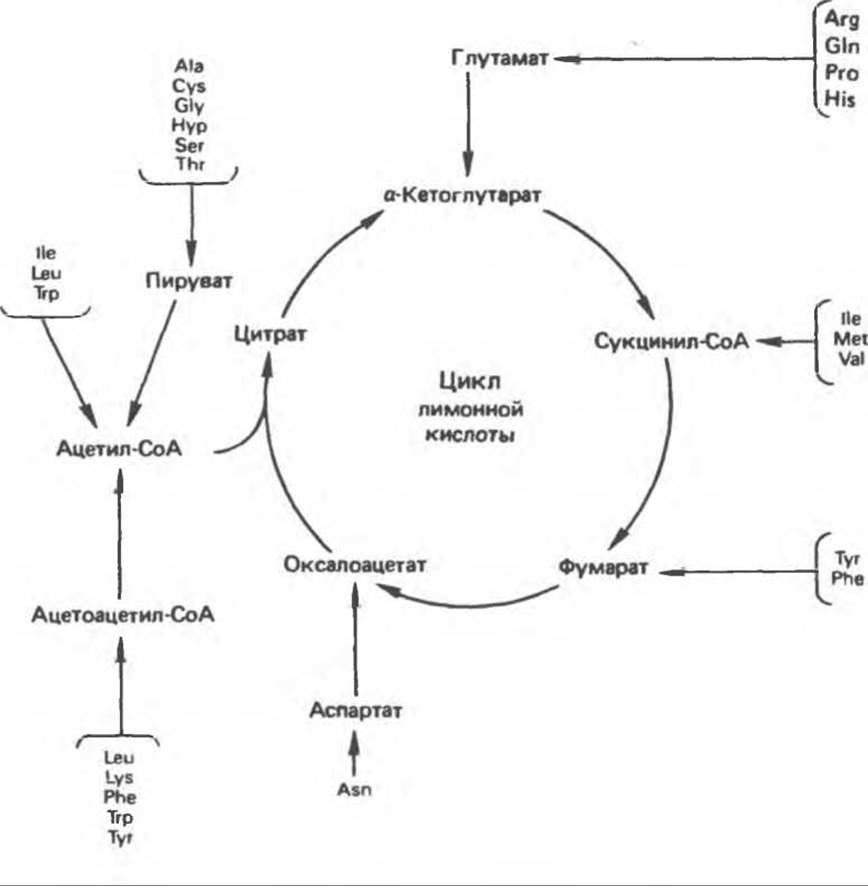
Fig. 31.1. Amphibolic intermediates derived from amino acid carbon skeletons.

Fig. 31.2. Catabolism of L-asparagine (top) and L-glutamine (bottom) leading to The formation of amphibolic intermediates. PYR — Pyruvate, ALA — Alanine. In this and subsequent figures, functional groups participating in chemical transformations are highlighted.
Last update: 06/08/2026
Editorial and Educational Adaptation: This material has been compiled based on the primary/original source text. The project team performed an editorial review, corrected technical inaccuracies, structured sections, and adapted the content for an educational format.
What was processed:
- elimination of formatting defects (OCR errors, structural breaks, corrupted characters);
- editorial organization of content;
- standardization of terminology in accordance with academic sources;
- verification of factual statements against the original source text.
All mentions of the author, publication year, and origin of the primary text have been preserved in accordance with the source.