Principles of Biochemistry Volume 1 - A. Lehninger 1985
Biomolecules
Lipids and Membranes
Fatty acids: structural components of most lipids
In the preceding chapters, we explored such vital cellular components as Water, Proteins, Enzymes, Coenzymes, and CARBOHYDRATES. Before diving into The Study of Cellular metabolic processes, we must examine yet another key group of Biomolecules: Lipids. Lipids are water-insoluble, oily or fatty substances that can be extracted from Cells using nonpolar Solvents such as ether or chloroform. The most common lipids—fats, or triacylglycerols—serve as the primary fuel source for the vastധികം of organisms, storing the bulk of The energy released during Chemical Reactions.
There is another compelling reason to discuss lipids in this chapter. Alongside nonpolar lipids, polar lipids also exist. These constitute the main Structural components of Cell membranes—the very "containers" where core metabolic processes take place. Membranes not only isolate The Cell's interior from its external environment but also ensure the Spatial Compartmentalization of metabolic processes within the cell. Furthermore, membranes are far more than mere cellular "coatings": they house numerous enzymes and transport systems. Moreover, the outer surface of The cell membrane features diverse recognition or receptor sites that facilitate cell-to-cell communication, bind specific Hormones, and perceive other environmental signals. Many of The properties of cell membranes stem precisely from the presence of polar lipids.
There are several distinct classes of lipids, each performing specific biological Functions (Table 12-1). We will begin our Structure/133.html">Discussion with Fatty Acids, which serve as the characteristic structural units of most lipids. Fatty acids are long-chain organic acids containing from 4 to 24 carbon atoms; they feature a single carboxyl group and a long, nonpolar hydrocarbon "tail" (Fig. 12-1), which accounts for the water-insolubility of most lipids and their oily or fatty nature. In Cells and Tissues, fatty acids do not occur in a free state; rather, they exist in covalently bound forms as constituents of various lipid classes. Free fatty acids can be obtained only through chemical or Enzymatic Hydrolysis. Natural lipids yield a diverse array of fatty acids that vary in chain length, as well as in the presence, number, and position of double bonds; some fatty acids also contain lateral methyl groups. Figure 12-1 and Table 12-2 illustrate the structures of the principal fatty acids found in natural lipids.
Class="center">Table 12-1. Major Types of lipids grouped according to their chemical structure
|
Other types of lipids are also known, though they are less prevalent in animal tissues |
|
Triacylglycerols |
|
Phosphoglycerides Phosphatidylethanolamine Phosphatidylcholine Phosphatidylserine Phosphatidylinositol Cardiolipin |
|
Sphingomyelin Cerebrosides Gangliosides |
|
Sterols and their fatty acid esters |
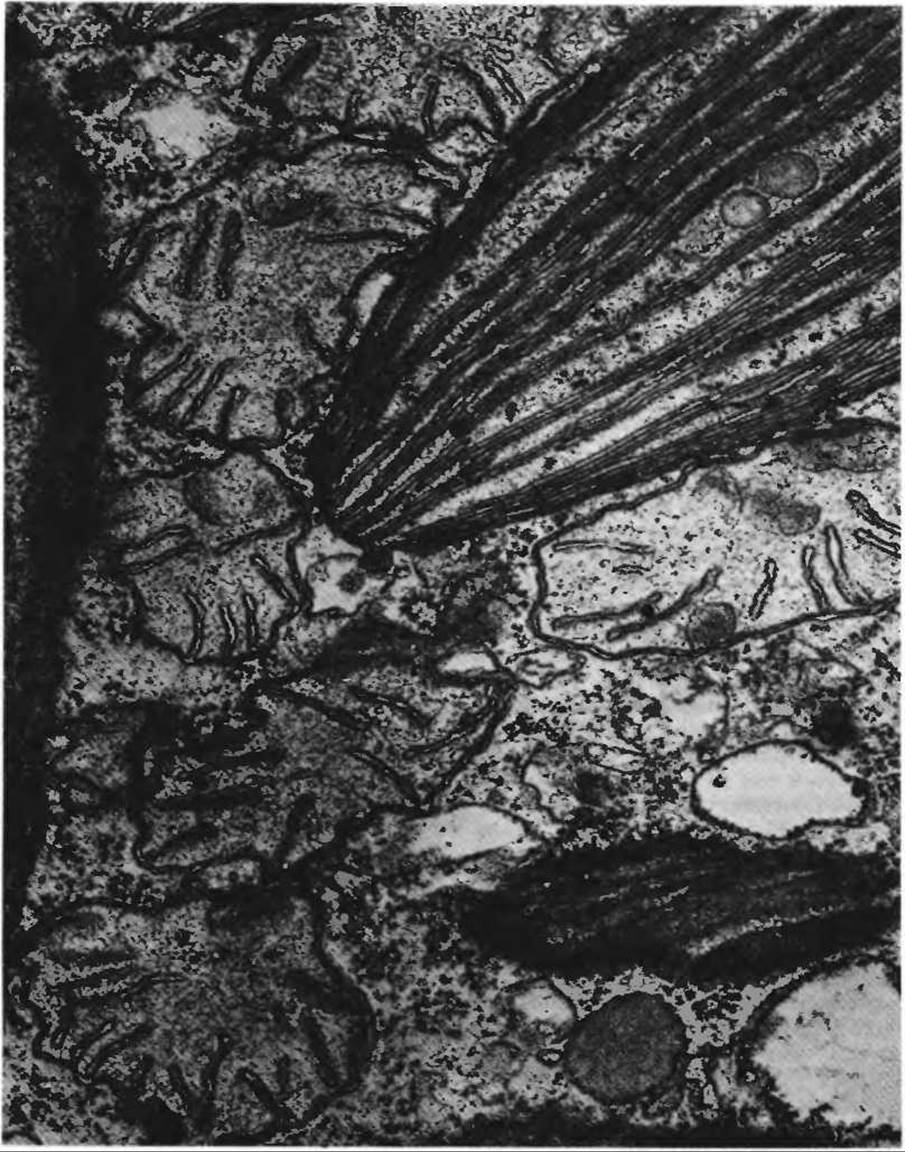
Lipids play a crucial role in cellular architecture and function. This electron micrograph shows the Cytoplasm of the photosynthetic alga Euglena. Clearly visible are the lipid-containing membranes of the chloroplast (top right) and several Mitochondria (surrounding the chloroplast and at the bottom left).
Also visible within the chloroplast are two lipid droplets that serve as an energy reserve. The gray oval structure at the bottom right represents a lipid inclusion in the cytoplasm.
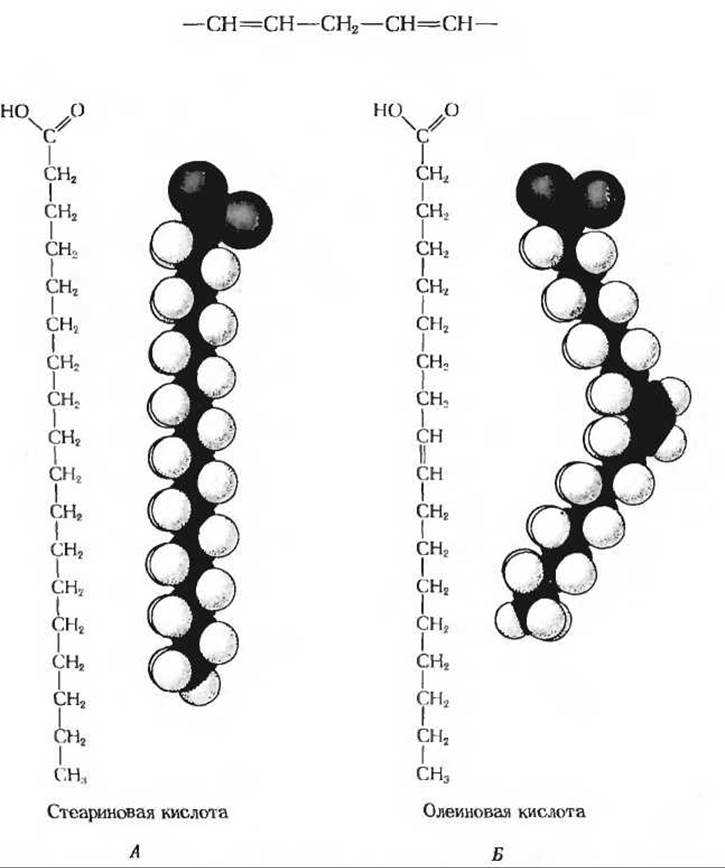
Fig. 12-1. Structural formulas and space-filling models of two typical fatty acids.
A. Stearic acid is depicted as an extended chain; however, in reality, its molecule lacks a rigid linear structure. Because free rotation is possible around any single bond, the hydrocarbon chain of stearic acid (like that of all other saturated fatty acids) is highly flexible and can adopt a variety of Conformations. B. In the oleic acid molecule, the cis double bond fixes a specific bend in the hydrocarbon chain. All other bonds in the chain are single, and thus relatively free rotation is possible around them.
Virtually all naturally occurring fatty acids contain an even number of carbon atoms, most commonly 16 or 18. The long hydrocarbon chain that forms the tail of the molecule may be fully saturated—meaning it contains only single bonds—or unsaturated, meaning it contains one or more double bonds. As a rule, Unsaturated fatty acids are found in both animals and plants twice as frequently as saturated ones. In most fatty acids, the double bond is located between the 9th and 10th carbon atoms (designated as ∆9). Additional double bonds are typically situated between the ∆9 double bond and the methyl end of the chain. Two double bonds in fatty acids are never conjugated (—СН=СН—СН=СН—); instead, they are always separated by a methylene group:
—СН=СН—СН2—СН=СЕ—
Table 12-2. Some naturally occurring fatty acids
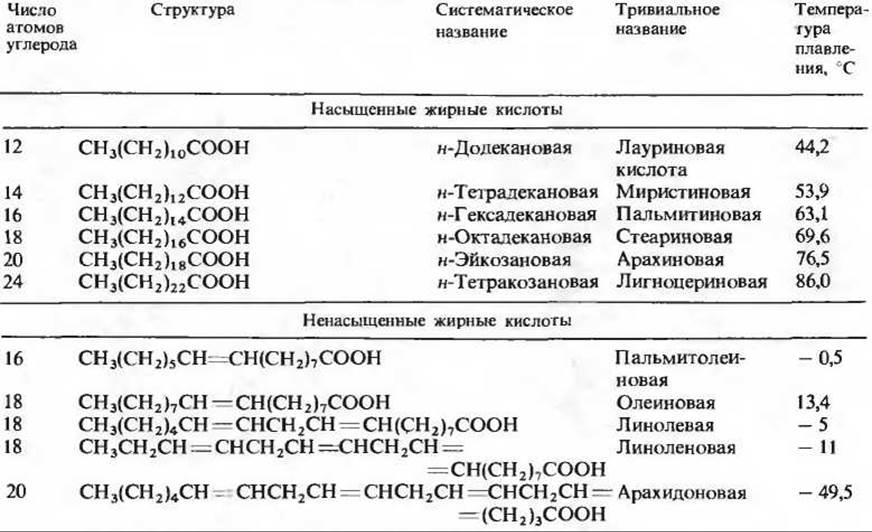
The double bonds in virtually all natural fatty acids are in the cis conformation, which causes a sharp bend in the aliphatic chain (Fig. 12-1). Polyunsaturated fatty acids (such as arachidonic acid, which contains four double bonds) have multiple chain bends and are more rigid than saturated fatty acids; the latter, owing to free rotation around single bonds, are characterized by greater flexibility and greater length. At body Temperature, saturated fatty acids ranging from C12 to C24 exist in a solid, waxy state, whereas unsaturated fatty acids are liquids.
Common fatty acids are insoluble in water, but in dilute NaOH or KOH solutions they can form micelles (Section 4.3), converting into so-called soaps, which are fatty acid salts. Household soaps consist primarily of potassium salts of fatty acids. Na+ or K+ soaps are amphipathic compounds (Section 4.3): their ionized carboxyl group forms a polar HEAD, while the hydrocarbon chain constitutes a nonpolar tail. Na+ or K+ soaps are capable of emulsifying water-insoluble oils and fats. The hydrocarbon tails of the soap embed themselves into fat droplets, while the polar heads interact with water. Thus, soaps form a hydrophilic shell around the fat droplets, producing a finely dispersed mixture or emulsion (Fig. 12-2).
Ca2+ and Mg2+ fatty acid soaps are very poorly soluble and therefore do not emulsify fats. This explains the appearance of white precipitate flakes when bath soap (consisting mainly of K+ soaps) is dissolved in hard water, which contains Ca2+ and Mg2+ salts.
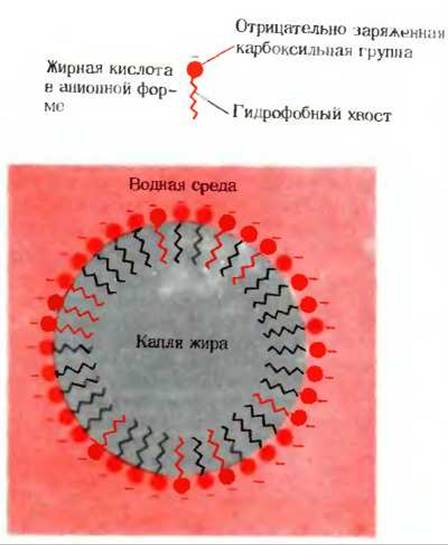
Fig. 12-2. The emulsifying action of soap on fat. Soap breaks down fat into droplets surrounded by a shell of hydrophilic, highly polar carboxyl groups, thereby forming a stable emulsion. The negative charge of the carboxyl groups is balanced by an equal number of positively charged ions, such as Na+.
Last update: 06/08/2026
Editorial and Educational Adaptation: This material has been compiled based on the primary/original source text. The project team performed an editorial review, corrected technical inaccuracies, structured sections, and adapted the content for an educational format.
What was processed:
- elimination of formatting defects (OCR errors, structural breaks, corrupted characters);
- editorial organization of content;
- standardization of terminology in accordance with academic sources;
- verification of factual statements against the original source text.
All mentions of the author, publication year, and origin of the primary text have been preserved in accordance with the source.