Principles of Biochemistry Volume 1 - A. Lehninger 1985
Biomolecules
Lipids and Membranes
Triacylglycerols are glycerol esters of fatty acids
Triacylglycerols are the simplest and most widespread Lipids containing Fatty acids. Other commonly used names for these lipids include fats, neutral fats, or triglycerides. Triacylglycerols are esters of the alcohol glycerol and three fatty acid molecules (Fig. 12-3). They are the primary component of fat depots in PLANT AND ANIMAL Cells, and are typically absent from membranes. Importantly, triacylglycerols are nonpolar, hydrophobic substances because they lack charged or strongly polar functional groups.
Triacylglycerols vary in type depending on The Nature and position of the three fatty acid residues esterifying the hydroxyl groups of glycerol. Triacylglycerols containing identical fatty acid residues at all three positions are called simple triacylglycerols; their names are derived from the corresponding fatty acid. For example, tristearoylglycerol, tripalmitoylglycerol, and trioleoylglycerol contain residues of stearic, palmitic, and oleic acids, respectively. Trivial names for these compounds are more commonly used, namely: tristearin, tripalmitin, and triolein. Triacylglycerols containing two different or three distinct fatty acid residues are termed mixed triacylglycerols. Most natural fats—such as olive oil, butter, and other dietary fats—contain complex mixtures of simple and mixed triacylglycerols comprising fatty acids that vary in both chain length and degree of saturation (Table 12-3).
Triacylglycerols containing residues of saturated fatty acids exclusively are solid at room Temperature. A typical example is tristearin, the primary component of beef tallow. Conversely, triacylglycerols containing three Unsaturated fatty acids (such as triolein, the main component of olive oil) are liquid at room temperature. Butter is a mixture of triacylglycerols, some of which incorporate fatty acids with relatively short chains; because the melting point of a fatty acid decreases with a shorter chain, butter maintains a soft consistency at room temperature (Table 12-3).
Natural triacylglycerols are insoluble in Water. Having a lower specific gravity than water, they float On the surface, which is why oil always floats on top in gravies and dressings.
Triacylglycerols dissolve readily in nonpolar Solvents such as chloroform, benzene, or ether, which are commonly used to extract fats from Tissues. Triacylglycerols undergo Hydrolysis upon boiling with acids or bases, or under the action of lipase, an enzyme secreted into the Small Intestine by the Pancreas. The hydrolysis of triacylglycerols in the presence of KOH or NaOH (a process known as saponification) yields a mixture of K+- or Na+-soaps and glycerol (Fig. 12-4). This exact chemical reaction forms The basis of the industrial production of laundry soap from triacylglycerols.
Class="center">Table 12-3. Fatty acid composition of three natural dietary fats1)

1) These fats consist of a mixture of triacylglycerols with varying fatty acid compositions and, consequently, different melting points. Olive oil, which is liquid at room temperature, predominantly contains unsaturated (liquid) fatty acids. Beef fat, rich in long-chain saturated fatty acids, has a solid consistency at room temperature. Butter, containing a significant amount of short-chain fatty acids, has a soft consistency at room temperature.
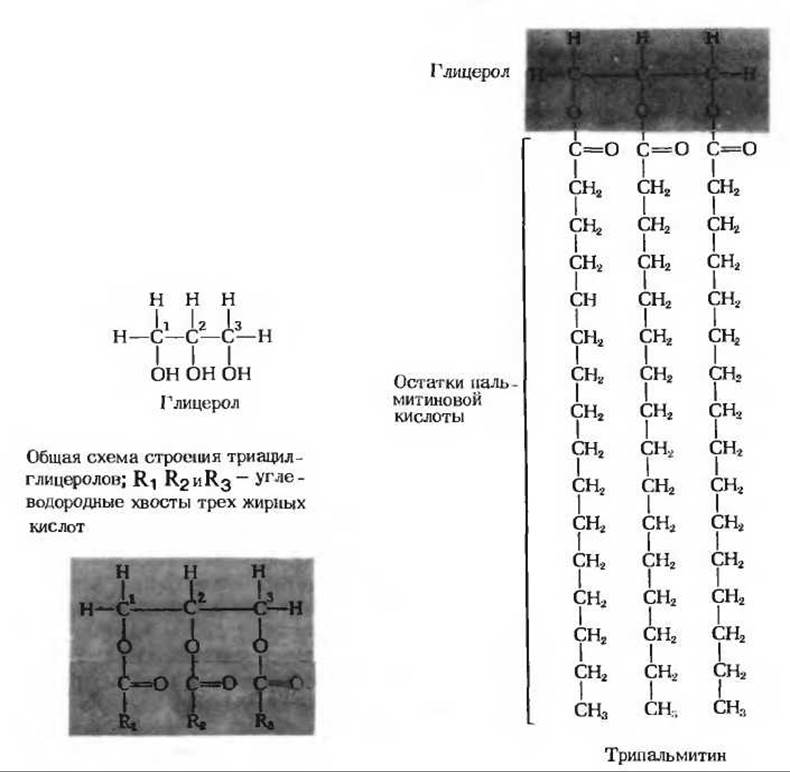
Fig. 12-3. Glycerol and the general structural formula of triacylglycerols. Note that if two different fatty acids occupy positions 1 and 3 in the glycerol molecule, carbon atom 2 becomes asymmetric.
In living matter, such triacylglycerols possess the L-configuration. Tripalmitin, shown on the right, is optically inactive, as are all triacylglycerols with identical fatty acids at positions 1 and 3.

Fig. 12-4. Saponification (alkaline hydrolysis) of a triacylglycerol. Household soap is produced by the hydrolysis of a triacylglycerol mixture with caustic potash. The resulting fatty acid K+-soaps are washed free of KOH and pressed into bars.
Triacylglycerols with a high content of unsaturated fatty acids, which are liquid at room temperature, can be converted into solid fats through partial reduction of their double bonds. Large quantities of liquid vegetable oils, such as corn oil, are processed into solid dietary fats (margarine) via catalytic hydrogenation, a process in which a portion of the double bonds is reduced to single bonds.
When exposed to air, triacylglycerols containing polyunsaturated fatty acids readily undergo autooxidation. The core of this complex process is that molecular oxygen interacts with fatty acid residues at the double bond sites, producing compounds that impart an unpleasant, rancid flavor to fats. Linseed oil, used as a binder in artistic oil paints, is very rich in polyunsaturated fatty acids. Upon exposure to air, this oil "dries"—that is, it undergoes autooxidation followed by polymerization, resulting in The formation of a tough, resinous film. Under normal cellular conditions, the autooxidation of unsaturated fats is completely inhibited by the presence of vitamin E (Section 10.16), various Enzymes, and presumably ascorbic acid (Section 10.12). However, it may occur in certain pathological states, leading to the formation of abnormal lipid inclusions in various tissues.
Last update: 06/08/2026
Editorial and Educational Adaptation: This material has been compiled based on the primary/original source text. The project team performed an editorial review, corrected technical inaccuracies, structured sections, and adapted the content for an educational format.
What was processed:
- elimination of formatting defects (OCR errors, structural breaks, corrupted characters);
- editorial organization of content;
- standardization of terminology in accordance with academic sources;
- verification of factual statements against the original source text.
All mentions of the author, publication year, and origin of the primary text have been preserved in accordance with the source.