Principles of Biochemistry Volume 1 - A. Lehninger 1985
Biomolecules
Lipids and Membranes
Triacylglycerols as a lipid storage form
The primary function of triacylglycerols is lipid storage. In most PLANT AND ANIMAL Cells, triacylglycerols reside in the Cytosol as finely dispersed, emulsified oil droplets (Fig. 12-5). In specialized animal Connective Tissue cells—specifically adipocytes, or fat cells—massive amounts of triacylglycerols can be stored as large fat droplets that occupy nearly the entire cellular volume (Fig. 12-5, 21). These fat cells are abundant beneath the Skin, in the Abdominal cavity, and in the Mammary Glands. In obese individuals, fat cells accumulate kilograms of triacylglycerols, whose stored energy could sustain the body's basal METABOLISM for several months. In contrast, energy stored as Glycogen can meet the body's needs for no more than a single day (Chap. 21). Triacylglycerols are far better suited for energy storage than glycogen: first, they can accumulate in vast quantities in a practically pure, unhydrated form, and second, on a weight-for-weight basis, they store twice as much energy as CARBOHYDRATES (Chaps. 18 and 26).
Class="center">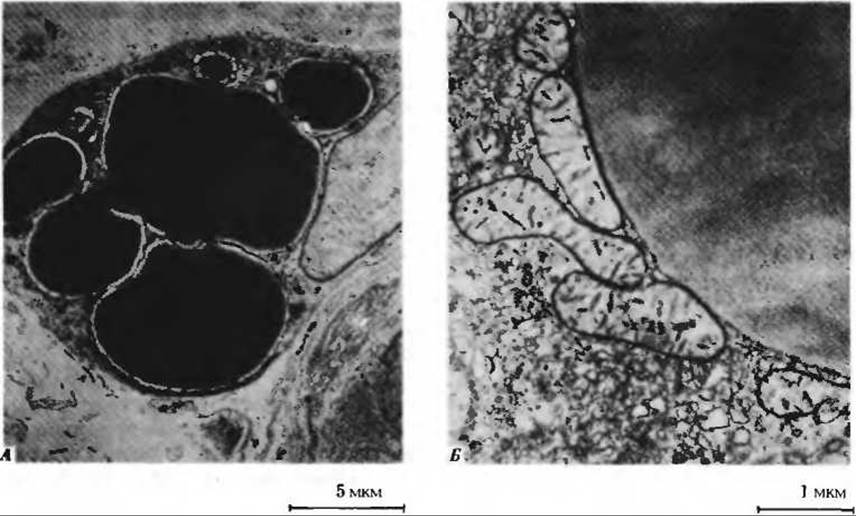
Fig. 12-5. Fat reserves in cells. A. A fat Cell (adipocyte) from porcine adipose tissue. Massive fat droplets fill nearly the entire volume of The Cell. The pale, elongated Structure on the right is the Cell Nucleus. B. A portion of a large fat droplet in the Cytoplasm of a Liver cell from a starved hamster. Under a normal diet, the liver contains only a small number of small fat droplets. During starvation, when fat becomes the primary energy source and is transported from adipose tissue to the liver, the number and size of fat droplets increase significantly. Several Mitochondria, the sites of Fatty acid oxidation, adjoin the droplet surface.
In certain animals, subcutaneous triacylglycerol reserves serve a dual function: they act as an energy depot and form a thermal insulation layer that protects the Organism against extreme cold. Seals, walruses, penguins, and other warm-blooded animals of the Arctic and Antarctic are equipped with substantial layers of triacylglycerols (Fig. 12-6).
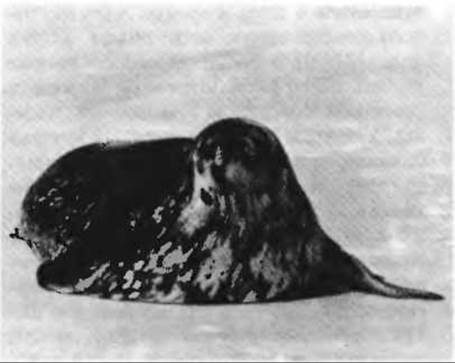
Fig. 12-6. A Weddell seal, an inhabitant of the Antarctic. The very thick layer of subcutaneous fat serves not only as an energy depot, but also as a highly effective cold-protective "wetsuit."
Last update: 06/08/2026
Editorial and Educational Adaptation: This material has been compiled based on the primary/original source text. The project team performed an editorial review, corrected technical inaccuracies, structured sections, and adapted the content for an educational format.
What was processed:
- elimination of formatting defects (OCR errors, structural breaks, corrupted characters);
- editorial organization of content;
- standardization of terminology in accordance with academic sources;
- verification of factual statements against the original source text.
All mentions of the author, publication year, and origin of the primary text have been preserved in accordance with the source.