Biochemistry: The Chemical Reactions of Living Cells, Volume 2 - D. Metzler 1980
Coenzymes are specialized natural reagents of a unique kind.
Thiamine diphosphate
The primary function of pyridoxal phosphate
Having examined various known PLP-dependent Enzymes responsible for Amino acid METABOLISM, Braunstein and Shemyakin [35] suggested a general mechanism for their action in 1953. Their proposed theory was in complete agreement with the results of then-unpublished model experiments mentioned above, and it was later fully confirmed by studies on A large number of enzymes.
The General mechanism of PLP action can be simplified as follows: Pyridoxal phosphate replaces the —NH2 group (or —NH+3 group) of substrate Amino Acids with a group that is electronically equivalent to an adjacent carbonyl group. This occurs through The formation of a Schiff base (Fig. 8-5). Note, however, that the polarity of a Schiff base formed by an Amino Acid and a simple aldehyde (e.g., acetaldehyde) is opposite to the polarity of the C=O group:
Class="center">

FIG. 8-5. Pyridoxal 5'-phosphate (PLP) is a specialized coenzyme for amino acid conversion reactions.
Such an imine cannot replace the carbonyl group in activating the a-hydrogen or in facilitating C—C bond Cleavage within The amino acid. This requires a strong electron-withdrawing pyridine ring conjugated with the C=N group, allowing electrons to flow from the substrate to the coenzyme (Fig. 8-6).
The transformations of Schiff bases formed by PLP and Amino acids can be compared to those of ß-keto acids, as shown in Fig. 8-6. These reactions can be divided into three groups (a, b, and c) depending on THE POSITION OF the cleaved bond (between the a-carbon of the substrate, on the one hand, and the hydrogen atom, carboxyl group, or side chain, on the other). A fourth group of reactions, d, also involves the elimination of the a-hydrogen, but The Mechanism of these reactions is more complex than that of group a.
a. Dissociation of the a-hydrogen
The abstraction of the a-hydrogen in the PLP Schiff base leads to the formation of a quinonoid intermediate, whose transformations, much like those of an enolate anion, can follow various pathways (Fig. 8-6, A).
1. Elimination. If a good leaving group is present at the ß-position of the amino acid, it can be eliminated (Fig. 8-6, B) [36]. Enzymes catalyzing this type of reaction are numerous. They include Serine and Threonine dehydratases (elimination of OH- as H2O), bacterial tryptophanase (elimination of indole), and alliinase from onions and garlic (elimination of 1-propenylsulfenic acid, the lachrymatory substance released when onions and garlic are chopped).

ß-Substitution reactions are catalyzed by such enzymes as Tryptophan synthase (Chap. 14, Sec. I,3) and Cysteine synthase (Chap. 14, Sec. G), which are essential for Amino acid Biosynthesis. Schiff bases of the coenzyme and unsaturated amino acids—typically aminoacrylate or aminocrotonate—can serve as intermediates in elimination and ß-substitution reactions (Fig. 8-6, B). According to current models, conversion to the final products proceeds via Hydrolysis to free aminoacrylate, tautomerization to the amino acid, and subsequent hydrolysis of the latter to Pyruvate and an ammonium ion (Fig. 8-6, B). However, there are reports, e.g., [37], indicating the stereospecific addition of a proton to the ß-carbon atom of a-ketobutyrate. Consequently, interested readers may ponder the possible pathways for The breakdown of the unsaturated amino acid Schiff base shown in Figure 8-6, B [see also scheme (8-28)].
2. Transamination. A proton can add to the carbon atom attached to position 4 of the PLP ring (Fig. 8-6, C), yielding a secondary Schiff base often referred to as a PMP ketimine. The latter readily hydrolyzes to pyridoxamine phosphate (PMP) and an a-keto acid. This series of transformations represents one of the two half-reactions [equations (8-17) and (8-18)] required for enzymatic transamination:


FIG. 8-6. Some reactions of pyridoxal phosphate Schiff bases (type 8 reactions in Table 9-1). A. Formation of a quinonoid intermediate. B. Elimination of a ß-substituent. C. Transamination.
Transaminases play an extremely important role in amino acid metabolism; over 50 different enzymes of this class are currently known [33]. The most thoroughly studied among them is cytoplasmic aspartate aminotransferase from pig Heart Muscle, a dimeric enzyme composed of subunits with a Molecular Weight of 46,344 (Fig. 2-1).
The mitochondrial isoenzyme differs somewhat in its properties from the cytoplasmic one.
3. Racemization. A proton can re-add to the original a-position, but in a non-stereospecific manner. Racemases catalyzing this type of reaction are vital for Bacteria, which must synthesize D-Alanine and D-glutamic acid—needed for peptidoglycan synthesis—from the corresponding L-isomers.
b. Decarboxylation
The bond between the a-C atom and the carboxyl group (but not the bond between this atom and the a-hydrogen) can be cleaved (Fig. 8-6, A). This reaction, catalyzed by amino acid Decarboxylases, also results in the formation of a quinonoid intermediate. The sequence of steps concludes with proton addition at the site of carboxyl cleavage, followed by the breakdown of the Schiff base. AMINO ACID DECARBOXYLATION is virtually irreversible and often serves as the final step in The biosynthesis of amines.
For example, in the Brain, glutamic acid is decarboxylated to y-aminobutyric acid, and 3,4-dihydroxyphenylalanine (DOPA) to dopamine. Histidine is converted into histamine. In bacteria, Lysine is produced by the decarboxylation of meso-diaminopimelic acid (Chap. 14, Sec. D,2), and phosphatidylethanolamine is formed via the decarboxylation of phosphatidylserine (Chap. 12, Sec. E,2).
c. Cleavage of amino acid side chains
In reactions belonging to the third type, the side chain of the Schiff base depicted in Figure 8-6, A can be cleaved via a retro-aldol reaction. Conversely, a side chain can be added through a ß-Condensation reaction. The best-characterized enzyme catalyzing side-chain cleavage is serine transhydroxymethylase, which converts serine into Glycine and formaldehyde [37]1). The latter is not released freely, but is instead selectively transferred by the same enzyme to tetrahydrofolic acid to form a cyclic adduct [equation (8-69)].

Threonine is cleaved by the same enzyme to acetaldehyde. Another reaction of this type is shown at the top of Fig. 14-27.
1) In recent years, data have been obtained proving the identity of this enzyme, also called serine hydroxymethyltransferase, with the alloenzymes threonine aldehyde-lyase and phenylserine aldehyde-lyase of macroorganisms and animal Cells. — Editor's note.
As a result of two ester condensation reactions, acyl groups of CoA derivatives are transferred to Schiff bases of glycine or serine. Succinyl-CoA serves as the acyl donor in the biosynthesis of δ-aminolevulinic acid, an intermediate inheme synthesis (Ch. 14, Sec. E, 4):

Since in the absence of succinyl-CoA the enzyme does not catalyze the decarboxylation of glycine, decarboxylation apparently occurs after condensation [Equation (8-20)] [39].
In sphinganine biosynthesis [Equation (12-24)], serine condenses (also coupled with a decarboxylation step) with palmitoyl-CoA with The intermediate formation of an aminoketone [40]:

It has been shown that the hydrogen atom marked with an asterisk in the scheme is originally the α-hydrogen of serine. Thus, in this case, decarboxylation apparently precedes condensation.
g. Quinoid derivative as an electron acceptor
According to current concepts, PLP-dependent Reactions of the fourth type involve either a quinoid intermediate or the ketimine shown in Fig. 8-6, B. Both of these compounds lack the original α-hydrogen of the amino acid, and the C = NH+ bond is polarized in a direction that facilitates the withdrawal of electrons from the amino acid toward the coenzyme. This enables A number of reactions analogous to the reactions of β-keto acid transformations. Both elimination and C—C bond cleavage occur at the α- and β-positions (relative to the C = N group) of the quinoid (or ketimine) derivative.
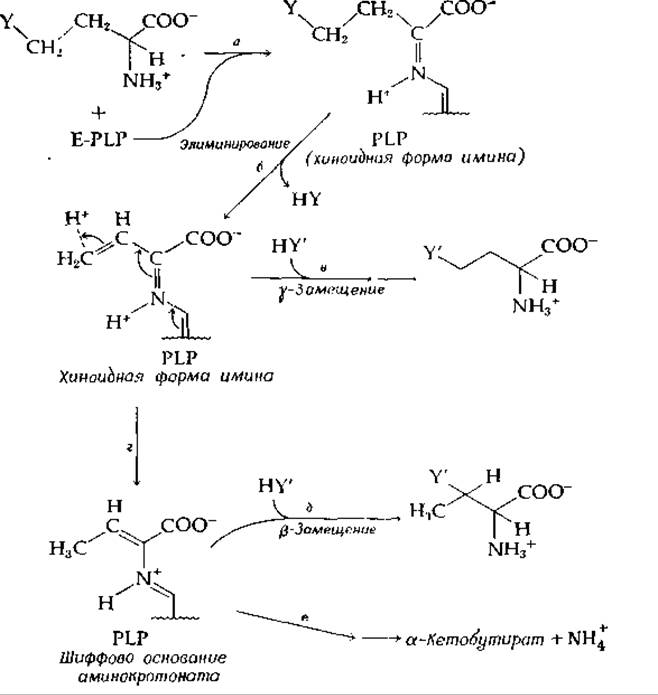
FIG. 8-7. Some PLP-dependent reactions involving elimination of a γ-substituent. Either its replacement by another γ-substituent or deamination to an α-keto acid can occur.
Among enzymes of this type are those that catalyze the elimination of a γ-substituent of an amino acid (Fig. 8-7). The eliminated group is sometimes replaced by another substituent either at the γ- or β-position. In the initially formed quinoid derivative, elimination of the γ-substituent (β-related to the C = N group) takes place along with the elimination of a proton at the β-position of the original amino acid [36] (Fig. 8-7, steps a and b). The resulting intermediate can enter into any of three reactions depending on The Nature of the specific enzyme involved. The addition of HY leads to γ-substitution (step c), whereas the addition of a proton at the γ-position (indicated by arrows in the figure) leads, in accordance with step d, to the formation of an α,β-unsaturated Schiff base. The latter can undergo addition of HY (β-substitution, step e) or be cleaved to an α-keto acid and an ammonium ion (step f), similarly to the β-elimination reactions shown in Fig. 8-6, B. An important γ-substitution reaction is The conversion of O-succinylhomoserine to cystathionine [Equation (8-22)]:

This reaction is part of the Methionine biosynthesis pathway in Salmonella cells. Cystathionine then undergoes β-elimination to form homocysteine, which is subsequently converted to methionine [Equation (8-85)]. In a similar biosynthetic pathway in Fungi and higher plants, O-acetylhomoserine is utilized. Threonine is formed from O-phosphorylhomoserine as a result of γ-elimination followed by replacement with an OH group at the β-position. This reaction is catalyzed by threonine synthase (Fig. 14-6).
The Cleavage of the β-carboxyl group as CO2 can also proceed via a quinoid intermediate complex. A well-known example is bacterial aspartate β-decarboxylase [41], which converts aspartate to alanine and CO2. A similar reaction, the Conversion of the amino acid kynurenine to alanine and anthranilic acid (Fig. 14-26), presumably requires Hydration of the carbonyl group prior to the β-cleavage step:

An analogous thiolytic cleavage is the reaction of CoA with 2-amino-4-ketopentanoate to yield acetyl-CoA and alanine [42].
d. The enigma of Glycogen phosphorylase
Pyridoxal phosphate is ideally suited for catalyzing amino compound reactions. Therefore, its discovery as an essential cofactor for glycogen phosphorylase (Ch. 7, Sec. B, 5) came as a surprise. The coenzyme is bound to phosphorylase in much the same way as in transaminase (Sec. D, 6), but its function remains unclear [43]. What is striking is the fact that, according to available data, 50% of the total vitamin B6 in the body is present as PLP bound to muscle phosphorylase [44]. Studies on vitamin B6-deficient rats indicate that PLP in phosphorylase may serve as a reserve pool, a significant portion of which can be utilized for other purposes under vitamin B6 deficiency.
In addition to its coenzyme function, PLP acts as a specific inhibitor and possibly an allosteric effector for a number of enzymes from various classes (these include, for example, aldolase, Glutamate dehydrogenase, and hexokinase). PLP also selectively binds to many other Proteins [45].
Last update: 06/08/2026
Editorial and Educational Adaptation: This material has been compiled based on the primary/original source text. The project team performed an editorial review, corrected technical inaccuracies, structured sections, and adapted the content for an educational format.
What was processed:
- elimination of formatting defects (OCR errors, structural breaks, corrupted characters);
- editorial organization of content;
- standardization of terminology in accordance with academic sources;
- verification of factual statements against the original source text.
All mentions of the author, publication year, and origin of the primary text have been preserved in accordance with the source.