Human Biochemistry Volume 1 - Murray R. 1993
Bioenergetics and Carbohydrate and Lipid Metabolism
The Citric Acid Cycle: Catabolism of Acetyl-CoA
Reactions of the Citric Acid Cycle (Fig. 17.3)
The initial reaction—the Condensation of acetyl-CoA and oxaloacetate to yield citrate—is catalyzed by the condensing enzyme citrate synthase. This process establishes a carbon-carbon bond between the methyl carbon of acetyl-CoA and the carbonyl carbon of oxaloacetate. The condensation step, which yields citryl-CoA, is followed by the Hydrolysis of the thioester bond, accompanied by a large release of Free energy in the form of heat; this renders the reaction irreversible under physiological conditions:
Class="center">Ацетил-СоА + Оксалоацетат + Н2О → Цитрат + СоА ∙ SH
The conversion of citrate to isocitrate is catalyzed by aconitase (aconitate hydratase), which contains iron in the Fe2+ state. This reaction proceeds in two stages: first, a dehydration yields cis-aconitate (a portion of which remains enzyme-bound), followed by Hydration to form isocitrate:
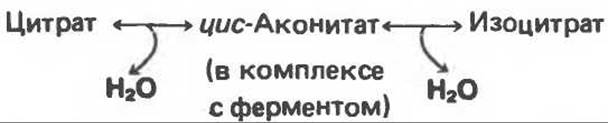
The reaction is inhibited by fluoroacetate, which is first converted into fluoroacetyl-CoA; the latter then condenses with oxaloacetate to form fluorocitrate. Fluorocitrate is the direct inhibitor of aconitase, and its inhibition leads to the accumulation of citrate.
Experiments using intermediates labeled with the 14C isotope demonstrate that aconitase interacts with citrate asymmetrically: it always acts on the specific moiety of the citrate molecule that originated from oxaloacetate. Initially, this was difficult to explain because citric acid is an outwardly symmetrical compound. However, the spatial orientations of the two -CH2COOH groups of citric acid relative to the —OH and —COOH groups are non-identical. The asymmetrical action of aconitase is evidenced by the "fate" of the labeled acetyl-CoA (i.e., the positions of the 14C atoms) within the intermediates of The Citric Acid Cycle (Fig. 17.3). It is possible that cis-aconitate is not an obligate intermediate between citrate and isocitrate, but rather forms on a side branch of the main pathway.
1 According to the recommendations adopted by the Committee of Editors of Biochemical Journals (1975), the suffix -ate (e.g., palmitate) denotes a mixture of the free acid and its ionized form (at the pH under consideration) without specifying The Nature of the cations present. This convention is adopted throughout the text for all carboxylic acids.
Next, isocitrate dehydrogenase catalyzes dehydrogenation to yield oxalosuccinate. Three distinct forms of isocitrate dehydrogenase have been described. One of these, the NAD+-dependent form, is found exclusively in Cell/35.html">Mitochondria. The other two forms are NADP+-dependent, with one residing in the mitochondria and the other in the Cytosol. The oxidation of isocitrate coupled to the Respiratory Chain is carried out almost exclusively by the NAD+-dependent enzyme:

This is followed by decarboxylation to yield α-ketoglutarate, also catalyzed by isocitrate dehydrogenase. Mn2+ (or Mg2+) ions are an essential component of this decarboxylation reaction. Available evidence suggests that the oxalosuccinate formed as a reaction intermediate remains enzyme-bound.
α-Ketoglutarate, in turn, undergoes oxidative decarboxylation, analogous to that of Pyruvate (see Fig. 18.5): in both cases, the substrate is an α-keto acid. The reaction is catalyzed by the α-ketoglutarate dehydrogenase complex and requires the same set of Cofactors—Thiamine diphosphate, lipoate, NAD+, FAD, and CoA—resulting in The formation of succinyl-CoA, a thioester containing a high-energy bond.

The equilibrium of this reaction lies so far toward succinyl-CoA formation that it can be considered physiologically unidirectional. As with pyruvate oxidation (see p. 186), the reaction is inhibited by arsenate, leading to the accumulation of its substrate (α-ketoglutarate).
The cycle continues with the conversion of succinyl-CoA to succinate, catalyzed by succinate thiokinase (succinyl-CoA synthetase):


Fig. 17.3. The Citric Acid cycle (Krebs cycle). The oxidation of NADH and FADH2 in the respiratory chain is coupled to the generation of ATP via Oxidative Phosphorylation. To trace The Fate of acetyl-CoA through the cycle, the carboxyl carbon of the two-carbon acetyl moiety is marked with an asterisk, and the methyl carbon with a dot. The two carbon atoms released as CO2 during one turn of the cycle do not originate from the acetyl-CoA molecule that just entered the cycle, but rather from the portion of the citrate molecule derived from oxaloacetate. However, upon completion of a single turn, the labeled carbon atoms end up in the regenerated oxaloacetate and are subsequently released as CO2 during the second turn of the cycle. Succinate is a symmetrical compound, and its two carboxyl groups are indistinguishable to succinate dehydrogenase; consequently, randomization of the label occurs at this stage, and after one complete turn, all four carbon atoms of the oxaloacetate molecule become labeled. During Gluconeogenesis, a portion of the label from oxaloacetate is incorporated into glucose and Glycogen (see Fig. 20.1). A Structure/133.html">Discussion of the stereochemical aspects of the citric acid cycle can be found in the review by Greville (Greville, 1968). The figure also indicates the sites of cycle inhibition (⊝) by fluoroacetate, malonate, and arsenate.
One of the substrates for these reactions is GDP (or IDP), which reacts with inorganic phosphate to form GTP (ITP). This is the sole step in the citric acid cycle where a high-energy phosphate bond is generated at the substrate level; during The oxidative decarboxylation of α-ketoglutarate, the potential free energy change is sufficient to form both NADH and a high-energy phosphate bond. In the reaction catalyzed by phosphokinase, ATP can be synthesized from either GTP or ITP. For example:

In an alternative reaction occurring in extrahepatic Tissues and catalyzed by succinyl-CoA-acetoacetate-CoA transferase (thiophorase), succinyl-CoA is converted to succinate, coupled with the conversion of acetoacetate to acetoacetyl-CoA (see p. 290). The Liver possesses deacylase activity, which ensures the hydrolysis of a fraction of succinyl-CoA to yield succinate and CoA.
Next, succinate undergoes dehydrogenation, followed by The addition of a Water molecule and a subsequent dehydrogenation step, culminating in the regeneration of oxaloacetate:

The initial dehydrogenation is catalyzed by succinate dehydrogenase, which is tightly bound to the inner surface of The inner mitochondrial membrane. This is the only dehydrogenase reaction in the citric acid cycle that involves the direct transfer of hydrogen from the substrate to a flavoprotein without the participation of NAD+. The enzyme contains FAD and an iron-sulfur (Fe:S) protein. This dehydrogenation yields fumarate. As isotope-labeling experiments have demonstrated, the enzyme is stereospecific for the trans-hydrogen atoms of the methylene groups of succinate. The addition of malonate or oxaloacetate inhibits succinate dehydrogenase, resulting in the accumulation of succinate.
Fumarase (fumarate hydratase) catalyzes the stereospecific addition of water to fumarate to yield malate:

Fumarase is specific for the L-isomer of malate and catalyzes the stereospecific addition of water across the double bond of fumarate in the trans configuration. Malate dehydrogenase catalyzes the conversion of malate to oxaloacetate, a reaction requiring NAD+:

Although the equilibrium of this reaction lies far to the side of malate, it proceeds efficiently in the direction of oxaloacetate because the latter, along with NADH, is continuously consumed in subsequent reactions.
Citric acid cycle Enzymes, with the exception of $\alpha$-ketoglutarate and succinate dehydrogenases, are also found outside the mitochondria. However, some of these enzymes (such as malate dehydrogenase) differ structurally and functionally from their mitochondrial counterparts.
Last update: 06/08/2026
Editorial and Educational Adaptation: This material has been compiled based on the primary/original source text. The project team performed an editorial review, corrected technical inaccuracies, structured sections, and adapted the content for an educational format.
What was processed:
- elimination of formatting defects (OCR errors, structural breaks, corrupted characters);
- editorial organization of content;
- standardization of terminology in accordance with academic sources;
- verification of factual statements against the original source text.
All mentions of the author, publication year, and origin of the primary text have been preserved in accordance with the source.