Human Biochemistry, Volume 1 - Murray R. 1993
Bioenergetics and Carbohydrate and Lipid Metabolism
The Citric Acid Cycle: Catabolism of Acetyl-CoA
Energetics of the Citric Acid Cycle
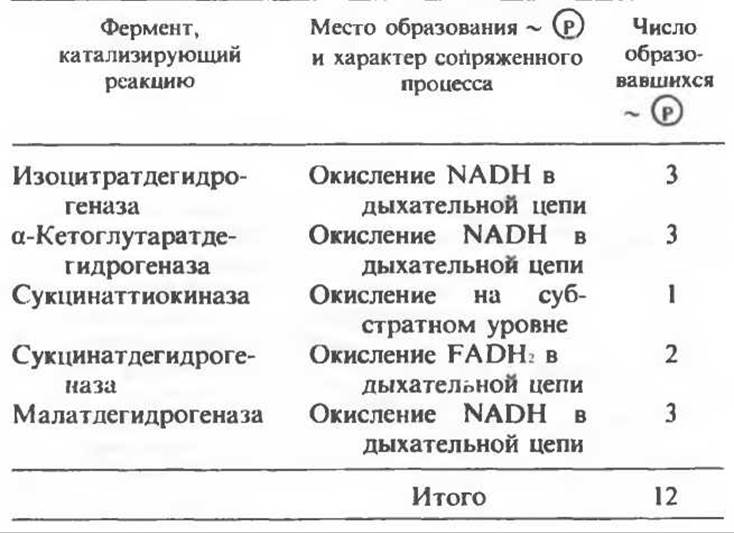
As a result of oxidation catalyzed by the dehydrogenases of The Citric Acid Cycle, three molecules of NADH and one molecule of FADH2 are formed for each molecule of acetyl-CoA catabolized during one turn of the cycle. These reducing equivalents are transferred to the Respiratory Chain located in The inner mitochondrial membrane (Fig. 17.2). As they pass along the chain, the reducing equivalents of NADH generate three high-energy phosphate bonds via The formation of ATP from ADP during Oxidative Phosphorylation (see Chapter 13). FADH2 yields only two high-energy phosphate bonds because it transfers its reducing equivalents to coenzyme Q, thereby bypassing the first site of oxidative phosphorylation in the respiratory chain (see Fig. 13.6). An additional high-energy phosphate is generated at one of the steps of The Citric Acid cycle, i.e., at the substrate level, during The conversion of succinyl-CoA to succinate. Thus, a total of 12 new high-energy phosphate bonds are produced per turn of the cycle (Table 17.1).
Class="center">Table 17.1. Generation of high-energy phosphate bonds during the functioning of the citric acid cycle
Last update: 06/08/2026
Editorial and Educational Adaptation: This material has been compiled based on the primary/original source text. The project team performed an editorial review, corrected technical inaccuracies, structured sections, and adapted the content for an educational format.
What was processed:
- elimination of formatting defects (OCR errors, structural breaks, corrupted characters);
- editorial organization of content;
- standardization of terminology in accordance with academic sources;
- verification of factual statements against the original source text.
All mentions of the author, publication year, and origin of the primary text have been preserved in accordance with the source.