BIOCHEMISTRY - L. Stryer - 1984
VOLUME 2
PART II GENERATION AND STORAGE OF METABOLIC ENERGY
CHAPTER 11 METABOLISM: BASIC CONCEPTS AND DESIGN
11.1. Free Energy Is the Most Useful Thermodynamic Function in Biochemistry
Let us first review some fundamental Principles of Thermodynamics that are essential for understanding metabolic processes. In thermodynamics, a system is defined as a specific collection of matter within a defined boundary. Everything outside this boundary, comprising the rest of the universe, is referred to as the surroundings. The First Law of thermodynamics states that the total energy of a System and Its surroundings is constant. In other words, energy is conserved. The mathematical expression of the first law of thermodynamics is:
∆E = Ев-ЕА = Q-W, (1)
where EA is the energy of the system at the beginning of the process, and Eв is the energy at the end of the process; Q is the heat absorbed by the system; and W is the work done by the system. A crucial point to note in equation (1) is that The change in the system's energy depends solely on its initial and final states and is independent of The pathway of the transformation.
Class="center">Fig. 11.1. Examples of processes driven by an increase in the system's Entropy: A - heat diffusion; B - solute diffusion
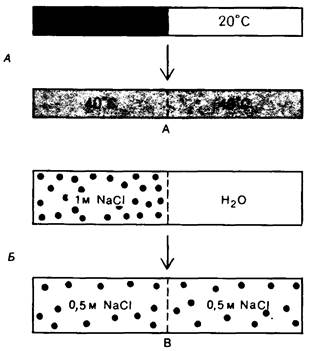
The first law of thermodynamics does not allow us to predict whether a given reaction can occur spontaneously. Some reactions do proceed spontaneously despite a positive value of ∆E. In such cases, the system absorbs heat from the surroundings, so that the total energy of the system and its surroundings remains constant. Obviously, predicting the spontaneity of a process under these conditions requires a function other than ∆E. One such function is entropy (S), which serves as a measure of the degree of disorder or randomness of a system. The entropy of a system increases (∆S is positive) when its disorder increases. The Second Law of thermodynamics states that a process can occur spontaneously only if the sum of the entropies of the system and its surroundings increases
(∆Scистемы +∆Sсреды) > 0 для спонтанного процесса. (2)
It is important to note the following: during a spontaneous process, the entropy of the system may decrease provided that the entropy of the surroundings increases by a greater amount, making their sum positive. For example, The formation of a highly ordered biological Structure is thermodynamically feasible because the decrease in entropy within the system is more than offset by the increase in entropy of the surroundings.
One of the difficulties in using entropy as a criterion for the spontaneity of a biochemical process is that entropy changes during Chemical Reactions are not easily measured. Furthermore, the Criterion for Spontaneity given by equation (2) requires knowledge of the entropy changes in both the surroundings and the system under study. These difficulties are circumvented by using another thermodynamic function called free energy, denoted by the symbol G (or F in older literature). In 1878, Josiah Willard Gibbs formulated the free-energy function by combining the First and Second Laws of Thermodynamics. The fundamental equation is as follows:
∆G = ∆Н - T∆S, (3)
where ∆G is the change in Free energy of a system undergoing transformation at constant pressure (P) and Temperature (T), ∆Н is the change in enthalpy of the system, and ∆S is the change in entropy of the system. It should be noted that no environmental or surrounding parameters appear in this equation. The change in enthalpy is calculated from the equation
∆Н = ∆Е + P∆V; (4)
The volume change A V is negligible for almost all biochemical reactions, which means that ∆Н is practically equal to ∆Е. Hence
∆G - ∆E - T∆S. (5)
Thus, the ∆G of a reaction depends on both the change in internal energy and the change in entropy of the system.
Unlike the change in internal energy (∆Е), the change in free energy (∆G) of a reaction serves as a valuable criterion for its spontaneity.
1. A reaction can proceed spontaneously only if ∆G is negative.
2. A system is at equilibrium and undergoes no net change when ∆G is zero.
3. A reaction cannot proceed spontaneously if ∆G is positive. An influx of free Energy is required to drive such a reaction.
Two additional points must be emphasized here. First, the ∆G of a reaction depends solely on the difference between the free energy of the products (final state) and the free energy of the reactants (initial state). The ∆G of a reaction is independent of the reaction pathway; the reaction mechanism has no effect on ∆G. For example, the ∆G for The oxidation of glucose to CO2 and H2O remains the same regardless of whether the transformation takes place via combustion in vitro or through a series of numerous enzymatic reactions within The Cell. Second, ∆G provides no information about the reaction rate. A negative value of ∆G indicates that a reaction can occur spontaneously, but it does not imply that it will proceed at a noticeable rate. As discussed previously (Section 6.6), the reaction rate depends on the free energy of activation (∆G+), which is unrelated to ∆G.
Units of Energy -
The calorie (cal) is equivalent to The amount of heat required to raise the temperature of 1 g of Water from 14.5 to 15.5 °C.
The kilocalorie (kcal) is equal to 1000 cal.
The joule (J) is the amount of energy required to apply a force of 1 N over a distance of 1 m.
The kilojoule (kJ) is equal to 1000 J.
1 kcal = 4.184 kJ.
11.2. Standard Free Energy Change of a Reaction and Its Relationship to the Equilibrium Constant
Let us consider the reaction A + B ⇄ C + D.
The ∆G of this reaction is given by the equation
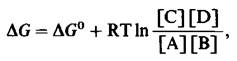 (6)
(6)
where ∆G0 is the Standard Free Energy change, R is the gas constant, T is the absolute temperature, and [A], [B], [C], and [D] are the molar concentrations (more precisely, activities) of the reactants. ∆G0 is the free energy change of the reaction under standard conditions, when each of the reactants A, B, C, and D is present at a concentration of 1.0 M. Thus, the ∆G of a reaction depends on The Nature of the reactants [characterized by ∆G0 in equation (6)] and on their concentration [expressed as a logarithmic function in equation (6)].
To simplify calculations of Free Energy Changes in biochemical reactions, it is convention to assume that the standard state corresponds to pH 7. Consequently, The activity of H+ corresponding to pH 7 in equations (6) and (9) is equal to 1. The activity of water in these equations is also assumed to be 1. Throughout this book, we will use METABOLISM/2.html">THE CONCEPT OF the standard free energy change at pH 7, denoted as ∆G0'. The unit of energy used will be the kilocalorie
(kcal).
One can easily derive the relationship between the standard Free Energy and the Equilibrium Constant of a reaction. At equilibrium, ∆G = 0. Equation (6) then takes the following form:
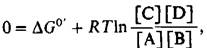 (7)
(7)
and therefore
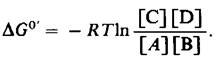 (8)
(8)
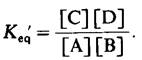
The equilibrium constant under standard conditions, Keq, is defined as follows:
 (9)
(9)
Substituting equation (9) into equation (8), we obtain
∆G0’ = -R T ln Keq, (10)
∆G0' = -2.303 R T log Keq. (11)
Rearranging the last equation, we obtain
Keq' = 10-∆G0'/(2.303RT) (12)
Substituting The values of R and T—respectively, 1.98 • 10-3 kcal mol-1 deg-1 and T = 298 K (25°C)—we get
Keq' = 10-∆G0 /1.36, (13)
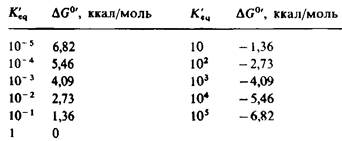
where ∆G0' is expressed in kcal/mol. Thus, the standard free energy and the equilibrium constant of a reaction are related by a simple expression. For example, an equilibrium constant of 10 corresponds to a standard free energy change of -1.36 kcal/mol at 25°C (Table 11.1).
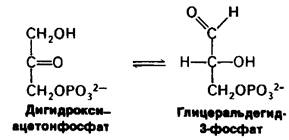
As an example, let us calculate ∆G0 and ∆G for the isomerization of dihydroxyacetone phosphate to glyceraldehyde 3-phosphate. This reaction occurs in Glycolysis (Ch. 12). At equilibrium, The ratio of glyceraldehyde 3-phosphate concentration to dihydroxyacetone phosphate concentration at 25°C (298 K) and pH 7 is 0.0475. The standard free energy change for this reaction is calculated from equation (11):
∆G0'= -2.303RTlogKeq = - 2.303 • 1.98 • 10-3 • 298 • log 0.0475 = +1.8 kcal/mol.
Now let us calculate ∆G for this reaction when the initial concentration of dihydroxyacetone phosphate is 2 • 10-4 M and the initial concentration of glyceraldehyde 3-phosphate is 3 • 10-6 M. Substituting these values into equation (6), we obtain
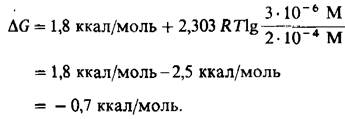
Table 11.1. Relationship between ∆G0' and K'eq (at 25°C)
A negative value for ∆G indicates that the isomerization of dihydroxyacetone phosphate to glyceraldehyde 3-phosphate can proceed spontaneously when these compounds are present at the concentrations specified above. Note that ∆G for this reaction is negative, even though ∆G0 is positive. It is important to emphasize that the relationship between the values of ∆G and ∆G0 for a reaction (whether ∆G is greater than, less than, or equal to ∆G0) depends on the concentration of the reactants. The criterion for reaction spontaneity is the value of ∆G, not ∆G0.
11.3. A thermodynamically unfavorable reaction can be driven by a thermodynamically favorable reaction
An important principle in thermodynamics is that the overall free energy change for a series of reactions is equal to the sum of the free energy changes of the individual steps. Consider the reactions
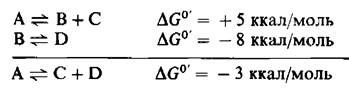
Under standard conditions, A cannot spontaneously convert to B and C because ∆G has a positive value. However, The conversion of B to D under standard conditions is thermodynamically feasible. Since free energy changes are additive, ∆G0 for the conversion of A to C and D is -3 kcal/mol. Consequently, under standard conditions, this conversion can proceed spontaneously. Thus, a thermodynamically unfavorable reaction can be driven by a thermodynamically favorable reaction. These reactions are coupled through B, their common intermediate. We will encounter many instances of energy coupling in metabolic processes.
Last update: 06/08/2026
Editorial and Educational Adaptation: This material has been compiled based on the primary/original source text. The project team performed an editorial review, corrected technical inaccuracies, structured sections, and adapted the content for an educational format.
What was processed:
- elimination of formatting defects (OCR errors, structural breaks, corrupted characters);
- editorial organization of content;
- standardization of terminology in accordance with academic sources;
- verification of factual statements against the original source text.
All mentions of the author, publication year, and origin of the primary text have been preserved in accordance with the source.