Biochemical Engineering Fundamentals Part 1 - Bailey J., Ollis D. 1989
Stoichiometry and Energetics of Metabolic Transformations
Principles of Thermodynamics
To determine whether a given chemical reaction in a Cell will proceed in the forward or reverse direction, we have to make A number of simplifications, since a complete analysis of all metabolic pathways is practically unfeasible. First of all, let us note that for an elementary chemical reaction
Class="center">
The change in Free energy ∆G' can be expressed as

As in previous chapters, lowercase letters a, b, etc., will denote the molar concentrations of compounds A, B, etc. Since the concentrations of substances in biological solutions are usually low, concentrations of the reactants can be substituted for activities in equation (5.2). The superscript (') over the symbols ∆G indicates that all calculations refer to aqueous solutions at pH 7; this makes it unnecessary to include the concentrations of Water and H+ in the final term of equation (5.2), even if H2O and H+ participate in reaction (5.1). Thus, the Standard Free Energy change ∆G°' denotes the free energy change for reaction (5.1) in a neutral aqueous solution when the concentrations of all other reactants and products are equal to 1 M (see [1]).
In a closed system, a reaction will proceed from left to right only if ∆G' is negative. It follows that at equilibrium, ∆G' is zero; thus, we obtain the well-known expression for a reversible reaction:

where

Keep in mind that if water or H+ participates in the reaction, their concentrations are not included in the right-hand side of equation (5.4); these parameters are already accounted for in K'eq (at pH 7).
In the subsequent Structure/133.html">Discussion, we will occasionally consider negative values of ∆G⁰' as evidence that a reaction proceeds from left to right. Such an assumption is, of course, valid only as a first approximation because, first, The Cell is not a closed system and, second, reactant concentrations usually do not reach 1 M. The usefulness of this assumption for understanding the Basic principles of Bioenergetics is well covered in Lehninger's book [1], recommended for Introduction/47.html">Further Reading.
At the same time, one should clearly recognize the limitations imposed by this approximate approach. In a complex metabolic network like the one shown in Fig. 5.1, the direction of the main pathway in cellular METABOLISM cannot always be established by studying an isolated reaction. Consider, for example, the reaction between two isomers that serve as intermediates in glucose degradation via the Embden-Meyerhof pathway:
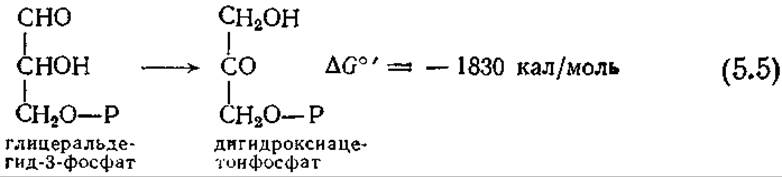
Here P stands for a phosphate group. The negative value of the free energy change shifts the equilibrium toward dihydroxyacetone to a ratio of 22:1. However, as shown in Fig. 5.1, in the Embden-Meyerhof pathway, glyceraldehyde-3-phosphate is continuously drawn into another sequence of reactions that ultimately leads to Pyruvate, thereby shifting the equilibrium and causing reaction (5.5) to proceed from right to left.
Many biological reactions and processes associated with Energy Metabolism involve oxidation-reduction Stages of the type

To determine the direction of such reactions, a parameter called the standard potential change ∆E⁰' is frequently used and defined as follows:

Here E°'(AOX/Ared) is the standard electrode potential of the half-reaction

The reference point for such electrode potentials is the hydrogen electrode, whose potential is taken as zero at a hydrogen pressure of 1.01 ∙ 105 Pa and a hydronium ion activity in solution equal to 1:

Free Energy Changes and the corresponding changes in electrode potential are related by the equation

Here n is the number of electrons participating in the reaction, and ℱ is the Faraday constant [ℱ = 23.062 kcal/(V ∙ mol)]. According to equation (5.10), only reactions with positive values of ∆E' proceed from left to right. If it is necessary to determine the value of ∆E' for non-standard conditions, equations (5.2) and (5.10) can be used.
Last update: 06/08/2026
Editorial and Educational Adaptation: This material has been compiled based on the primary/original source text. The project team performed an editorial review, corrected technical inaccuracies, structured sections, and adapted the content for an educational format.
What was processed:
- elimination of formatting defects (OCR errors, structural breaks, corrupted characters);
- editorial organization of content;
- standardization of terminology in accordance with academic sources;
- verification of factual statements against the original source text.
All mentions of the author, publication year, and origin of the primary text have been preserved in accordance with the source.