Biochemical Engineering Fundamentals Part 1 - Bailey J., Ollis D. 1989
Stoichiometry and Energetics of Metabolic Conversions
A living Cell is a complex chemical Reactor that carries out over 1,000 independent enzyme-catalyzed reactions. Nonetheless, biological systems obey the same fundamental laws of conservation of mass and energy and the same thermodynamic principles that are well-known to us from chemical engineering processes. In this chapter, we will examine The Cell precisely as a chemical reactor, focusing on the stoichiometric relationships and the energy-releasing or energy-absorbing processes characteristic of living organisms.
The sum total of all chemical transformations occurring within a cell is called METABOLISM. Fig. 5.1 shows a simplified diagram of some of the most important Metabolic Pathways in the bacterium Escherichia coli. It is easy to see that metabolic reactions are mostly grouped into sequences called metabolic pathways, with connections between them established, first, through cyclic, closed pathways in which the product of the final step serves as the Starting Material for the first step, and second, through branch points branching off from main pathways and linking one reaction sequence to another. All the arrows in Fig. 5.1 denote one or more enzyme-catalyzed reactions that convert certain cell components (metabolites) into others.
Individual Cells and their populations represent a more ordered system compared to their environment, and ordering any system requires an input of energy. Today, we already understand in varying degrees of detail how the energy required for this is extracted from the cell's environment. On the other hand—and this is probably most important from the perspective of biochemical technology—studying Energy Metabolism helps us understand and explain the fundamental differences between Cell Functioning in the presence and absence of oxygen. As we have already noted, these conditions are referred to as aerobic and anaerobic, respectively. Some cells (obligate or strict anaerobes) do not use free oxygen at all, others (obligate aerobes) require oxygen, while still others can grow both in the presence and absence of oxygen. The metabolically versatile third group of cells is called facultative anaerobes; these include, notably, the well-known Yeasts.
Class="center">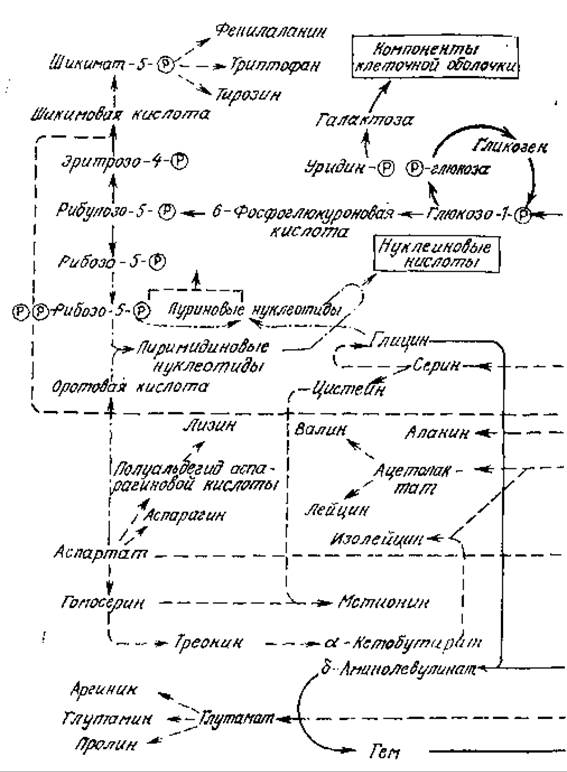
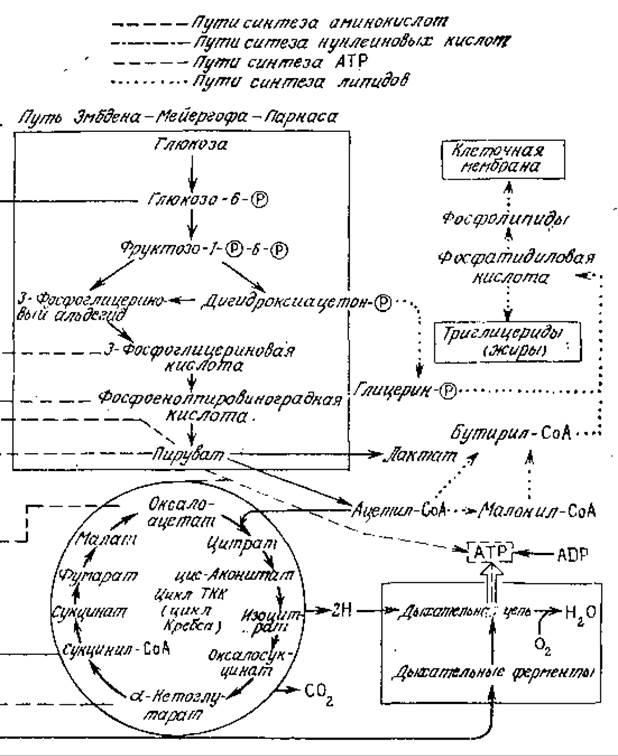
FIG. 5.1. Schematic diagram of some Major Metabolic Pathways in E. coli. J. D. Watson, Molecular Biology of the Gene. — Moscow: Mir, (1978).
Microorganisms utilize two forms of energy: light and chemical. Organisms for which light is the primary energy source are called phototrophs, whereas those that obtain energy from the degradation of specific nutrients are termed chemotrophs. Depending on The Nature of the latter, chemotrophs are further subdivided into several subgroups. Specifically, lithotrophs oxidize inorganic substances, while organotrophs use organic nutrients to harvest energy. We will provide a few concrete Examples after we examine the Fundamentals of Cell Nutrition in greater detail.
Energy acquired in one way or another is usually stored and transported (within the cell) in the form of convenient high-energy intermediates such as ATP (Sec. 2.3.1). The cell uses this energy to perform three main Functions: the Chemical synthesis of large or complex molecules (i.e., for growth); The transport of ionic and neutral substances into and out of the cell, as well as into and out of cellular Organelles; and mechanical work associated with Cell Division and motility. None of these processes occur spontaneously, and their result is an increase in the cell's Free energy. For this reason, they proceed only when coupled with other reactions accompanied by a large absolute decrease in free energy. We will return to this topic in Sec. 5.1.
The efficiency of free-energy utilization in Biosynthesis is quite high, typically exceeding 20%. Transport processes also involve ATP; this process is unique in that it ensures the movement of small molecules and ions across membranes against a concentration gradient, even when the concentration ratio of the transported substance on opposite sides of the membrane is 105. Mechanical work is obviously performed during cell division and the locomotion of Bacteria and Protozoa. Animal Muscle activity and sperm motility also involve ATP; the direct conversion of chemical free energy into mechanical work without intermediates such as electricity or hot gases represents another unique property of living systems. The chemical energy partially lost during such processes is converted into heat, which must be taken into account in technological processes involving growing cell populations.
Table 5.1. Major sources of chemical elements
Chemical element |
Source |
Carbon |
CO2, sugars, Proteins, fats |
Nitrogen |
Proteins, NH3, NO3- |
Sulfur |
Proteins, SO42- |
Phosphorus |
PO43- |
To grow and self-replicate, a cell must consume the substances required to build membranes, proteins, Chromosomes, walls, and other structural elements. Among the basic chemical elements essential for life, carbon, nitrogen, sulfur, and phosphorus are paramount; hydrogen and oxygen can be obtained from environmental components or, in some cases, from Water. Typical sources of these elements are listed in Table 5.1, and Fig. 5.2 illustrates a scheme for their utilization by a hypothetical bacterium. This Organism could be called a heterotroph, since it obtains its required carbon from organic matter. Other microorganisms can utilize simpler nutrients; for example, autotrophs satisfy all their carbon requirements using CO2. Combining this gradation with the aforementioned Classification of organisms according to their Energy Sources, we can define a set of traits describing cell metabolism. The corresponding nomenclature and examples of organisms of each type are given in Table 5.2. The Use of various energy and carbon sources by different cells indicates that the Chemistry of the processes occurring within them is not identical. In this chapter, the primary focus is on studying the most general metabolic pathways characteristic of A wide variety of living cells; important issues regarding the differentiation of metabolic pathways will be discussed later.
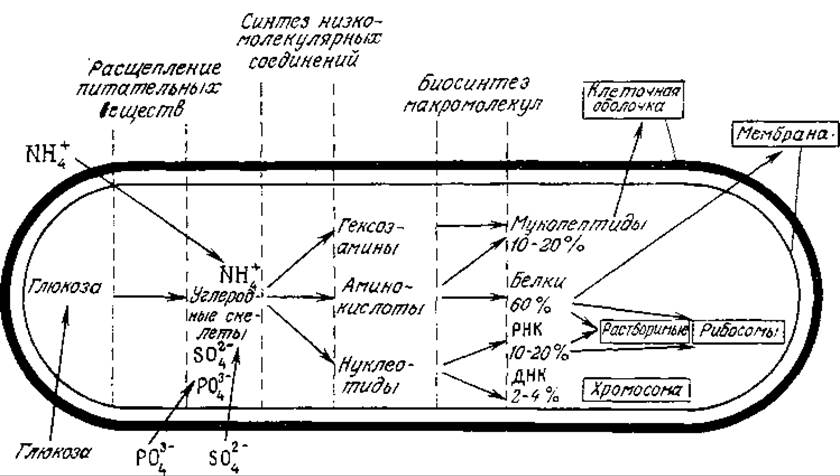
FIG. 5.2. Schematic representation of The biosynthesis of macromolecular compounds by a bacterium from simple nutrients. [Reprinted with permission from: Biochemistry of Bacterial Growth, Mandelstam J., McQuillen K., (eds.), 2d ed., p. 4, Blackwell Scientific Publications, Oxford.]
Table 5.2. Classification and Nomenclature of organisms based on carbon and energy sources
|
Energy source |
||
Carbon source |
Chemical |
Light |
Chemoheterotrophs (higher animals, protozoa, Fungi, and most bacteria) |
Photoheterotrophs (some bacteria, A number of eukaryotic Algae) |
|
CO2 |
Chemoautotrophs (some bacteria) |
Photoautotrophs (higher plants, eukaryotic algae, blue-green algae, and some bacteria) |
In Fig. 5.2, the reactions occurring in the cell are divided into three groups: nutrient degradation, Biosynthesis of Low-molecular-weight substances, and biosynthesis of polymeric macromolecules. As already noted, each reaction is catalyzed by a specific enzyme; the latter thus perform a crucial function by determining which reactions will take place in the cell and at what rates.
To appreciate Structure/19.html">The Importance of regulating relative reaction rates, it is helpful to look at cell chemistry from another perspective. Many substances present within the cell (metabolites) can simultaneously undergo the action of multiple Enzymes, which, for instance, may oxidize, reduce, or condense them with other substances. As a result, the reaction sequences occurring within the cell intersect and overlap in the most intricate ways, as illustrated, in particular, in Fig. 5.1. Note, for example, that Pyruvate—the end product of the Embden–Meyerhof pathway (also known as the Embden–Meyerhof–Parnas or EMP pathway)—can be further utilized in five different biosynthetic pathways. Although the diagram in Fig. 5.1 may at first glance seem exceedingly complex, we must not forget that it actually depicts only a tiny fraction of the approximately 1,000 reactions taking place in the cell. Furthermore, Fig. 5.1 does not indicate that many steps of these Metabolic pathways are reversible; this reversibility enables both the Synthesis and degradation of bioorganic compounds. A bit later in this chapter, we will examine some of these metabolic pathways in greater detail, along with the enzymatic mechanisms that control and regulate them.
Another important detail is missing from Figs. 5.1 and 5.2: we have not shown the pathways for excreting End products of Metabolism from the cell. Many of these substances are not needed for cellular activity, while others, such as Antibiotics or extracellular enzymes, serve a specific function. Some of these metabolic metabolites (alcohols, organic acids, Amino Acids, antibiotics, and many others) are of great value to humans, which economically justifies their industrial production through cell culture cultivation. For such purposes, researchers typically strive to find a biologically inefficient cell strain that produces the substance of interest in quantities far exceeding the organism's own requirements. For this reason, in this chapter we will also attempt to trace the pathways of interconversion of various chemical compounds within the cell in order to understand what can be produced using living organisms. Although we will only Touch upon this topic here and in subsequent chapters, this superficial view will be more than enough to appreciate the incredible complexity and almost inexhaustible diversity of chemical transformations occurring in the biological world.
The chemical composition of microorganisms or animal cells of a single type varies within relatively narrow limits, and cellular metabolic activity obeys the usual principles of stoichiometry and Thermodynamics. Thus, synthesizing a given amount of cellular matter requires specific quantities of carbon, nitrogen, and oxygen from the cell's immediate surroundings. Furthermore, if we know the chemical form in which these elements are consumed by cells from the medium, we can establish additional constraints linking The amount of nutrients utilized by the cells to the mass of newly formed cells in General and Specific biosynthetic products in particular. In addition, since the synthesis of all substances required to build new cells demands an Energy Expenditure, the sources of this energy must also be taken into account. This, in turn, imposes corresponding constraints on the amount of chemical or light energy utilized by the cell, since the cell assimilates energy in the form of ATP via a specific sequence of reactions.
In essence, material balance constraints and thermodynamic principles alone can serve as a sufficient basis for developing mathematical expressions that describe cellular activity in a highly simplified manner. This approach, discussed in more detail in Sec. 5.10, completely disregards data on the internal chemistry of cellular processes, focusing instead exclusively on parameters that characterize cell mass growth, substrate consumption, and The production of specific metabolic products. This approach makes it possible to derive equations that allow us to deduce certain required operating conditions for a biological reactor from a series of easily measurable quantities and to verify their consistency with experimental data.
We will begin our study with the fundamental mechanisms underlying cellular life and then move on to the end results of processes carried out in accordance with these mechanisms. First, we will analyze in greater or lesser detail The Role of ATP, the universal cellular energy carrier, as well as the types of reactions in which ATP absorbs and releases energy. In the same sections, we will examine important oxidation-reduction processes and the electron carriers (NADH and NADPH) that facilitate them within the cell; we will then proceed to study several Catabolic pathways associated with nutrient breakdown (with primary focus on glucose), define the energetics and stoichiometry of these processes, and briefly review the mechanisms of Photosynthesis. Next, from the same perspective, we will study some pathways of intracellular biosynthesis, after which we will examine the interconnection between the metabolic pathways that generate energy and electrons and the reaction sequences that consume them. Finally, we will analyze the general stoichiometric relationships characteristic of cell growth and conclude the chapter by examining the stoichiometry of metabolic product formation and its relationship to the stoichiometry of cell growth.
Last update: 06/08/2026
Editorial and Educational Adaptation: This material has been compiled based on the primary/original source text. The project team performed an editorial review, corrected technical inaccuracies, structured sections, and adapted the content for an educational format.
What was processed:
- elimination of formatting defects (OCR errors, structural breaks, corrupted characters);
- editorial organization of content;
- standardization of terminology in accordance with academic sources;
- verification of factual statements against the original source text.
All mentions of the author, publication year, and origin of the primary text have been preserved in accordance with the source.