BIOLOGY Volume 1 - A Guide to General Biology - 2004
7. AUTOTROPHIC NUTRITION
7.2. Classification of organisms according to energy and carbon sources
As mentioned above, Nutrition involves the acquisition of both energy and matter. The most essential element required by All living organisms is carbon (sec. 3.1). Living organisms can be grouped based on their sources of energy or carbon.
Despite the variety of forms in which energy exists, only two—light and chemical—are available to living organisms. Organisms that use light energy are called photosynthetic or phototrophic (phōtós — light; trophē — nourishment); organisms that use chemical energy are called chemotrophic. Phototrophs contain pigments, including certain forms of chlorophyll, capable of absorbing light energy and converting it into chemical energy.
Carbon sources
Organisms that use inorganic sources of carbon, specifically carbon dioxide (CO2), are called autotrophic (autós — self), whereas organisms that use organic sources of carbon are called heterotrophic (héteros — other). Unlike heterotrophs, autotrophs synthesize their own Organic compounds from simple inorganic substances.
These concepts were previously discussed in sec. 2.3.4 and summarized in Table 2.3. An important principle that follows from this is that chemotrophs are entirely dependent on photosynthetic organisms, as the latter provide them with energy, while heterotrophs are entirely dependent on autotrophic organisms, since the latter supply them with carbon.
The most prominent groups are photosynthetic organisms (green plants and Algae) and chemoheterotrophic organisms (animals and Fungi).
7.1. Define photoautotrophic and chemoheterotrophic organisms.
More detailed relationships between the two main groups of organisms are presented in Fig. 7.1. This figure schematically illustrates the Pathways of Energy flow and the carbon cycle in nature—topics that hold a prominent place in ecology (ch. 10).
Class="center">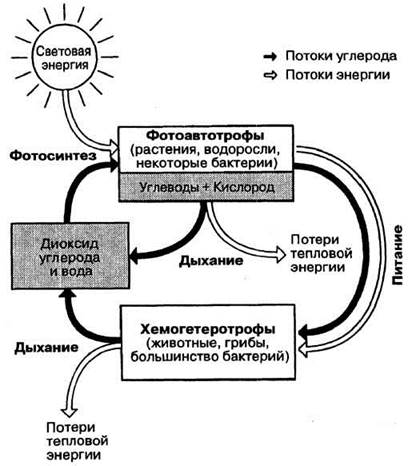
Fig. 7.1. Energy flows (white arrows) between photoautotrophs and chemoheterotrophs, the carbon cycle (black arrows), and the balance between Photosynthesis and Respiration. During photosynthesis, light energy is converted into chemical energy and then, together with carbon dioxide and Water, is used to synthesize organic compounds from inorganic substances. Organic compounds serve as sources of energy and carbon for chemoheterotrophs. Energy and carbon dioxide are released again through respiration—a process characteristic of all living organisms. Any energy transformation is accompanied by some loss of energy in the form of heat, which in this case is unusable.
Last update: 06/08/2026
Editorial and Educational Adaptation: This material has been compiled based on the primary/original source text. The project team performed an editorial review, corrected technical inaccuracies, structured sections, and adapted the content for an educational format.
What was processed:
- elimination of formatting defects (OCR errors, structural breaks, corrupted characters);
- editorial organization of content;
- standardization of terminology in accordance with academic sources;
- verification of factual statements against the original source text.
All mentions of the author, publication year, and origin of the primary text have been preserved in accordance with the source.