Principles of Biochemistry Volume 1 - A. Lehninger 1985
Biomolecules
Biochemistry - The Molecular Logic of Living Organisms
All living organisms contain organic macromolecules built on a common blueprint
Most Cell/6.html">Chemical Components of Living organisms are Organic compounds—that is, carbon compounds in which carbon atoms are covalently bonded to other carbon atoms, as well as to hydrogen, oxygen, and nitrogen atoms. Living matter consists of a vast array of highly diverse organic compounds, many of which are extraordinarily large and complex molecules. Even the simplest and smallest bacterial Cells contain a very large number of various organic molecules. For example, a cell of the bacterium Escherichia coli (the common colon bacillus) contains about 5,000 different species of organic compounds, including 3,000 different Proteins and 1,000 Different types of Nucleic Acids. Proteins and nucleic acids are very large and complex molecules (macromolecules); their exact Structure is known for only a few of these molecules. In the much more complex human Organism, the number of distinct proteins certainly exceeds 50,000. In all likelihood, not a single protein in E. coli is identical in molecular structure to any human protein, although many function in a similar manner. In fact, each species of living organism contains its own characteristic set of proteins and nucleic acids, and almost all of them are clearly distinct from those of any other species. Given that there are approximately 10 million species of living organisms, it is easy to calculate that all these species combined must contain, by a conservative estimate, 1011 different proteins and nearly as many different nucleic acids.
Class="center">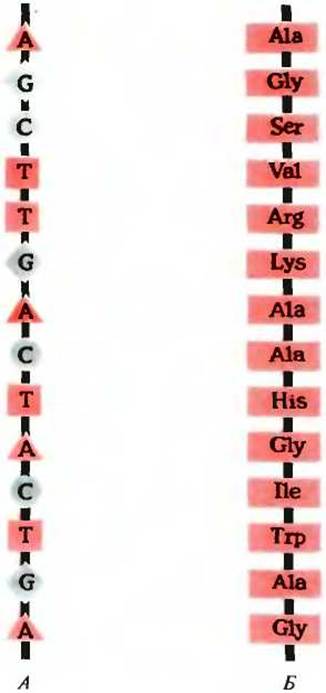
Fig. 1-2. A. Schematic representation of a portion of a DNA molecule, consisting of nucleotide Building Blocks of four types arranged in a specific sequence. B. Schematic representation of a portion of a protein molecule, constructed from amino acid units arranged in a specific sequence.
If biochemists were to set themselves the task of isolating, characterizing, and synthesizing all the organic molecules that make up living organisms, it would be an utterly hopeless endeavor. Yet, paradoxically, this vast diversity of organic molecules in living systems reduces to a rather straightforward picture. This is because all cellular macromolecules are constructed from simple, small molecules of a few types that serve as building blocks, which are linked into long chains containing anywhere from 50 to many thousands of units. The long, chain-like molecules of deoxyribonucleic acid (DNA) are built from just four types of building blocks—deoxyribonucleotides—arranged in a specific sequence. Proteins are chains composed of 20 different covalently linked Amino Acids—low-molecular-weight organic compounds of known structure. These Amino acids can be arranged in a multitude of different sequences to form a vast array of diverse proteins, much like the 26 letters of the English alphabet, when arranged in a certain order, can form an almost limitless number of words, sentences, and even books. Furthermore, the four NUCLEOTIDES from which all nucleic acids are built, and the 20 amino acids from which all proteins are constructed, are identical across all organisms, including animals, plants, and microorganisms. This fact strongly Supports the Conclusion that all living organisms share a common ancestor.
The simple molecules from which all macromolecules are built exhibit another remarkable feature: each of these molecules performs multiple Functions within The Cell. Various amino acids serve not only as building blocks for proteins, but also as precursors for Hormones, Alkaloids, pigments, and many other Biomolecules. Nucleotides are utilized not only as building blocks for nucleic acids, but also as Coenzymes and energy carriers. In living organisms, compounds that serve no function are virtually nonexistent, although the functions of certain biomolecules remain unknown to us.
Building on these considerations, we can now formulate several key principles of the molecular logic of life:
The structure of biological macromolecules is fundamentally simple.
All living organisms are composed of the same fundamental building-block molecules, pointing to their descent from a common ancestor.
The identity of each species of organism is preserved through a unique set of Nucleic Acids and Proteins specific to that species alone.
All biomolecules perform specific functions within cells.
Last update: 06/08/2026
Editorial and Educational Adaptation: This material has been compiled based on the primary/original source text. The project team performed an editorial review, corrected technical inaccuracies, structured sections, and adapted the content for an educational format.
What was processed:
- elimination of formatting defects (OCR errors, structural breaks, corrupted characters);
- editorial organization of content;
- standardization of terminology in accordance with academic sources;
- verification of factual statements against the original source text.
All mentions of the author, publication year, and origin of the primary text have been preserved in accordance with the source.