Pharmacognosy with the Basics of Plant Biochemistry - Kovalyov V. M. 2004
Special Part
Alkaloids
Medicinal plants and raw materials containing sesquiterpene alkaloids
YELLOW POND-LILY RHIZOMES — RHIZOMAJA NUPHARІS LUTEI
Yellow pond-lily — Nuphar luteum (L.) Smith., fam. Water/186.html">Water lily family — Nymphaeaceae
Yellow water-lily, brandy-bottle; from Arabic *naufar* — shiny, blue; Latin *luteus, -a, -um* — yellow.
Plant. The rhizome is horizontal, thick, long, and creeping, covered with rounded-triangular scars from fallen leaves. The surface is dark gray, and the fracture surface is grayish-cream or yellowish. Numerous roots anchor underwater in silt. Lower leaves are submerged and translucent; upper leaves are floating, long-petioled, leathery, oval, with a deeply cordate base and entire margins. Flowers are solitary, large, bisexual; yellow sepals and petals form a bell shape, fragrant, emerging 5–6 cm above the water. The fruit is berry-like, juicy, and green. Seeds are surrounded by an air-bearing sac, allowing them to float on water and be dispersed by the wind over long distances.
Distribution. Yellow pond-lily grows in dense stands in slow-flowing shallow rivers, ponds, and lakes throughout Ukraine, except for Crimea.
Harvesting. During flowering and in autumn, rhizomes are first cut with a knife and then pulled out of the water using pitchforks, rakes, or hands. Leaves, roots, and rotted parts are removed; the rhizomes are then washed, cut into pieces, spread in a thin layer, sun-wilted, and dried under a canopy or in dryers at a Temperature of 60 °C. The yellow pond-lily is a plant with a limited distribution and small raw material reserves; the harvesting of its rhizomes is licensed.
Class="center">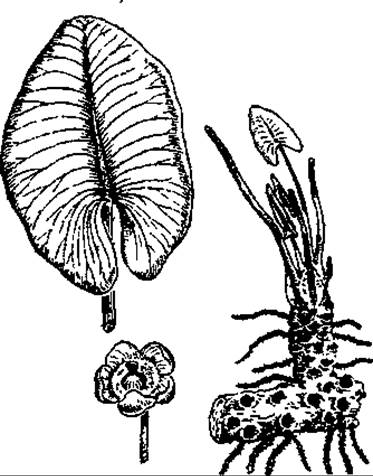
Chemical composition of raw Materials. Pond-lily alkaloids have a unique Structure and contain, In addition to nitrogen, sulfur and oxygen heteroatoms (a furan ring). These alkaloids are known as nupharidines and thiobinupharidines. Previously, they were classified as quinolizidine alkaloids, but biogenetically they are of isoprenoid origin.
The total alkaloid fraction contains a- and ß-nupharidines (0.4-0.5%), nuphleine (the main constituent), pseudothiobinupharidine, deoxynupharidine, etc. Rhizomes also contain Tannins, sitosterol, stigmasterol, carotene, and starch (20%).
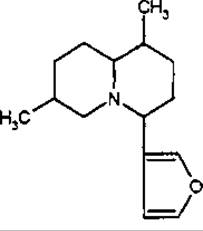
Deoxynupharidine
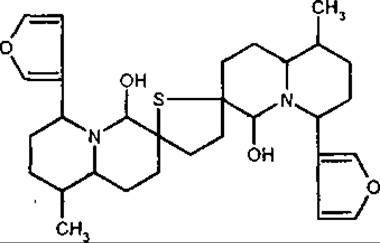
Nuphleine (thiobinupharidine)
Biological activity and application. Pond-lily alkaloids exhibit protistocidal, protistostatic, and spermatocidal effects. Lutenurin (a mixture of alkaloid hydrochlorides) acts topically as a contraceptive agent and is used to treat chronic trichomonal and urogenital infections complicated by fungal and bacterial flora.
In homeopathy, fresh rhizome is used for sexual asthenia, enterocolitis, Skin pruritus, and psoriasis.
Diterpene alkaloids
The first diterpene alkaloids were isolated in O. P. Orekhov's laboratory back in the 1930s, but due to their complex structure, their constitution remained unclear for a long time. They are found among plants of the families Ranunculaceae (Aconitum, Delphinium), Cornaceae (Garria), and Asteraceae (Inula).
Currently, diterpene alkaloids are divided into two groups — aconitines and atisines.
Aconitines are complex esters of plant acids with various polyhydric amino alcohols (aconines). Aconitine, the parent compound of the subgroup, is unstable and easily hydrolyzes to form aconine, benzoic acid, and acetic acid. The carbon Skeleton of aconine consists of 19 carbon atoms. During The formation of aconitine, one carbon atom of its precursor is lost. Aconitine is toxic to humans, but its Hydrolysis product is relatively nontoxic.
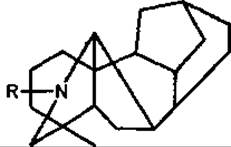
Aconitines
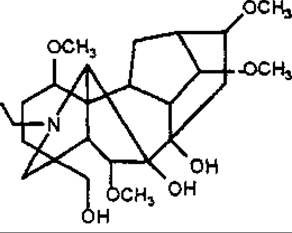
Lycoctonine
The alkaloid aconitine initially stimulates and then paralyzes the motor centers of the Brain AND SPINAL cord. Upon contact with the skin, it causes itching followed by anesthesia. In cases of poisoning with small doses of aconitine (0.2-0.4 mg), a person experiences a burning sensation in the Mouth, salivation, nausea, stocking-and-glove skin anesthesia, and Cardiac Arrhythmias. Aconitine poisoning from external and internal use can cause death from respiratory arrest.
Plants of the genus *Delphinium* contain a lycoctonine core similar to that of aconine. These are alkaloids with curare-like activity: condelphine, methyllycaconitine, elatine, and delsemine.
Atisines are free amino alcohols whose carbon skeleton contains 20 carbon atoms within a perhydrophenanthrene-type structure.
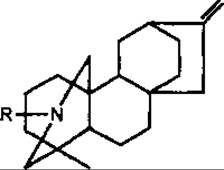
Atisines
Diterpene pseudoalkaloids, known as taxoids, are classified into a distinct subgroup. They were discovered during a large-scale screening program aimed at finding plant-derived antitumor agents. In the early 1960s, researchers at the U.S. National Cancer Institute discovered the cytotoxic activity of a crude alcoholic Histology/2.html">EXTRACT FROM THE bark of the Pacific yew (Taxus brevifolia, Taxaceae), which grows along the Pacific coast of North America. In 1971, paclitaxel, an antineoplastic agent, was isolated from the extract. Its research and Introduction into medical practice are considered a landmark achievement of phytochemical science at the end of the second millennium.
The paclitaxel content in yew bark is extremely low, approximately 0.005%. Natural raw materials cannot meet the clinical demand because a single patient's Treatment course requires the bark of 3 to 6 centenarian trees. Attempts have been made to obtain this substance via semi-synthetic and biotechnological routes. The total synthesis of paclitaxel was accomplished in the USA in 1994. The compound possesses a unique structure uncharacteristic of typical alkaloids (general formula C47H51NО14). It contains an unusually high number of oxygen atoms for an alkaloid, incorporates nitrogen in its side chain, and exhibits basic properties.
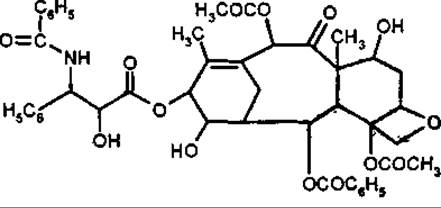
Paclitaxel (Taxol)
The limited raw material Base of the Pacific yew stimulated the search for alternative sources. In 1986, a new compound, docetaxel (Taxotere), was synthesized in France from the needles of the European yew (Taxus baccata). Currently, Taxotere is produced semi-synthetically from yew needle biomass.
The MECHANISM OF ACTION and cytotoxic effect of taxoids involve altering the Structure and function of tubulin. Tubulin is a protein that forms microtubules through polymerization. Tubulin dimers and microtubules maintain a quantitative dynamic equilibrium regulated by balanced polymerization and depolymerization processes. One of the Functions of microtubules is the Formation of the mitotic spindle during the M-phase of the Cell Cycle. Taxotere enhances tubulin polymerization into microtubules, rendering them defective and causing The Cell to arrest in the M-phase of the cell cycle. Failure to form the mitotic spindle disrupts mitosis and interphase processes in tumor Cells.
Last update: 06/08/2026
Editorial and Educational Adaptation: This material has been compiled based on the primary/original source text. The project team performed an editorial review, corrected technical inaccuracies, structured sections, and adapted the content for an educational format.
What was processed:
- elimination of formatting defects (OCR errors, structural breaks, corrupted characters);
- editorial organization of content;
- standardization of terminology in accordance with academic sources;
- verification of factual statements against the original source text.
All mentions of the author, publication year, and origin of the primary text have been preserved in accordance with the source.