Pharmacognosy with the Basics of Plant Biochemistry - Kovalyov V. M. 2004
Special Part
Phenolic Compounds
Tannins
Tannins (tannides) are a complex mixture of low- and high-molecular-weight polyphenols, genetically linked to one another, that exhibit tanning properties, possess an astringent taste, and precipitate Proteins and Alkaloids from dilute solutions.
The term "tannins" was coined in 1796 by French researcher F. Seguin to describe plant extract substances capable of tanning and converting raw animal hides into leather. Tanning is not a simple physical process, but rather a complex chemical interaction between the phenolic groups of tannides and Collagen molecules in the Skin. When tannin lies flat against a protein molecule, stable Hydrogen Bonds are formed between the OH groups of the phenols and the carboxyl groups of the Amino Acids.
Class="center">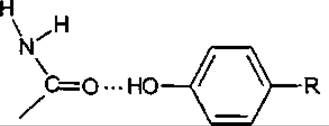
Simple polyphenols (pseudotannins, dietary tannins, tea tannins) have a low molecular weight; therefore, they cannot form strong cross-links and do not exhibit tanning activity, yet they possess an astringent taste and provide therapeutic effects in A number of conditions. Compounds with a molecular weight exceeding 20,000 are also ineffective for leather tanning because they cannot penetrate between the collagen fibers of animal skin.
Early studies of tannins already demonstrated that compounds with similar physicochemical properties differ significantly in structure.
The first classification, proposed by Procter in 1894, divided tannins into two groups based on the products of their thermal decomposition:
pyrogallol tannins (which yield pyrogallol upon pyrolysis) and pyrocatechol tannins (which form pyrocatechol).
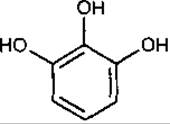
Pyrogallol
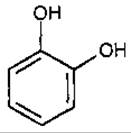
Pyrocatechol
In 1920, K. Freudenberg proposed classifying tannins into hydrolyzable and condensed types based on their natural Structure and Chemical properties.
Hydrolyzable tannins, under METABOLISM/18.html">The Influence of acids, Enzymes, and alkalis, break down into simple Phenolic Compounds and a sugar. The latter may be glucose, galactose, arabinose, xylose, maltose, fructose, sucrose, or a sugar-like moiety—such as quinic acid, hydroxycinnamic acid, or flavan.
Based on their structure, hydrolyzable tannins are divided into three groups:
gallotannins (esters of gallic acid and sugars), ellagitannins (esters of ellagic acid and sugars), and non-sugar esters of phenolic carboxylic acids.
Gallotannins are the most widespread group of tannins.
The general formula of gallotannins, where R is a mono-, di-, tri-, tetra-, penta-, or polygallic acid residue:
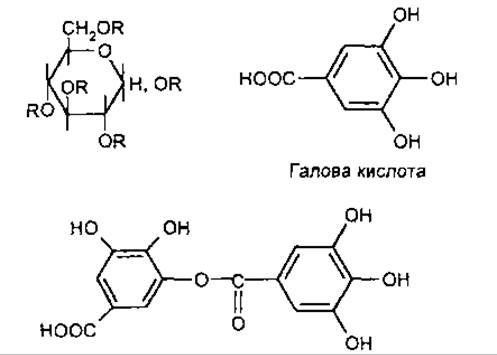
meta-Digallic acid, or gallic acid depside
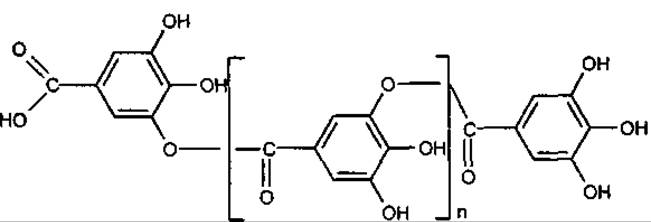
Polygallic acid
The highest concentration of gallotannins is found in plant growths known as galls. Work by E. Fischer and K. Freudenberg proved that The ratio of glucose to gallic acid is 1:5–6 in Turkish galls and 1:9–10 in Chinese galls. Previously, these types of galls were imported for tannin production.
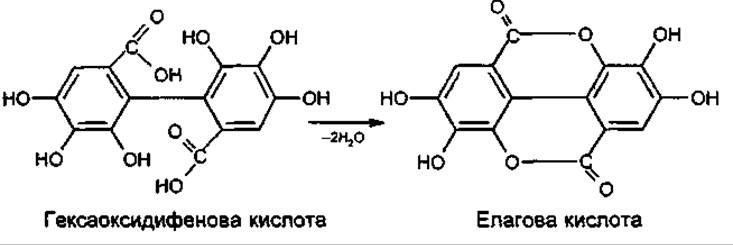
Upon Hydrolysis, ellagitannins yield ellagic acid or acids biogenetically related to it, such as hexahydroxydiphenic acid, chebulic acid, dehydrodigallic acid, etc.
Ellagic acid is formed via the lactonization of hexahydroxydiphenic acid during the hydrolytic breakdown of ellagitannins. Heating or The addition of mineral acids accelerates this process.
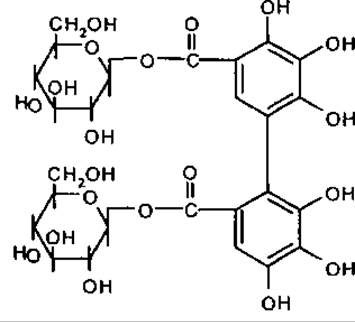
Alnitanin
Corilagin, obtained from divi-divi and myrobalan tannin raw Materials, was the first ellagitannin isolated in crystalline form. Upon hydrolysis, it yields one molecule each of gallic and ellagic acids, along with glucose. Later, alnitanin was isolated from the infructescences of black alder (Alnus glutinosa).
A non-saccharide ester of gallic acid has been found in green tea. It is a depside of gallic and quinic acids, designated as theogallin.
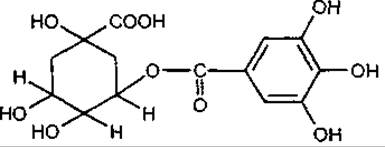
Theogallin
Three galloyl esters linked to catechins, such as catechin gallate, have been isolated from black (fermented) tea (Camellia sinensis).
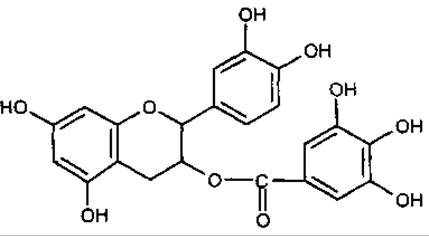
Catechin gallate
Such esters of gallic acid and catechin form an intermediate link between gallotannins and Flavonoids.
Condensed tannins are likewise divided into three groups:
flavan-3-ol derivatives;
flavan-3,4-diol derivatives;
hydroxystilbene (diphenylethylene) derivatives.
Elucidating the Chemical Structure of this group of tannins presents considerable difficulties because they readily condense under the influence of mineral acids, oxidizing agents, and high temperatures.
Despite extensive research in this field, the Mechanism of formation and the chemical structure of condensed tannins remain largely unclear. K. Freudenberg put forward the hypothesis of a catechin-like structure for all condensed tannins. He was also the first to propose the term "catechins" for substances possessing a flavan-3-ol framework.
Another precursor of condensed tannins is flavan-3,4-diol, which is widely distributed in the plant kingdom.
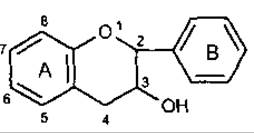
Flavan-3-ol
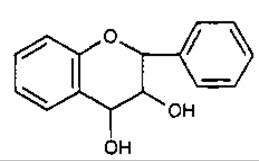
Flavan-3,4-diol
Flavan derivatives must meet specific structural requirements for autoconcondensation to occur:
an -OH or -OCH3 group at position 4 of the flavan Skeleton; two -OH groups in the meta-position of ring A, or a single -OH group at position C-7.
Under acidic conditions, flavan-3,4-diols undergo Condensation much more readily than the corresponding flavan-3-ols.
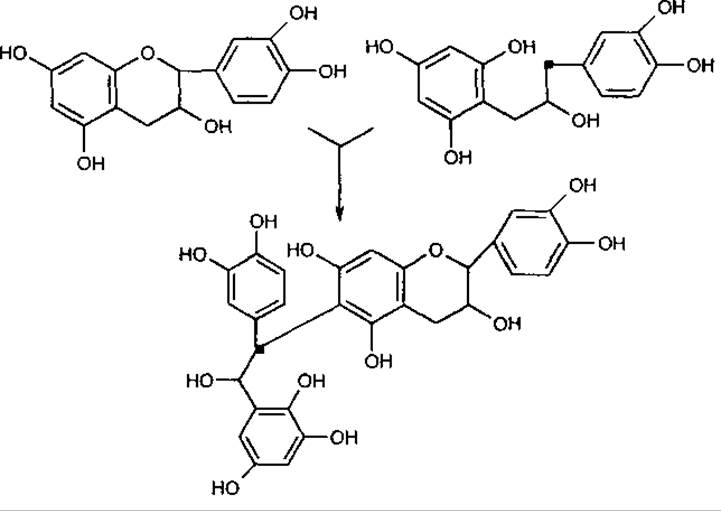
There are a number of arguments suggesting that oxidative reactions of phenols play a major role in The Biosynthesis of Lignans, alkaloids, etc.
Formation of condensed tannins according to Freudenberg
Condensed tannins, which are derivatives of oxystilbenes, have been isolated from pine, spruce, and the roots of higher plants. For instance, the stilbene piceatannol serves as the aglycone for Glycosides found in spruce phloem. Upon Treatment with phenol oxidases, as well as upon heating with dilute mineral acids, piceatannol forms dark condensation products.
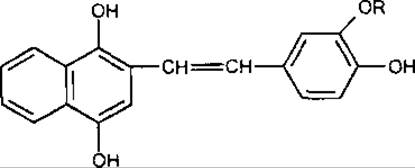
Piceatannol
Oxystilbenes can also form mixed polymers with flavans.
Distribution and Localization
Tannins occur predominantly in higher plants. The highest number of plant species with a high tannin content is found in the families Fabaceae, Polygonaceae, Anacardiaceae, Myrtaceae, Rosaceae, Hamamelidaceae, Salicaceae, Geraniaceae, Plumbaginaceae, and Asteraceae. Pods of Caesalpinia brevifolia and Caesalpinia coriaria (up to 45% on a dry weight basis) and the bark of certain eucalyptus species (Eucalyptus sp.) are exceptionally rich in tannins. Approximately 64% of hydrolyzable tannins accumulate in pathological growths (galls) on the leaves of the Chinese sumac (Rhus semialata) and the Lusitanian oak (Quercus lusitanica).
The following sources of tannins are known worldwide:
Catechu — a dry Histology/2.html">EXTRACT FROM THE wood of the cutch tree (Acacia catechu, fam. Fabaceae) and other species. Catechu appears as irregular dark brown pieces with an astringent and bitter taste, completely soluble in Water and alcohol. It contains condensed tannins and is used internally as an astringent.
Myrobalan fruits (Terminalia chebula, fam. Anacardiaceae), which contain about 40% tannins, used for gastrointestinal disorders and dysentery;
Gambier — a dry extract from the leaves and young shoots of Uncaria gambir, fam. Rubiaceae, obtained by extracting the raw material with water. It contains condensed tannins and is used internally as an astringent;
Kino — a dried juice of various tropical plants containing tannins and coloring agents. In South Asian countries, it is obtained from Pterocarpus marsupium, fam. Fabaceae; in Australia, from Eucalyptus rostrata, fam. Myrtaceae; and in Central America, from Butea frondosa, fam. Fabaceae. Upon incision, a dark red juice exudes from the bark, which is collected and sun-dried. The juice is soluble in hot water and alcohol, contains condensed tannins, and is used both internally and externally as an astringent;
Rhatany ROOT from Krameria lappacea (syn. Krameria briandra), fam. Fabaceae, which contains about 20% condensed tannins and a large amount of water-insoluble rhatany red (phlobaphenes). It is used externally.
Physicochemical Properties, Isolation, and Analysis
Tannins capable of tanning hides and converting them into leather (true tannins) have a molecular weight ranging from 1,000 to 20,000. These are amorphous substances ranging in color from pale yellow to light brown, readily soluble in water, methanol, and ethanol, and insoluble in chloroform, benzene, and petroleum ether.
Those with a lower molecular weight (pseudotannins, or astringent tannins) do not interact with hide proteins, but they possess an astringent taste and are used in the medical and food industries. Some of them have been isolated as crystals and thoroughly studied. Many tannins are optically active and easily oxidized in air, becoming darker in color. Oxidized condensed tannins are called phlobaphenes.
Isolation. Tannins are extracted from the raw material with hot water, after which the extract is purified from accompanying compounds by sequential treatment with chloroform, diethyl ether, and ethyl acetate.
Pre-extraction of the raw material with organic Solvents is often employed to remove chlorophyll, Terpenes, etc., followed by ethanol extraction to isolate the tannins. Low-molecular-weight tannins are isolated via Column Chromatography using sorbents such as silica gel, polyamide, etc.
Identification. Tannins form precipitates with gelatin and alkaloid solutions; like other phenolic compounds, they form precipitates (sometimes colored) with heavy metal salts, most commonly iron salts. Hydrolyzable tannins turn dark blue with an iron-ammonium alum solution, whereas condensed tannins turn dark green.
Condensed tannins yield a red color with vanillin in concentrated Hydrochloric acid or 70% sulfuric acid.
When lead acetate in an acetic acid medium is added to a mixture of both tannin groups, the hydrolyzable tannins precipitate, while the condensed tannins remain in solution.
Free ellagic acid can be detected by adding a few crystals of sodium nitrite and 3–4 drops of acetic acid — the solution turns red-violet. To detect bound ellagic acid (hexahydroxydiphenic acid), acetic acid is replaced with 0.1 N sulfuric acid or 0.1 N hydrochloric acid. In this case, the color becomes carmine red, gradually shifting to blue.
Chromatographic analysis is used exclusively for low-molecular-weight tannins. On chromatograms under UV light, catechins appear as purple-tinged spots that yield a gray-blue fluorescence upon exposure to ammonia vapors. Catechins turn colored when treated with vanillin reagent or iron-ammonium alum solution. Gallic acid exhibits dark fluorescence under UV light and turns green upon treatment with Fe3+ salts.
Quantitative determination. More than a hundred modifications of various Analytical Methods are currently known. The most widespread is the Löwenthal method (State Pharmacopoeia XI). It is based on The oxidation of tannins with potassium permanganate in a weakly acidic medium using indigosulfonic acid as an indicator. While the method is relatively simple, the accuracy of the results is affected by a number of factors, primarily the ability of potassium permanganate to oxidize other naturally occurring substances under these conditions.
To determine the gallotannin content in sumac and smoke tree leaves, a complexometric titration method has been developed.
The Quantitative determination of catechins is carried out by photoelectrocolorimetry using a 1% solution of vanillin in concentrated hydrochloric acid.
In the leather industry, the hide-powder precipitation method is used for the Quantitative evaluation of plant tannins.
Biological Activity and Applications
Experimental and clinical data gathered to date indicate that there are at least three distinct types of biological effects exerted by plant polyphenols on the mammalian Organism. First, they have a direct effect on Cell membranes, smooth Muscle Cells, enzyme proteins, and Nucleic Acids. Second, they influence the metabolism of BIOLOGICALLY ACTIVE SUBSTANCES such as adrenaline, ascorbic acid, and acetylcholine. Third, they impact the leading neurohumoral and neuroendocrine regulatory systems.
Constantly entering The Human Body through plant-based foods, polyphenols exert a prolonged effect on all PARTS OF THE digestive tract, and upon absorption into the bloodstream, on The Cardiovascular system, Kidneys, and other Organs and systems. The main dietary sources of polyphenols are fruits and berries. Polyphenols are found in high concentrations in tea, coffee, cocoa, as well as in herbal infusions and decoctions.
Catechins and flavan-3,4-diols exhibit the highest activity regarding vascular permeability.
Tannins entering the body act on the mucous membrane of the digestive tract, affecting motility, as well as secretory and absorptive Functions. They have an astringent taste and promote The formation of a thin layer of precipitated protein. This reduces mucosal irritation and helps heal superficial erosions and ulcers. Plant polyphenols significantly mitigate the Toxic effects of chemical agents. The primary role here is played by The Cell membrane-tightening mechanism, which impedes The entry of toxic substances into vital organs and helps preserve endogenous ascorbic acid and Glycogen.
The anti-inflammatory action of polyphenols promotes the healing of minor wounds. They are particularly effective in reducing and even eliminating the exudative component of the inflammatory response, which is readily explained by the membrane-stabilizing action of phenols. Polyphenol compounds mobilize the body's intrinsic homeostatic mechanisms, stimulate adrenal cortex function and glucocorticoid Hormones, thereby exhibiting anti-inflammatory, antimicrobial, antifungal, and antiprotozoal activity. In PLANT AND ANIMAL Tissues, polyphenols perform a protective function, the most crucial element of which is their antioxidant effect. During oxidative reactions in the body, free radicals are formed, which interact with tissue Lipids to produce toxic lipid peroxides and oxides that slow down cell proliferation. The level of tissue antioxidants plays a significant role in malignant cell growth.
Phenolic compounds capable of forming reversibly oxidized species (phenol → semiquinone → quinone) inhibit The activity of thiol enzymes. However, this is not the only Molecular Mechanism of the biological action of polyphenols. Their influence on the activity of redox enzymes—especially via the semiquinone → quinone pathway—has been proven. The inhibitory effect of polyphenols on dozens of enzymes has been studied and reliably established.
Tannins have found widespread application in medical practice. They exhibit astringent, anti-inflammatory, and antimicrobial properties. Tannin-containing preparations are used internally for acute and chronic colitis, enteritis, and gastritis, and occasionally as a hemostatic agent for uterine and hemorrhoidal bleeding. Tannins are extensively used for inflammatory conditions of the Oral Cavity, Larynx, and nasal passages as mouthwashes and gargles, as well as for Burns, bedsores, and ulcers in the form of irrigations and lotions. Although all polyphenols possess capillary-strengthening properties, the antihemorrhagic effect of plant substances may be due not only to their vascular action but also to enhanced Blood Coagulation.
Catechins are prescribed as Vitamin P agents. The radioprotective action of most tannins has been established, as well as their ability to facilitate the elimination of radioactive isotopes of cesium and strontium from the body.
Information on the pharmacological action of plant materials and tannin-containing preparations is presented in Table 11 of the Appendices.
Last update: 06/08/2026
Editorial and Educational Adaptation: This material has been compiled based on the primary/original source text. The project team performed an editorial review, corrected technical inaccuracies, structured sections, and adapted the content for an educational format.
What was processed:
- elimination of formatting defects (OCR errors, structural breaks, corrupted characters);
- editorial organization of content;
- standardization of terminology in accordance with academic sources;
- verification of factual statements against the original source text.
All mentions of the author, publication year, and origin of the primary text have been preserved in accordance with the source.