Biochemistry - The Chemical Reactions of Living Cells, Volume 2 - D. Metzler 1980
Biosynthesis: How New Molecules Are Formed
Polyprenyl (Isoprenoid) Compounds
Terpenes
Plants, animals, and Bacteria contain an astonishingly vast array of compounds derived from isopentenyl pyrophosphate. Selected Examples are shown in Figs. 12-12 and 12-13. The compounds in Fig. 12-12 contain 10 carbon atoms and belong to the monoterpene group. They are found predominantly in plants, although some serve as arthropod pheromones. The biosynthetic pathways of terpenes in plant Tissues are generally much less understood than the Major Metabolic Pathways in animals; in particular, the Enzymes involved in their Biosynthesis have not been isolated and purified. It has been demonstrated, however, that feeding plants with radioactively labeled acetate results in a specific distribution of the label within the terpenes. This holds true for most of the terpenes mentioned, with the label distribution matching theoretical expectations. Plants typically contain A wide variety of different terpenes concentrated in specialized oil glands or resin-impregnated conducting tissues. Intracellularly, terpenes are present in smaller amounts, usually as Glycosides of terpene alcohols. The Abundance of certain terpenes is truly immense. For instance, turpentine contains up to 64% $\alpha$-pinene, and juniper oil consists of 65% $\alpha$-terpineol [80].
Class="center">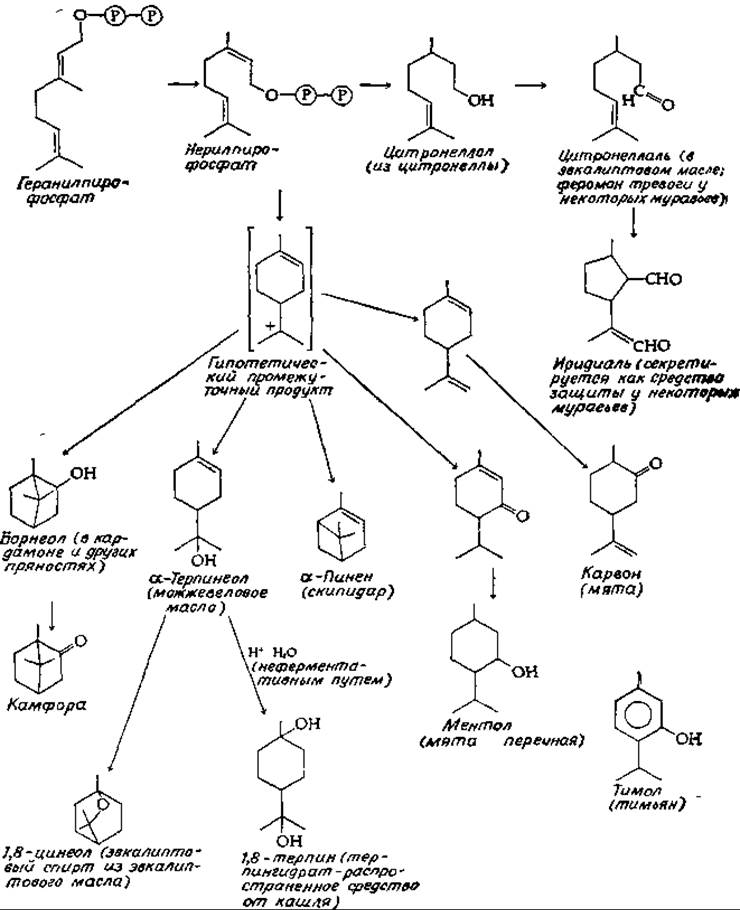
FIG. 12-12. Probable biosynthetic pathways for a series of monoterpenes and related compounds. Some natural sources of the given compounds are indicated in the figure.
Most of the compounds depicted in Fig. 12-13 are derivatives of C15-farnesyl pyrophosphate. Abscisic acid belongs to one of the five known types of Plant HORMONES widely distributed in higher plants (Chap. 16, Sec. A,3). Gibberellins constitute another class of plant hormones, the first representative of which was isolated from plants infected with the fungus Fusarium. Notably, the rice plants from which these gibberellins were isolated exhibited abnormally long and weak stems. It was subsequently shown that gibberellins, which include numerous highly modified C20- and C19-terpene compounds, function as hormones in all higher plants.

FIG. 12-13. Terpenes and related compounds.
The biosynthesis of gibberellins is highly complex [78, 81]. Equation (12-26) outlines the simplified synthesis of gibberellin A1. Step a in Eq. (12-26) appears to be a single enzymatic isomerization reaction leading to ring closure. In addition to the electron transfer required for The formation of two rings, this step involves the elimination of a proton from a methyl group and The addition of a proton to the terminus of the double bond on the left side of the first structural formula.
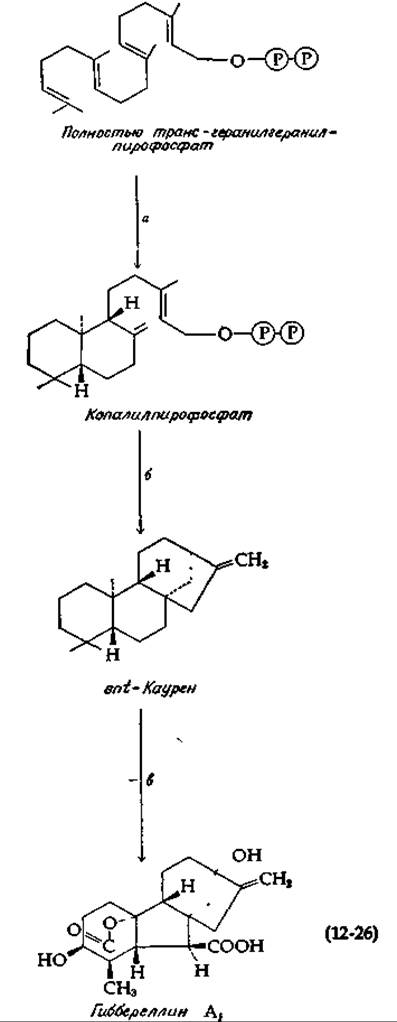
Steps b and c in Eq. (12-26) represent complex multistep reactions. Note that step b involves the elimination of pyrophosphate accompanied by the migration of a methyl group, which becomes a methylene group in kaurene. Step c in Eq. (12-26) is even more intricate, involving multiple hydroxylation and oxidation stages as well as ring contraction; this step ultimately converts a methyl group (via oxidation) into the carboxyl group of the final reaction product.
The insect juvenile hormone (Fig. 12-13) is also of polyprenoid nature. It should be noted, however, that two of its methyl groups are replaced by (or have been converted into) ethyl groups. The isolation and structural identification of the juvenile hormone posed a formidable challenge. To the utter astonishment of the researchers upon its completion, it was discovered that a whole range of synthetic compounds, often bearing very little structural resemblance, exhibit juvenile hormone activity—that is, they are capable of preventing insect hatching or arresting development at the larval stage. Furthermore, A number of plant-derived products, such as juvabione (Fig. 12-13), first isolated from paper, elicit the exact same physiological effect. This implies that plant metabolites exert a profound influence on the developmental cycle of phytophagous insects in nature. The potential use of juvenile hormone or synthetic analogs with similar activity as insecticides appears highly promising.
Last update: 06/08/2026
Editorial and Educational Adaptation: This material has been compiled based on the primary/original source text. The project team performed an editorial review, corrected technical inaccuracies, structured sections, and adapted the content for an educational format.
What was processed:
- elimination of formatting defects (OCR errors, structural breaks, corrupted characters);
- editorial organization of content;
- standardization of terminology in accordance with academic sources;
- verification of factual statements against the original source text.
All mentions of the author, publication year, and origin of the primary text have been preserved in accordance with the source.