Plant Physiology - Musiyenko, M. M. 2001
General principles of plant growth and morphogenesis regulation
Abscisic acid
To survive changes in environmental conditions, a plant must be able to inhibit or stimulate specific physiological processes at the right time. Consider the plant Organism's transition to summer dormancy, preparation for winter, or, conversely, springtime awakening. Undoubtedly, phytohormones, particularly abscisic acid (ABA), play a significant role in these processes.
The discovery of abscisic acid was associated with The Study of two phenomena: the abscission of leaves and fruits, and bud dormancy.
In 1949, it was proven that dormant buds of potato and ash contain growth inhibitors that block the action of auxin in the oat coleoptile test. Later, F. Wareing and coworkers (1963) isolated a substance that also promoted the transition of birch buds to dormancy. The compound that showed the greatest effect in this regard was named dormin. Simultaneously, various researchers isolated a compound causing the abscission of leaves and cotton bolls. They named it abscisin. As it turned out later, dormin and abscisin are the same substance, belonging to growth inhibitors, which was named abscisic acid (С15Н20О4). Its molecular Structure was simultaneously established in 1963 by Ohkuma and Cornforth with coworkers (Fig. 182).
Class="center">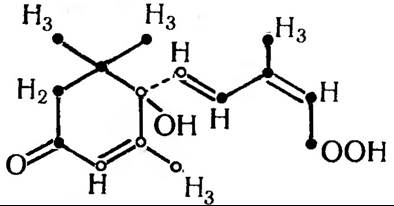
Fig. 182. Abscisic acid. Carbon (C) atoms are shown as white or black circles to designate the original isoprene units.
The following processes form The basis of bioassays for abscisic acid:
·inhibition of auxin-induced oat coleoptile growth;
·inhibition of germination of isolated wheat embryos;
·stimulation of stomatal closure;
·acceleration of petiole abscission in cotton cotyledon seedlings;
·inhibition of gibberellin-induced a-amylase synthesis in the barley aleurone layer;
·Inhibition of Growth in various duckweed species (Lemna minor).
Most higher plant Tissues are capable of synthesizing abscisic acid. The sites of synthesis are leaves (in most tissues, it is likely synthesized in Plastids), fruits, and the ROOT cap. Its Biosynthesis occurs via a pathway common to all terpenoids, i.e., through mevalonic acid. Another pathway of ABA synthesis can be the degradation of carotenoids, specifically the Catabolism of such a carotenoid as violaxanthin:
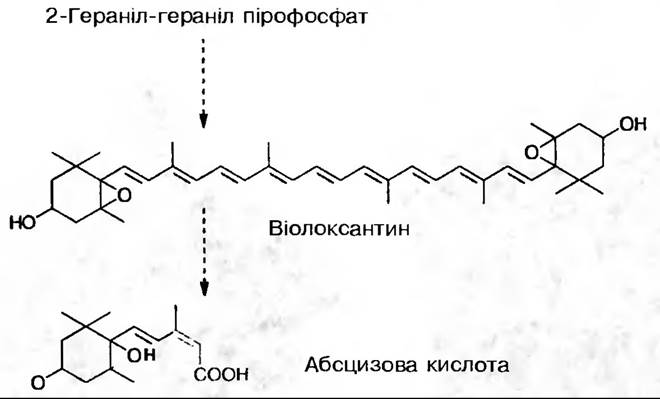
The highest amounts of ABA are detected at the time of fruit abscission. ABA is transported in various directions through both the phloem and the xylem.
Physiological Action of ABA
For A number of years, The Role of ABA in stimulating dormancy has been a subject of Discussion. Unlike previous groups of phytohormones, ABA retards growth processes in all their manifestations. It controls the transition to dormancy, leaf senescence, and fruit ripening, and takes part in tuber formation. The role of ABA is particularly important in the formation and expression of the root's response to gravity. Roots grow downward under METABOLISM/18.html">The Influence of gravity. ABA also plays a significant role in The Mechanism of gravitropism: synthesized in the root cap, under normal conditions it is transported through conductive vessels in a basipetal direction (toward the base). If the root is placed horizontally, abscisic acid is transported to the lower part, where it inhibits growth; accordingly, the upper part continues to grow, causing the root to bend downward. This is confirmed by the disruption of gravitropic sensitivity upon removal of the root cap and the fact that
ABA is extracted from the root cap, meaning it is synthesized there. Applying ABA to the root surface inhibits growth, and asymmetric application of ABA to the root surface causes bending toward the side where the ABA was applied. Removal of half the cap also causes bending toward the side where ABA was applied.
Abscisic acid is a stress hormone; it rapidly accumulates in tissues, especially under Water deficit. ABA is synthesized in Chloroplasts and then flows via plasmodesmata to guard Cells, where it induces their closure. Evidence: ABA translocation occurs throughout the entire duration of drought while The water potential remains low. Furthermore, exogenous application of low concentrations of ABA to leaves causes stomatal closure within just 3–9 min. The concentration of ABA in leaves increases sharply under stress. In addition, it is known that mesophyll chloroplasts synthesize ABA, whereas guard Cell chloroplasts are incapable of synthesizing it. A possible mechanism for this phenomenon is that ABA inhibits the efflux of H+ from guard cells and the influx of K* into these cells.
It is hypothesized that the Plasmalemma of guard cells contains a proton pump whose activity is controlled by ATP generated during cyclic Photophosphorylation in the chloroplasts of these Stomata. The proton pump actively pumps H+ out of The Cell. Consequently, this process is counterbalanced by the passive influx of K+ ions into the cell. The efflux of hydrogen ions from the Cytoplasm causes its pH to rise to 8–9, which is optimal for the functioning of phosphoenolpyruvate carboxylase. This enzyme catalyzes The conversion of phosphoenolpyruvate, formed from starch, into oxaloacetate, which is reduced to malate by the action of malate dehydrogenase. The latter accumulates in vacuoles. As a result, the water potential decreases (in other words, the magnitude of osmotic pressure in vacuoles increases), which causes water to flow into the vacuoles. An increase in the turgor of the two guard cells causes the stomatal pore to open. It is believed that ABA disrupts this normal course of the process by blocking the operation of the proton pump. The changes that subsequently occur increase the water potential (decrease the osmotic pressure) in the vacuoles and thus ensure the efflux of water from them. As a result, guard cells lose turgor, and the stomatal pore closes. Not only water deficit, but also other adverse factors cause an increase in ABA levels.
Abscisic acid is a potent inhibitor of seed germination and bud growth, and therefore accumulates in them during the transition to physiological dormancy. It promotes the appearance of the abscission layer in petioles and pedicels, accelerating leaf and fruit fall (Fig. 183). ABA accelerates senescence, causing The breakdown of Nucleic Acids, Proteins, and chlorophyll.
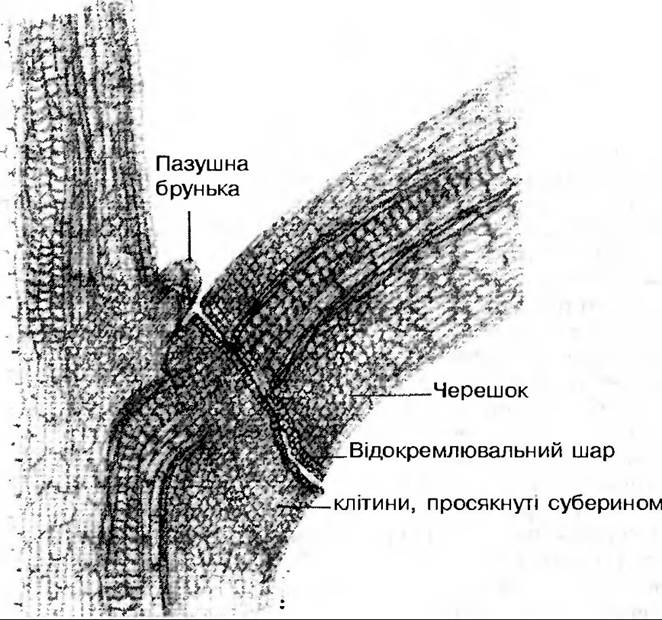
Fig. 183. Formation of the abscission layer in the leaf petiole during leaf fall.
In addition, ABA is involved in tuber formation, and its exogenous application causes accelerated fruit ripening (grapes and strawberries have a high ABA content during ripening).
The MECHANISM OF ACTION of ABA at THE MOLECULAR LEVEL is unknown, although it is believed that all physiological effects are associated with the inhibition of growth processes. Therefore, it is plausible to assume that ABA blocks certain Stages of Transcription with The formation of mRNA and the Translation of mRNA into protein. It is also hypothesized that ABA inhibits the functional activity of the H+ pump, which can, in turn, cause various consequences. Accumulating data indicate that ABA can influence metabolic processes by altering the permeability of certain membranes to various ions. Therefore, the mechanism of action of ABA can be explained partly by its effect on Protein Synthesis AND partly by its effect on selective membrane permeability. In agricultural practice, ABA is used to spray fruit trees at the end of the growing season to accelerate ripening and shorten harvest periods.
Last update: 07/08/2026
Editorial and Educational Adaptation: This material has been compiled based on the primary/original source text. The project team performed an editorial review, corrected technical inaccuracies, structured sections, and adapted the content for an educational format.
What was processed:
- elimination of formatting defects (OCR errors, structural breaks, corrupted characters);
- editorial organization of content;
- standardization of terminology in accordance with academic sources;
- verification of factual statements against the original source text.
All mentions of the author, publication year, and origin of the primary text have been preserved in accordance with the source.