Fundamentals of Molecular Biology. Part 2: Molecular Genetic Mechanisms - A. N. Ogurtsov 2011
DNA Transcription
Stages of Transcription
The METABOLISM/31.html">Transcription process can be viewed as a sequence of stages during which RNA polymerase performs various operations (Figure 9).
During Transcription initiation, RNA polymerase recognizes the promoter—a specific sequence of nucleotide pairs in the DNA double helix—and binds to it (Figure 9(a)).
Finding the promoter and initiating nuclear RNA transcription requires the presence of specific Proteins known as transcription factors. Upon binding to the promoter, RNA polymerase unwinds ("melts") the DNA to expose the nucleotide bases of the DNA template strand for pairing with rNTPs (Figure 9(b)). In total, RNA polymerase melts approximately 14 DNA Base Pairs around the transcription start site.
The first ribonucleotide enters the chain retaining its triphosphate group, while subsequent ones attach to the 3'-OH group of the preceding nucleotide with the release of pyrophosphate (Figure 9(c)).
At the initiation stage, the RNA product is loosely bound to the template and RNA polymerase, and has a high probability of dissociating from the complex. In this case, RNA polymerase re-initiates RNA Synthesis without leaving the promoter.
Such synthesis of di-, tri-, and longer oligonucleotides is called abortive initiation, in contrast to productive initiation, which results in The formation of a full-length RNA product.
When the RNA product reaches a critical length (ranging from 3 to 9 NUCLEOTIDES depending on the promoter), abortive initiation ceases entirely, the transcription complex stabilizes and no longer disassembles until RNA synthesis is completed, after which RNA polymerase dissociates from the promoter and begins moving along the template DNA. This point marks the end of initiation and the beginning of elongation.
Class="center">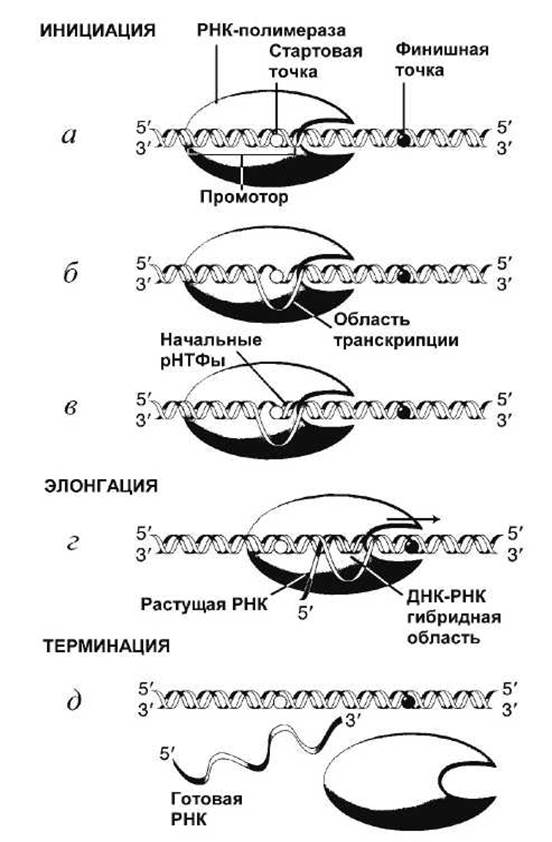
Figure 9 - Stages of transcription: a, b, c - initiation; d - elongation; e - termination
During the elongation stage, RNA polymerase moves along the DNA step-by-step, one nucleotide at a time, unwinding the DNA helix ahead of its direction of movement and re-annealing the DNA double helix behind it (Figure 9(d)). In each step, a single ribonucleotide is added to the 3'-end of the growing (nascent) RNA strand. RNA polymerase maintains a transcription bubble—a region of DNA approximately 14 base pairs long—in an unwound state. Approximately 8 nucleotides at the 3'-end of the growing RNA remain paired with nucleotides of the DNA template strand within the transcription bubble, forming a DNA-RNA hybrid region.
The elongation complex, consisting of RNA polymerase, template DNA, and the growing RNA chain, exhibits extreme stability. For example, RNA polymerase transcribes one of the longest known mammalian genes, consisting of 2x10⁶ base pairs, in a single transcription event (without dissociating from the DNA and releasing the growing RNA). Because RNA synthesis proceeds at an average rate of 1000 nucleotides per minute at 37°C, the elongation complex must remain functional for more than 24 hours to complete transcription.
The final stage of transcription is termination, during which the synthesized RNA, or primary transcript, is released from RNA polymerase, and the polymerase itself dissociates from the template DNA (Figure 9(e)).
A specific sequence of DNA nucleotide pairs—the terminator—signals the polymerase to end transcription. The released polymerase can immediately begin transcribing the same or another Gene.
Prokaryotic and eukaryotic RNA polymerases are organized similarly. They consist of two relatively large subunits (β' and β), two identical small α subunits, and a single ω subunit, which does not participate in transcription but stabilizes the Enzyme Structure (Figure 10).
Eukaryotic RNA polymerases have several additional small subunits attached to this core complex, which is known as the core enzyme.
In schematic diagrams (Figure 9), RNA polymerase is depicted attached to a straight DNA molecule. However, according to Modern views on the interaction between bacterial RNA polymerase and the DNA promoter, it is believed that the DNA is sharply bent inside the RNA polymerase (Figure 10).

Figure 10 - Model of the bacterial RNA polymerase core enzyme bound to a promoter. Numbers indicate the positions of DNA nucleotides relative to the transcription start site
Last update: 12/08/2026
Editorial and Educational Adaptation: This material has been compiled based on the primary/original source text. The project team performed an editorial review, corrected technical inaccuracies, structured sections, and adapted the content for an educational format.
What was processed:
- elimination of formatting defects (OCR errors, structural breaks, corrupted characters);
- editorial organization of content;
- standardization of terminology in accordance with academic sources;
- verification of factual statements against the original source text.
All mentions of the author, publication year, and origin of the primary text have been preserved in accordance with the source.