Genetics - A. V. Sivolob 2008
Gene Expression
Gene expression in eukaryotes
Transcription initiation
There are Three types of RNA polymerases functioning in Eukaryotic Cells: RNA polymerase I operates on ribosomal RNA Gene clusters and synthesizes 18S, 28S, and 5.8S rRNAs; RNA polymerase II transcribes protein-coding genes, small nuclear RNA genes, and several other non-coding RNAs; RNA polymerase III carries out the synthesis of tRNAs, 5S rRNA, and a few other small non-coding RNAs. Each of these polymerases contains from 12 to 16 subunits. The overall architecture of eukaryotic polymerases closely resembles that of prokaryotic polymerase, and the core operational mechanisms of the polymerases are also shared.
Each polymerase has its own set of basal METABOLISM/31.html">Transcription factors that ensure the precise positioning of the enzyme on the promoter, the Selection of the start site (as in prokaryotes, the transcription start site does not coincide with the Translation start codon), and the selection of one of the DNA strands as a template. RNA polymerases I and III are highly specialized—with the aid of their basal factors, they recognize 1-2 types of promoters. RNA polymerase II operates on a vast diversity of protein-coding gene promoters and, In addition to basal factors, requires specific transcription factors that recognize specific promoter regulatory elements to initiate transcription.
The RNA polymerase II promoter, a GENERALIZED SCHEME OF which is shown in Fig. 2.11, may consist of the following sequence elements (numerous variations of this scheme are observed for specific promoters). Proximal regulatory elements (located approximately at -50 to -200 Base Pairs relative to the transcription start) and distal regulatory elements (located anywhere relative to the start—at a large distance, within the coding region of the gene, etc.) have an affinity for specific transcription factors, whose interaction activates or blocks the binding of RNA polymerase. If a distal element enhances initiation efficiency, it is called an enhancer, whereas if it does so inversely, it is called a silencer. The start region contains the so-called basal promoter, where initiation actually takes place.
Class="center">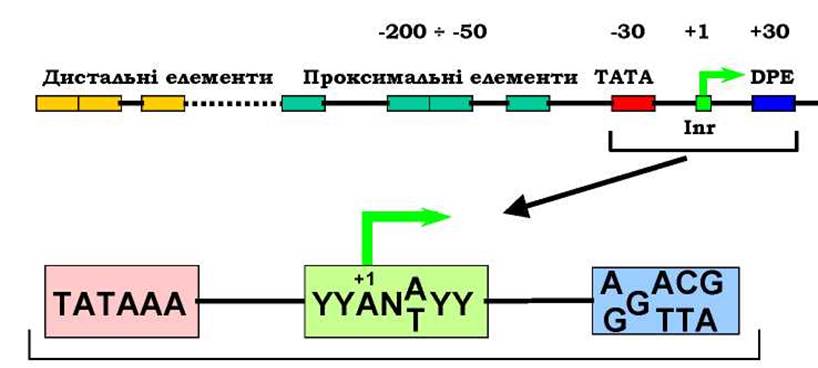
Fig. 2.11. Approximate generalized diagram of RNA polymerase II promoter Organization and consensus sequences of the core basal promoter elements
The basal promoter may (but does not necessarily) include three elements: the TATA box (starting at approximately -30 base pairs), the initiator element (Inr) located directly at the start site, and the DPE (Downstream Promoter Element) located approximately +30 base pairs downstream from the start. The latter two elements, Inr and DPE, typically occur together (when present). For example, about 14% of Drosophila promoters contain all three elements, 29% contain only the TATA box, 26% contain only the DPE along with the Inr, and 31% lack any of the three elements. In the latter case, the promoter is defined by other, more specific sequence elements recognized by specific factors, which in turn interact with basal factors.
Initiation of transcription requires the assembly of a preinitiation complex at the promoter involving RNA polymerase II and six basal (general) transcription factors: TFIIA, TFIIB, TFIID, TFIIE, TFIIF, and TFIIH. The order of its assembly may vary, but all basal factors must be present within the preinitiation complex for subsequent transcription to proceed. The TFIID factor recognizes standard basal promoter elements. TFIIB interacts with TFIID and RNA polymerase, performing Functions somewhat reminiscent of the prokaryotic $\sigma$ factor (see above). TFIIH mediates the initial melting of The Double Helix during initiation and phosphorylates specific elements of RNA polymerase, which serves as a signal for promoter clearance and the onset of elongation. Other basal factors provide additional stabilization to the complex and play an auxiliary role.
Efficient assembly of the preinitiation complex is possible only with the participation of yet another structural module—the mediator, which contains over 20 subunits. This multi-protein complex engages exclusively in Protein-Structure/156.html">Protein Interactions with the RNA polymerase complex and with specific transcription factors bound at the proximal and distal promoter elements (Fig. 2.12). Thus, the mediator acts as a vehicle for transmitting activation signals from sequence regulatory elements to RNA polymerase: an increase in the number of interactions enhances the efficiency of preinitiation complex assembly.
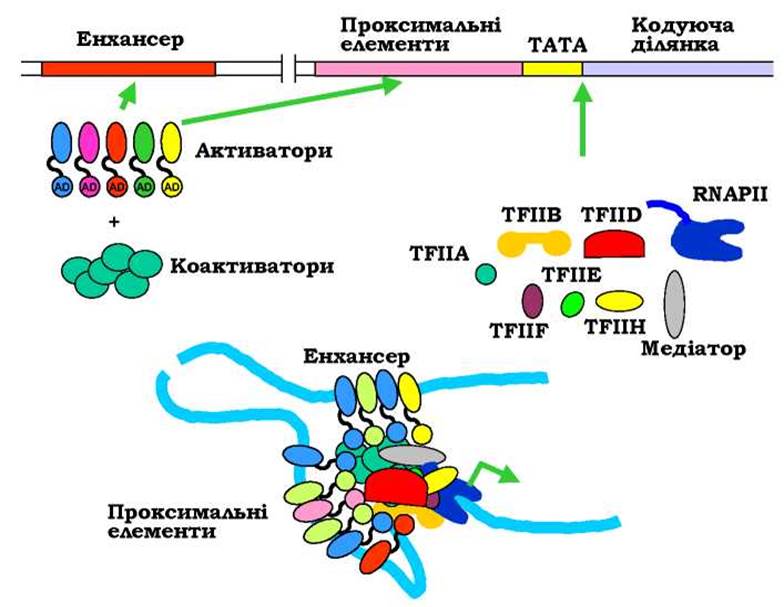
Fig. 2.12. Diagram of transcription activation complex assembly
Most specific transcription factors (hereinafter referred to as TFs) possess at least two Structural domains: one that interacts with DNA, and the so-called activation domain (AD), which is used to interact with other Proteins (Fig. 2.12). Activation domains bind protein Cofactors (coactivators), resulting in The formation of a complex multi-protein assembly—the enhanceosome—at the distal and proximal promoter elements. TF activation domains and coactivators exhibit an affinity for the mediator and basal transcription factors. The result of this interaction is the efficient assembly of the preinitiation complex on the basal promoter (Fig. 2.12).
Following the assembly of the preinitiation complex, local DNA melting occurs, the template strand is immersed into the active center of the polymerase, and synthesis of a short primary transcript begins. Subsequently, driven by TFIIH activity, phosphorylation of the C-terminal domain (a long disordered polypeptide tail) of the largest RNA polymerase subunit takes place. This serves as the switch point from initiation to elongation: promoter clearance occurs, the polymerase loses its connection with the basal factors, and continues RNA Synthesis.
Last update: 11/08/2026
Editorial and Educational Adaptation: This material has been compiled based on the primary/original source text. The project team performed an editorial review, corrected technical inaccuracies, structured sections, and adapted the content for an educational format.
What was processed:
- elimination of formatting defects (OCR errors, structural breaks, corrupted characters);
- editorial organization of content;
- standardization of terminology in accordance with academic sources;
- verification of factual statements against the original source text.
All mentions of the author, publication year, and origin of the primary text have been preserved in accordance with the source.