Principles of Protein Structure - G. Schultz 1982
Methods of polypeptide chain folding and association
Structural domains
Symmetry
Repeated structural units are frequently found within a single polypeptide chain. Such repeating units exist in many Proteins. This unit may be a domain, a supersecondary Structure, or some other structural element. Examples of these structures are listed in Table 5.3. In some proteins, the repeating units are arranged asymmetrically relative to one another, as, for example, the domains of Ser-proteases (Fig. 5.17, d) or the cofactor-binding domains of Glutathione reductase [124]. It is noteworthy, however, that frequently the repeating units have an approximately symmetrical arrangement, suggesting that symmetry is a characteristic feature of the structure they form.
For A large number of identical units, the state with the lowest Free energy is a crystal. The preference for symmetry in Proteins can be understood by considering crystals, whose symmetry is a consequence of favorable packing. Packing depends on the shape of the repeating units and their surface profile. Since among all possible packing schemes there is one that is energetically the most favorable, it will correspond to the minimum free energy, provided it is adequate for all subunits. In any case, this state corresponds to a crystal belonging to one of the 65 Space Groups of symmetry admissible for asymmetric units, since crystallization remains the only way of aggregating an infinite number of units in which all formed contacts are identical.
For a small number of associated units, point group symmetry is energetically favorable. A similar principle is used in constructing a structure of limited size. Among all contacts between identical units, there is one that is energetically the most favorable. If only this contact is realized, a helix is formed, i.e., a linear group of unlimited size. Its dimensions will be limited if Steric hindrances arise at the first turn (Fig. 5.16, b). However, in this case, the final contact, and hence the entire structure, is energetically unfavorable*. The energetic optimum is achieved when the cycle is strictly closed, i.e., when symmetry is maintained. Therefore, symmetrical formations are also preferred for aggregates of limited size. This argument is illustrated in Fig. 5.16, b for the point group n, i.e., for a symmetrical arrangement around a point with an n-fold rotation axis as a symmetry operator. This case can be generalized to all point groups formed by symmetry elements: n, n2, 23, 432, 532 [251, 252]; some of them are shown in Fig. 5.16, a.
Class="center">Table 5.3 Repeating Structural elements of Globular proteinsa
|
Protein |
Repeating structure |
Number of repeating structures |
Approximate symmetry |
|
Cavity formed by a six-stranded antiparallel β-structure |
2 |
Absent |
|
|
proteinase-B |
β-Zigzag inside the cavity |
2 |
|
|
Parvalbumin |
Ca2+-binding site and two α-helices |
2 |
2 |
|
+1 |
Absent |
||
|
Ferredoxin |
FeS cluster and 27 residues |
2 |
2 |
|
Glyceraldehyde-3-phosphate dehydrogenase, Lactate dehydrogenase s-malate dehydrogenase, Alcohol dehydrogenase, phosphoglycerate kinase, phosphorylase |
Rossmann fold consisting of three parallel β-structural strands and two connecting segments |
2 |
2 |
|
Triosephosphate isomerase, Pyruvate kinase |
(βaβ-Structural motif |
8 |
8 |
|
Wheat germ agglutinin |
41 residue with 4 S—S bridges |
4 |
Linear group |
|
Hemerythrin |
Two antiparallel α-helices |
2 |
2 |
|
Rhodanese |
Single domain |
2 |
2 |
|
Immunoglobulin |
V-domain |
4 per molecule |
2 |
|
CH1 and CH3 domains |
6 per molecule |
2 |
|
|
Glutathione reductase |
Four-stranded parallel β-structure and β-zigzag |
2 |
Absent |
|
Acid protease |
Single domain |
2 |
2 |
|
L-Arabinose-binding protein |
» |
2 |
2 |
a See literature in Table 5.2.

Fig. 5.16. Point symmetry.
a — depiction of point groups 2 (C2), 222 (D2), 32 (D3), and 532 (Y, icosahedron). The numbers denote rotation axes of the 2nd, 3rd, etc. orders; b — asymmetric elements forming a preferred contact. In the general case, such a preferred contact does not lead to a point group. The formation of a linear group may also be prohibited due to steric hindrances. In the given example, there is no binding energy between the first and fifth subunits, and therefore the fifth contact does not contribute to stability. Due to additional binding energy, fully closed, highly symmetrical structures are preferred.
* An open structure consisting of four units forming three very similar contacts has been found in wheat germ agglutinin [253]. This indicates that a particularly strong triple-repeated contact can be more advantageous than an alternative contact that satisfies symmetry and is therefore repeated four times.
On The basis of symmetry, structural units that fold independently can be identified. A polypeptide chain represents a structure of limited size. If, during the folding process, structural domains, Supersecondary structures, and other structural elements are formed independently at an early stage and then aggregate, they obey the rule of association of individual units and will tend to form symmetrical arrangements.
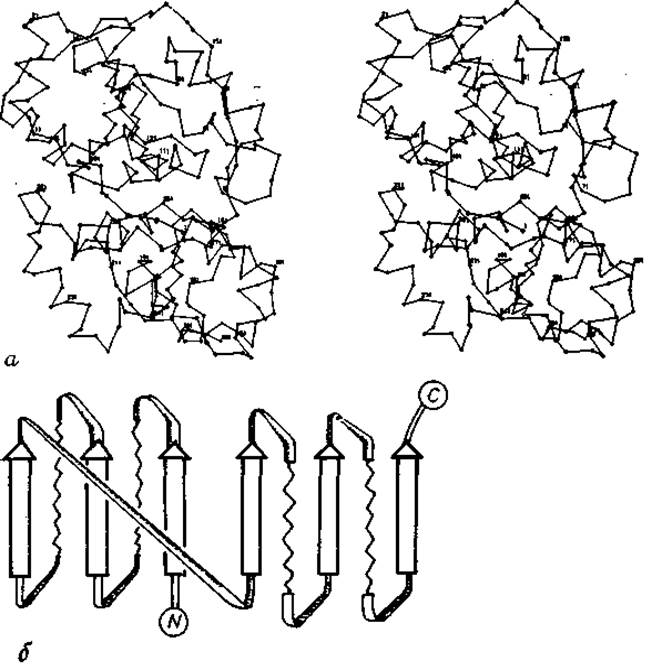
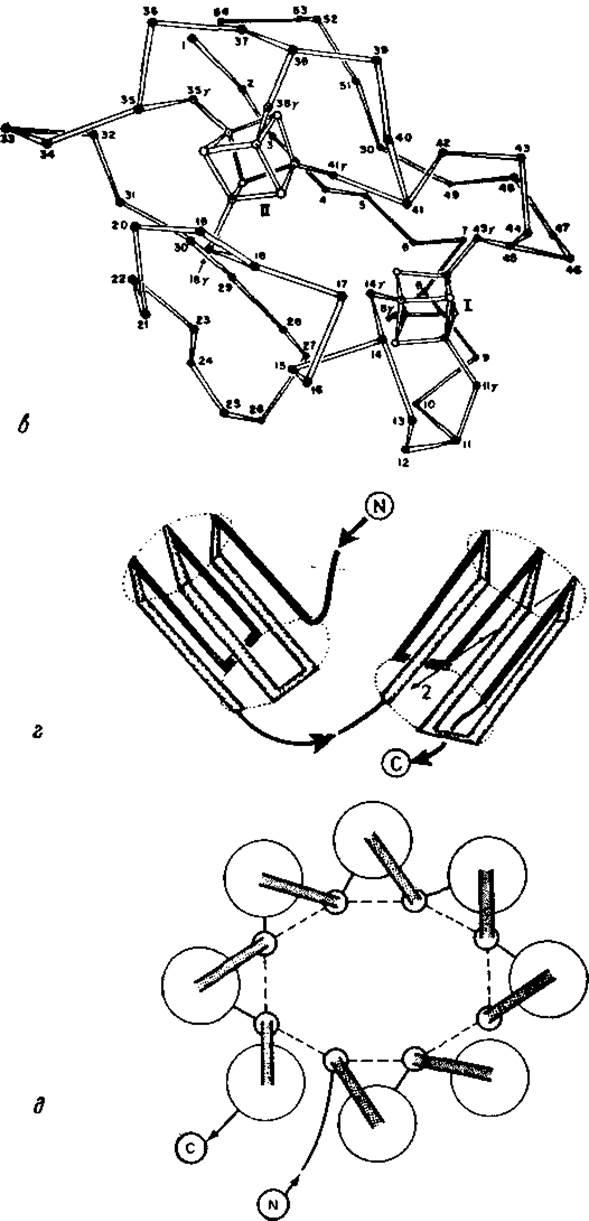
Fig. 5.17. Symmetry of single polypeptide chains.
a — stereoprojection of the rhodanese backbone [799]. Disregarding a short intermediate region, the relationship between the upper and lower halves of the chain is conveyed almost precisely by a 2nd-order rotation axis perpendicular to the plane of the drawing; b — topology of the β-STRUCTURE OF THE nucleotide-binding domain of an NAD-dependent dehydrogenase. α-Helices are shown as wavy lines. The structure contains two Rossmann-folded chain regions (Fig. 5-12, b) related by a vertical 2nd-order axis; c — schematic of the ferredoxin backbone [314] with FeS clusters. Certain Amino Acids, FeS clusters, and part of the folded chain segments have a 2nd-order axis as a symmetry element, which is approximately perpendicular to the plane of the drawing; d — topology of two cylindrical formations composed of β-structures in chymotrypsin and some other trypsin-like proteases. As can be seen, each cylinder possesses approximate internal 2nd-order rotation axis symmetry. The entire molecule lacks any symmetry; e — topology of the β-structure in triosephosphate isomerase [305], including eight parallel pleated sheets and surrounding helices. Neglecting the ellipticity of the cavity cross-section and differences between the helices, an 8th-order rotation axis symmetry can be assumed.
Since structural domains appear to be folding units, the symmetrical domain arrangement observed in rhodanese (Fig. 5.17, a) and IMMUNOGLOBULINS (Table 5.3) is well explained. It can be hypothesized that in symmetrically related supersecondary structures, domains are formed predominantly at the initial stage of the folding process, as they are sufficiently stable on their own. Subsequent aggregation establishes symmetry. Symmetrical supersecondary structures have been found as the βaβaβ-motif of dehydrogenase (Fig. 5.12, b and 5.17, b), as the βaβ-motifs of triosephosphate isomerase and pyruvate kinase (Fig. 5.17, d), as well as β-zigzags within the cavity of the β-structure of Ser-proteases (Fig. 5.17, g) and as antiparallel pairs of α-helices in hemerythrin.
The polypeptide chain of ferredoxin (Fig. 5.17, c) can be divided into two symmetrically related halves. Each half of the chain is folded around a single FeS cluster. The clusters are related to each other by symmetry. The symmetrical structure formed by the FeS clusters and their surrounding polypeptide chains is quite stable. A similar situation is found in parvalbumin, which is formed by two symmetrically related structural elements, each consisting of a Ca2+-binding site and two α-helices extending from it in opposite directions [59]. At first glance, such an extended structure should not be stable on its own. However, the symmetrical arrangement suggests that the energy at the Ca2+-binding site is sufficient to stabilize this structural element in solution. Thus, symmetry makes it possible to identify stable structural elements and, in some cases, indicates a specific sequence of structural formation during the folding process.
Last update: 06/08/2026
Editorial and Educational Adaptation: This material has been compiled based on the primary/original source text. The project team performed an editorial review, corrected technical inaccuracies, structured sections, and adapted the content for an educational format.
What was processed:
- elimination of formatting defects (OCR errors, structural breaks, corrupted characters);
- editorial organization of content;
- standardization of terminology in accordance with academic sources;
- verification of factual statements against the original source text.
All mentions of the author, publication year, and origin of the primary text have been preserved in accordance with the source.