Molecular Biology: Protein Structure and Function - Stepanov V.M. 2005
Enzymes
Triosephosphate isomerase
Triosephosphate isomerase is an enzyme belonging to the isomerase Class that catalyzes the interconversion of dihydroxyacetone phosphate and D-glyceraldehyde 3-phosphate:
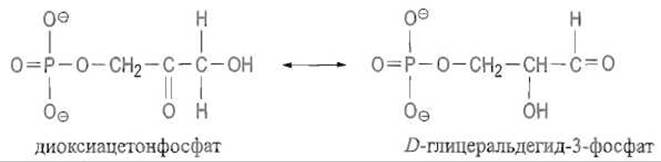
This enzyme is among the most catalytically efficient, with its reaction rate limited only by diffusion. The Structure of trypanosomal triosephosphate isomerase, which is structurally similar to the animal enzyme, has been thoroughly studied. Triosephosphate isomerase is a dimer composed of identical subunits.
Each subunit is a polypeptide chain of 250 amino acid residues. Its tertiary structure belongs to the a/ß-type and features alternating eight a-helices and eight ß-strands. The ß-strands form an inner barrel shielded from Water by the a-helices (Fig. 10.12). Both subunits contribute to The formation of each of the two active sites, rendering the monomer inactive. At the same time, there is no cooperativity between the active sites; in other words, the function of either site is independent of whether the other site is active, although the presence of the second subunit is strictly required.

Fig. 10.12. Spatial arrangement of the catalytic site within the structure of triosephosphate isomerase. The Functional groups of the catalytic site are located in a pocket that closes upon substrate binding due to the movement of a loop situated between strand ß3 and helix a3.
The phosphate group plays a critical role in substrate binding by forming seven Hydrogen Bonds with the enzyme, complemented by an ionic interaction with the ammonium group of Lys-13. Formation of the enzyme-substrate complex triggers a substantial conformational shift — by 3–5 Å — in a flexible loop comprising residues 167–178. The primary outcome of this conformational change is the exclusion of water from the Active Site, which facilitates the isomerization process.
In the bound substrate (with dihydroxyacetone phosphate considered here), one of the methylene hydrogen atoms falls within the electrostatic field of the negatively charged carboxylate ion of Glu-167. This hydrogen is abstracted from the substrate as a proton and transferred to the carboxyl group of Glu-167. The resulting lone pair of electrons from the C—H bond migrates to the adjacent C—C bond, converting it into a double bond. This induces the polarization of the C=O double bond, generating a negative charge on its oxygen atom that is stabilized by electrostatic interaction with the cationic ammonium group of Lys-13:

This series of transformations converts the substrate into the anionic form of an unstable enediol intermediate:

Next, a proton is transferred from the carboxyl group of Glu-167 to the second carbon atom of the substrate, adding across the C=C double bond.
Simultaneously, a double bond is established between C-1 and the oxygen atom via the abstraction of a proton from the C-1 hydroxyl group, which migrates first to the nitrogen of the His-95 imidazole group and then to the negatively charged oxygen at C-2 of the substrate. The pathway of this migration is predetermined — much like the Catalytic Mechanism of Serine proteases — by the presence of a Histidine imidazole group in the active site:

Protein Engineering replacement of glutamic acid at position 167 with aspartic acid shifts the catalytically crucial carboxyl group approximately 1 Å further away from the substrate, resulting in an almost 1000-fold reduction in reaction rate (103-fold). The fact that the thus-modified enzyme still retains activity can be explained by structural fluctuations within the enzyme-substrate complex that, albeit with low probability, bring the carboxyl group of aspartic acid close enough to the substrate carbon atoms.
Thus, the MECHANISM OF ACTION of triosephosphate isomerase highlights Characteristic Features of Enzymatic Catalysis: the exclusion of water from the reaction microenvironment into the interior of the enzyme, driven by the displacement of a structural loop in response to substrate binding; and the coordinated action of a functional group ensemble integrated with the tightly bound substrate into a unified system.
Last update: 13/08/2026
Editorial and Educational Adaptation: This material has been compiled based on the primary/original source text. The project team performed an editorial review, corrected technical inaccuracies, structured sections, and adapted the content for an educational format.
What was processed:
- elimination of formatting defects (OCR errors, structural breaks, corrupted characters);
- editorial organization of content;
- standardization of terminology in accordance with academic sources;
- verification of factual statements against the original source text.
All mentions of the author, publication year, and origin of the primary text have been preserved in accordance with the source.